

Maddy summaryThis bill requires New Jersey's Attorney General to study how law enforcement agencies currently use facial recognition technology and issue a report with recommendations for statewide policy within six months. The report must assess the technology's accuracy, summarize existing law enforcement usage (including for police reports), and propose guidelines for its future use. It applies to all state and local police departments. The study does not create new laws but aims to inform potential future policy decisions.
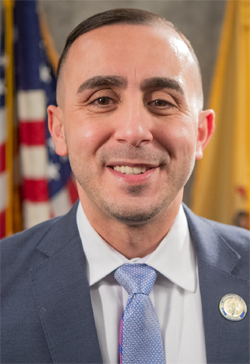
Asm. Al Abdelaziz
Sponsored bills
Maddy summaryThis bill changes New Jersey law to allow mail-in ballots to be counted even if the voter dies after mailing, delivering, or depositing the ballot (e.g., via drop box) but before election day. It directly affects voters who pass away after submitting their ballot and county election boards that process ballots. The key provision repeals laws requiring rejection of such ballots, meaning they will be counted unless they have other defects (like missing signatures) unrelated to the voter's death. Ballots rejected for non-death-related issues will not be eligible for correction, and the rejection decision is final except in election result challenges.
Maddy summaryNew Jersey's Bill A1696 updates optometrists' scope of practice by expanding their ability to provide eye care services. The bill allows optometrists to prescribe pharmaceutical agents (including controlled substances under specific conditions), administer immunizations for coronaviruses, flu, and shingles (for patients 18+), and perform minor procedures like removing superficial foreign bodies or treating chalazions. It also permits certain non-invasive laser/ultrasound treatments (e.g., trabeculoplasty) using only topical anesthesia, while explicitly prohibiting invasive eye surgery, orbital procedures, or general anesthesia. These changes apply to all optometrists practicing in New Jersey and require adherence to CDC guidelines for immunizations and reporting to the state immunization registry.
Maddy summaryThis bill, designated "Michelle Sous' Law," requires law enforcement to obtain a mandatory blood sample from any driver involved in a motor vehicle accident that results in a death. It directly affects drivers in fatal crashes by adding a specific investigative step to determine if alcohol or drug impairment contributed to the accident. The key provision mandates blood sample collection as part of the standard investigation process, without altering existing DUI penalties. The law is named after Michelle Sous, a victim of a fatal crash involving an impaired driver.
Maddy summaryThis bill requires public utilities in New Jersey to keep complete billing records for the entire time a customer has an account. It mandates that utilities refund customers in full (including interest) for any overpayment they made, as required by existing law. The law ensures utilities can accurately resolve billing disputes by maintaining detailed account histories. This directly affects utility customers who may overpay and the utilities responsible for managing billing records and refunds.
Maddy summaryThis bill provides New Jersey businesses with tax credits for hiring qualified ex-offenders. Specifically, it allows a 15% credit against corporation business tax and gross income tax for wages paid to eligible individuals, capped at $900 per employee per year. A "qualified ex-offender" is defined as someone convicted of a first-, second-, third-, or fourth-degree crime in New Jersey who was hired within one year of conviction or release from incarceration. The credit cannot exceed 50% of the tax liability and may be carried forward if unused in the current year.
Maddy summaryThis bill (A-764) would have amended the list of environmental infrastructure projects eligible for loans from New Jersey's Infrastructure Bank for fiscal year 2026. It would have directly affected local governments and public water utilities seeking funding to finance projects like wastewater treatment, stormwater management, or drinking water system upgrades. The key mechanism involved updating which specific projects qualified for the bank's financing under existing law, ensuring funds targeted approved environmental infrastructure needs. The bill was withdrawn on January 13, 2026, as it was superseded by the approved law P.L.2025, c.183.
Maddy summaryThis bill would have established criminal penalties (fourth-degree crimes) for employers who knowingly falsify payroll records required under New Jersey's Prevailing Wage Act or make false statements on public works contractor registration forms. It directly affects employers working on public construction projects subject to prevailing wage requirements. Currently, such violations are punishable only as minor offenses (up to 90 days in jail), but this bill would have increased penalties to up to 18 months in jail or $10,000 fines. The bill was withdrawn on January 13, 2026, as it was approved as part of P.L.2025, c.356, meaning the changes are now law.
Maddy summaryThis bill (A 760) eliminates a 5% down payment requirement for local governments issuing bonds to fund hazard mitigation and resilience projects. It directly affects municipalities and counties when financing projects like flood protection, storm recovery, or climate adaptation infrastructure. The key change exempts these projects from needing to set aside 5% of bond proceeds as a down payment and removes the requirement to apply to the Local Finance Board for maturity adjustments on related bonds. This simplifies financing for communities addressing climate risks without changing bond maturity rules for other projects.
Maddy summaryThis bill requires New Jersey's Attorney General to establish and regularly update guidelines for investigating bias incidents - crimes motivated by prejudice against protected groups. It mandates that local law enforcement agencies report confirmed or suspected bias incidents to the Electronic Uniform Crime Reporting system within 24 hours and immediately notify the Attorney General and county prosecutors for serious cases (e.g., homicide, hate group involvement). The guidelines also set procedures for investigations, require victim referrals to the Division on Civil Rights for discrimination-related incidents, and include mandatory training for officers on detecting and reporting bias crimes. These standards directly affect county/municipal police departments, prosecutors, and victims of bias incidents.