

Maddy summaryThis bill authorizes funding for on-demand micro transit services under New Jersey's Senior Citizen and Disabled Resident Transportation Assistance Program. It directly affects senior citizens and disabled residents by allowing them to access technology-enabled shared transportation that lets them choose pick-up and drop-off locations via phone or mobile app. The legislation amends existing state law to formally define "on-demand micro transit" and update related terminology within the transportation assistance framework. The program operates through the New Jersey Transit Corporation in coordination with local counties and advisory committees to ensure services meet accessibility needs.
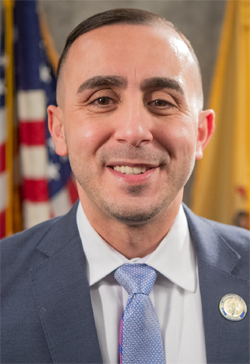
Asm. Al Abdelaziz
Sponsored bills
Maddy summaryThis bill, titled the "John R. Lewis Voter Empowerment Act of New Jersey," is a commemorative resolution naming a state initiative after civil rights leader John Lewis. It appropriates $2.5 million but does not establish new voting procedures or protections. The bill primarily includes recognition language affirming New Jersey’s commitment to voting rights for protected classes and defines terms like "covered entity" for future reference, though no specific implementation mechanisms are detailed. As it is pending technical review and lacks concrete policy changes, it functions as a symbolic gesture rather than a substantive legislative action.
Maddy summaryThis bill allows police officers in Newark and Paterson who were promoted to sergeant after the February 2019 exam to keep their promotions as permanent appointments instead of requiring them to retake the test. It overrides a previous court order that had made these promotions conditional and threatened to invalidate them, which could have led to demotions for over 100 officers. The legislation applies only to officers in these two cities who were promoted based on that specific exam and ensures their personnel records reflect their original appointment dates.
Maddy summaryBill A4525 extends the deadline for developers to submit a temporary certificate of occupancy for qualified residential or mixed-use parking projects under New Jersey's Economic Redevelopment and Growth Grant program. The current deadline of December 31, 2024, is changed to June 30, 2032, directly affecting developers of eligible projects participating in this grant program. This amendment adjusts a specific administrative requirement within the program's rules, allowing more time for project completion while maintaining existing environmental, labor, and sustainability standards. The change applies to projects approved under the grant program that require this certificate to access tax incentives.
Maddy summaryThis bill changes how the state calculates financial aid for preschool programs in school districts that are newly receiving this funding for the 2025-2026 and 2026-2027 school years. Currently, these districts must split the cost of preschool programs between state aid and local taxes, but the legislation exempts them from this requirement. Instead, the state will provide a larger share of funding based on the total number of enrolled students and program costs. This change allows affected districts to receive more state money without needing separate voter approval to raise local taxes to cover the remaining expenses. The bill is estimated to increase state spending by approximately $7.5 million in the 2027 fiscal year.
Maddy summaryThis bill directs unspent funds originally set aside for the City of Paterson's recreation center capital improvements to the New Jersey Community Development Corporation instead. The legislation allows these remaining dollars from the Fiscal Year 2025 budget to be used for a youth center project in Paterson, subject to approval by the Director of the Division of Budget and Accounting. This change does not add new money to the state budget but simply shifts the purpose of existing unexpended appropriations to support the new initiative.
Maddy summaryThis bill makes a temporary community crisis response team pilot program in New Jersey permanent and allocates $6 million in funding. It allows eligible municipalities and community organizations in specific counties to apply for grants to establish teams that handle emergencies through non-police methods like triage and referrals to social services. The Attorney General will manage the annual grant selection process, which prioritizes groups that have already been approved for violence intervention work for at least two years. Funds can be used for planning, staffing, operational costs, and training to support these community-based safety initiatives.
Maddy summaryThis bill restructures the governance of New Jersey's State Health Benefits Program by creating a new State Health Benefits Commission with 13 members. The commission will include existing state officials, representatives from local and higher education employers, and members appointed by various public employee unions, including specific seats for police and firefighters. A key provision is the addition of a non-voting expert member selected by the other commissioners to provide independent advice on health care plan design. The bill also establishes a new committee to assist with plan design and outlines how members will be appointed, serve terms, and manage conflicts of interest. Ultimately, the legislation aims to broaden representation and oversight in how the state manages health benefits for its employees.
Maddy summaryThe Climate Superfund Act (A 3735) holds fossil fuel companies liable for climate change damages by requiring them to pay compensatory payments into a state fund. Companies that extracted or refined fossil fuels during 1995-2026 and emitted over one billion metric tons of greenhouse gases must pay based on their proportional liability, with joint liability for companies in a "controlled group." Funds collected will be distributed to implement climate adaptation projects, such as flood protection, infrastructure upgrades, and health programs in overburdened communities. The Department of Environmental Protection will administer the Climate Superfund Cost Recovery Program to manage payments and fund these projects.
Maddy summaryThis bill expands New Jersey's existing requirement for health insurance plans to cover prostate cancer screenings without any out-of-pocket costs. It specifically requires coverage for annual screenings - including digital rectal exams and PSA tests - for men aged 50 and older (asymptomatic) and men aged 40 and older with a family history of prostate cancer or other risk factors. The law applies to most health insurance plans, including high-deductible plans where permitted by federal law, and mandates coverage "to the same extent as for any other medical condition." It does not alter existing coverage for other preventive services but ensures no cost-sharing (like deductibles or copays) applies to these specific screenings.