

Maddy summaryThis bill creates a legal defense for victims of human trafficking who commit crimes while being trafficked. It allows individuals to avoid prosecution for offenses (like theft or assault) committed as a direct result of their trafficking situation, provided they were trafficking victims at the time of the offense. The defense applies even if the trafficking case against them didn't result in a conviction. It directly affects people exploited through human trafficking who may have broken laws while trying to survive or escape. The law amends New Jersey's criminal code to explicitly recognize this defense, shifting focus from punishing victims to addressing their exploitation.
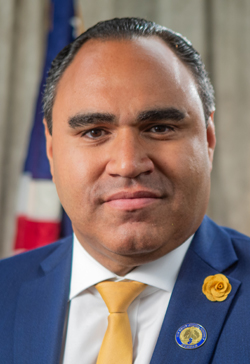
Asm. Gabe Rodriguez
Sponsored bills
Maddy summaryThis bill requires New Jersey's Commission on Human Trafficking to create a report addressing human trafficking prevention ahead of the 2026 FIFA World Cup, which will be partially hosted in the state. The commission must evaluate existing laws, recommend expanded victim services and awareness campaigns, develop public awareness signs with trafficking hotlines, and coordinate with organizations to reduce trafficking risks. The report, due within 180 days of enactment, will include specific proposals such as additional hotlines, public service announcements for fans, and guidelines for law enforcement, while mandating businesses to display new trafficking prevention signs alongside existing ones.
Maddy summaryAJR 19 designates May 7 of each year as "Cystinosis Awareness Day" in New Jersey. This symbolic resolution aims to raise public awareness about cystinosis, a rare genetic disorder affecting approximately 500-600 Americans, including children in New Jersey. The bill requests the Governor issue an annual proclamation encouraging state agencies, organizations, and residents to support education and advocacy efforts. It specifically references the Cystinosis Research Network's existing May 7 designation to promote early detection and treatment awareness. The resolution does not create new laws or funding, but seeks to amplify existing awareness initiatives for a condition that causes organ damage if undetected.
Maddy summaryThis bill prohibits the sale or assembly of lithium-ion batteries made from used storage cells for electric bicycles and scooters, and requires new devices to have safety certification (like UL 2849/2272) with visible labels. It directly affects manufacturers, retailers, and businesses selling or leasing low-speed electric bikes/scooters, with penalties up to $1,000 for violations after a warning. Commercial operators must provide fire safety materials to employees using these devices, covering operation and storage. The law aims to reduce fire risks by setting safety standards for these products.
Maddy summaryThis bill establishes the Governor's Survivor Leader Advisory Council within New Jersey's Department of Health to address human trafficking risks associated with the 2026 FIFA World Cup. The council, composed of nine members including trafficking survivors and a law enforcement officer, will evaluate existing laws, review assistance programs, develop public awareness campaigns (including toll-free hotline signage), and submit a report with recommendations to the Governor and Legislature within 180 days. The bill appropriates $1 million from the state's General Fund to fund the council's operations, with the council's work ending upon report submission or one year after the World Cup, whichever occurs later. This directly affects New Jersey's state response to trafficking during the event, focusing on prevention, victim support, and coordination.
Maddy summaryThis bill (A 473) requires public university governing boards in New Jersey to set tuition and fee rates for the next academic year after the Governor releases their budget, specifically during the Spring semester. It directly affects governing boards of public institutions of higher education. The key provision mandates that tuition and fee schedules must be adopted following the Governor’s budget announcement, ensuring campus communities have the opportunity to provide input while members are physically present on campus. The bill aims to align the timing of these financial decisions with the academic calendar and increase transparency.
Maddy summaryNew Jersey's "Safe Storage of Firearms Act" (Bill A 3560) requires all legal firearm owners to store unloaded firearms in locked containers (like gun safes) and keep ammunition separate at their homes or premises. It repeals older laws about minors accessing firearms and mandates a $500,000 public awareness campaign by the Attorney General. Retail dealers must provide written warnings about these storage rules to customers, and courts must inform convicted violators about firearm ownership restrictions. The law directly affects firearm owners, with exceptions for active law enforcement officers and certain retail displays.
Maddy summaryThis bill allows New Jersey municipalities to place liens on insurance proceeds from fire-damaged commercial, industrial, and multi-family residential properties (excluding single-family homes) to cover demolition costs and unpaid taxes. The lien applies only to real property damage up to the policy’s coverage limits for fire/explosion damage, prioritizing municipal claims over most other debts except mortgages. Property owners must maintain fire and explosion insurance coverage for affected properties, and insurers must withhold lien-eligible payments until municipal claims are resolved. This change modifies how municipalities can access insurance funds for property restoration after fire incidents.
Maddy summaryThis bill amends New Jersey law to increase penalties for public servants who disclose domestic violence or sexual assault victims' personal information during official misconduct. Currently, such misconduct is a second-degree crime only if the benefit involved exceeds $200, otherwise it's a less severe third-degree crime. Under this bill, disclosing victims' personal information - defined as names, addresses, Social Security numbers, or other identifying details - automatically elevates the offense to a second-degree crime, regardless of the benefit's value. This change imposes stricter penalties: second-degree crimes carry 5-10 years in prison or fines up to $150,000, versus 3-5 years or $15,000 for third-degree offenses. It directly affects public servants like police, court staff, or social workers handling victim cases.
Maddy summaryThis bill requires the New Jersey Motor Vehicle Commission (MVC) to provide all vehicle and licensing services - such as license renewals, registration, and address changes - in person at every MVC agency location, without requiring appointments for walk-in customers. It mandates emergency printing services for temporary licenses, creates an online scheduling system for commercial driver tests at all locations, and requires the MVC to distribute clear informational brochures (both online and in-person) listing all available services. The bill directly affects MVC customers seeking in-person transactions and MVC staff managing agency operations. These changes aim to improve accessibility and reduce wait times for everyday vehicle and driver services.