

Maddy summaryThis bill requires that the outer envelope for mailed-in ballots in New Jersey include prepaid postage, which will be paid for by county clerks and reimbursed by the state. The law applies to all voters submitting mail-in ballots, including those in the state and overseas residents, ensuring their envelopes are ready for mailing without additional postage costs. Additionally, the bill updates procedures for overseas voters by specifying how ballots are packaged and mailed, and it includes updated instructions and fraud warnings for these voters.
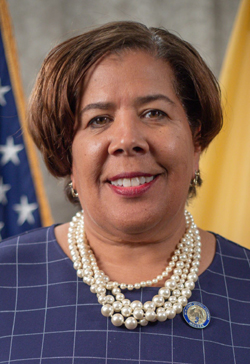
Asm. Linda Carter
Sponsored bills
Maddy summaryThis New Jersey bill restricts colleges and private degree-granting schools from asking about criminal history on standard admission applications, except for specific serious offenses like homicide, sexual assault, and child exploitation. While applicants cannot be asked about most crimes upfront, schools are allowed to check criminal records after accepting a student and can deny admission only for the listed serious offenses. The law also requires schools to consider factors like the time passed since the crime and evidence of rehabilitation when making decisions, and it explicitly excludes expunged records from consideration.
Maddy summaryThis bill designates July as "Self-Care Awareness Month" in New Jersey to encourage residents to prioritize healthy lifestyle choices and well-being. The resolution does not alter laws or allocate funding but serves to raise public awareness about the benefits of self-care, such as improved health and potential cost savings for the healthcare system. Each year, the Governor may issue a proclamation calling for public officials and residents to observe the month with appropriate activities and programs. This symbolic measure aims to promote personal health habits without imposing new regulations or obligations on citizens or businesses.
Maddy summaryThis bill establishes a statewide system of mobile crisis response teams to assist adults with disabilities who are experiencing behavioral health emergencies. The legislation requires these teams to provide face-to-face support for up to 72 hours at the individual's home or current location, with the option to transport them to temporary stabilization units for up to seven days if needed. Key provisions include the creation of individualized crisis stabilization plans and the authorization of mobile crisis response agencies to deliver these services around the clock. The act aims to de-escalate crises and stabilize individuals without relying solely on traditional emergency services.
Maddy summaryThis bill requires commercial driver license applicants and renewers in New Jersey to complete human trafficking awareness training. It also mandates one-time human trafficking awareness training for hotel and motel staff and healthcare facility employees, with completion tied to license or permit renewal. The training materials will be provided by state departments in consultation with the Commission on Human Trafficking, and the courses must be reviewed every two years.
Maddy summaryThis bill establishes a five-year pilot program for New Jersey's Department of Transportation to inventory, assess, and monitor all state, county, and municipal bridges. It requires creating a digital bridge inventory, a risk scoring model for bridge safety, climate vulnerability assessments, and a public dashboard showing bridge conditions. The $9.5 million appropriation funds the program ($4.5M) and a separate AI-driven "Bridge Infrastructure Innovation Module" ($5M) to test sensor-based monitoring on high-risk bridges. The program mandates annual progress reports and a final evaluation after five years to determine if the approach should be expanded statewide to other infrastructure like roads and tunnels.
Maddy summaryThis bill requires New Jersey's Motor Vehicle Commission (MVC) to issue special windshield stickers for qualifying electric vehicles. Owners of eligible EVs would display these stickers to prove exemption from annual emission inspections. The bill defines "electric vehicle" as one powered solely by electricity without hydrocarbon fuel (excluding plug-in hybrids). It directly affects EV owners by eliminating a required inspection for their vehicles under the new sticker system.
Maddy summaryBill A 2558 allows retired school superintendents, administrators, and nurses in New Jersey to be rehired by school districts for periods exceeding two years without requiring approval from the Commissioner of Education. Currently, such reemployment is limited to a two-year total under annual one-year contracts needing Commissioner approval. This bill removes that two-year cap and approval requirement, permitting school districts to renew one-year contracts annually indefinitely. It explicitly states that rehired retirees will not gain tenure or seniority rights during reemployment, and their previous retirement benefits remain unaffected. The bill directly affects retired education professionals and school districts seeking to retain experienced staff.
Maddy summaryThis New Jersey bill prohibits colleges and universities from giving admission advantages to students based on their family connections to alumni or donors. It defines "legacy status" as having a familial relationship to a graduate of the institution and bans any preferential treatment for applicants with this background. The law applies to all higher education institutions within the state and takes effect immediately upon passage. By removing these preferences, the legislation aims to ensure that admissions decisions are made without regard to a student's family ties to the school or its benefactors.
Maddy summaryThis bill requires the New Jersey Secretary of State to launch a public awareness campaign explaining how federal postal rules define postmarks and how they might affect the validity of mail-in ballots. The campaign will inform voters about the risk that a ballot could be rejected if its postmark date is later than the election day, even if mailed on time, and will highlight options like requesting a manual postmark or using ballot drop boxes. Additionally, the bill directs the Secretary of State to evaluate the placement and usage of ballot drop boxes across the state and submit a report with recommendations for any necessary changes. To fund these efforts, the bill appropriates $100,000 from the General Fund to the Department of State.