

Maddy summaryThis bill updates New Jersey's regulations regarding hemp and medical cannabis by clarifying restrictions on specific products and sales methods. It prohibits the sale of viable seeds from high-THC plants, synthetic cannabinoids, and certain intermediate hemp-derived products, while allowing licensed producers to temporarily possess and transport these items for processing purposes. The legislation also bans the online sale of intoxicating hemp beverages and forbids their distribution through vending machines, imposing civil penalties of up to $10,000 for violations.
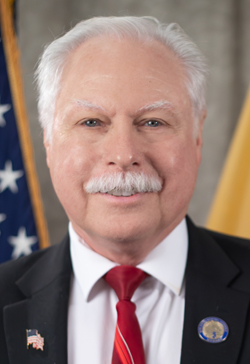
Asm. Robert Karabinchak
Sponsored bills
Maddy summaryThis bill expands New Jersey's child tax credit to include children aged six through 11, in addition to the current eligibility for children under six. It directly affects resident taxpayers with taxable income of $80,000 or less who have children in this age range. The key provision amends existing state tax law to allow a credit of up to $1,000 per child, with the amount decreasing as family income rises above $30,000, and applies to tax years beginning on or after January 1, 2026.
Maddy summaryThis bill requires New Jersey's Division of Consumer Affairs to create a model policy within three months for how professionals and licensed workers can use generative artificial intelligence in their work. Professional and occupational boards would then have six months to adopt this model policy with any necessary adjustments specific to their fields. The law defines generative artificial intelligence as systems that create text, audio, or visual content with minimal human oversight and temporarily bypasses standard rule-making procedures to speed up implementation. Once adopted, these rules would remain in effect for one year before being reviewed and updated through normal administrative processes.
Maddy summaryThis New Jersey bill prohibits companies from advertising generative artificial intelligence as capable of practicing regulated professions or occupations such as law, medicine, or accounting. The law applies to any person or entity developing or deploying AI systems in the state that generate text, audio, or visual outputs with minimal human oversight. Violations would be treated as consumer fraud offenses, subjecting violators to fines up to $10,000 for first offenses and $20,000 for subsequent ones, along with potential cease and desist orders. The legislation aims to prevent misleading public representations about AI capabilities while maintaining oversight of licensed professions.
Maddy summaryThis bill designates May 24, 2026, as "Watchung Centennial Jubilee Day" to honor the 100th anniversary of the Borough of Watchung in Somerset County, New Jersey. The resolution formally recognizes the borough's history, including its 1926 incorporation, scenic natural features, and significant role in the American Revolution. It directs copies of the document to be sent to the borough's mayor and council, with no changes to existing laws or funding.
Maddy summaryThis Assembly Resolution commemorates the 37th anniversary of the sister-state relationship between New Jersey and Taiwan and the 47th anniversary of the Taiwan Relations Act. It reiterates support for strengthening economic, educational, and scientific partnerships among the United States, New Jersey, and Taiwan. The resolution does not create new laws or policies but serves as a formal statement recognizing existing diplomatic and economic ties. It directs copies to state and local officials and representatives of Taiwan's economic and cultural office in New York.
Maddy summaryThis bill regulates pharmacy benefits managers (PBMs) and insurance carriers to increase transparency and fairness in prescription drug coverage. It requires carriers and PBMs to establish pharmacy and therapeutics committees with strict conflict-of-interest rules, prohibits commission-based PBM compensation (mandating flat fees instead), and mandates detailed reporting of PBM fees for insurance filings. The law directly affects insurers, PBMs, and pharmacies by changing how drug formularies (approved drug lists) are managed and how PBM costs are calculated and disclosed. Key provisions include banning preferential formulary placement for higher-cost drugs over lower-cost generics/biosimilars and requiring actuarial documentation for PBM compensation. The bill aims to reduce patient cost-sharing and ensure PBM compensation aligns with administrative costs.
Maddy summaryNew Jersey bill A 3108 requires the Department of Agriculture to promote community supported agriculture (CSA) programs. Within 180 days of enactment, the Department must create a public website listing all CSA farms and enabling online subscriptions, run statewide advertising campaigns highlighting CSA benefits, and develop promotional labels for CSA-marketed products (using "Jersey Fresh" branding where appropriate). The bill also establishes an annual "Community Supported Agriculture Week" in February to showcase local farm-to-table connections through events in schools, markets, and community venues. This directly affects New Jersey farms participating in CSAs and consumers seeking locally sourced seasonal food through subscription programs.
Maddy summaryThis New Jersey bill (A3256) requires restaurants to clearly disclose any mandatory gratuity fee to customers. It mandates that the fee be visible on menus, at the restaurant entrance, on the customer's bill, and on the restaurant's website. Restaurants that fail to disclose the fee face fines of $1,000 for the first violation, $2,500 for the second, and $5,000 for the third or subsequent offenses, with each day of violation counted separately. The law directly affects restaurants operating in New Jersey and ensures customers are informed about mandatory service charges before paying.
Maddy summaryThis bill requires New Jersey's Governor to include a detailed annual report in the budget message about revenues and spending from the "societal benefits charge" on utility bills. The report must show, for each of the past five fiscal years and the current year, how much was collected from electricity and gas customers, and how those funds were spent - specifically for energy efficiency programs, low-income energy assistance, plug-in electric vehicle incentives, and other approved initiatives. It also mandates itemized breakdowns of funds allocated by each utility company. The goal is to increase transparency about how this charge, embedded in customer bills, finances state energy and assistance programs.