

0 co-sponsors
Total votes
2,324
all sessions
Attendance
96%
41 missed
Near the chamber average
With party
100%
of cast votes
Higher than 76% of chamber peers
Bipartisan score
0%
crosses aisle rarely
Lower than 78% of chamber peers
Sponsored
1,480
bills & resolutions
Higher than 86% of chamber peers
Committees
4
assignments
1,480 bills and resolutions
Sponsored bills
Total
1,480
Primary
833
Co-sponsor
647
This page
1,480
matching current filters
Concerns local government financing and acquisition of fire fighting apparatus and equipment.**
Maddy summaryThis bill updates New Jersey state law to clarify the maximum lease terms local governments can use when acquiring fire fighting apparatus and equipment. It directly affects municipal governing bodies that purchase or lease fire trucks and related gear for public safety purposes. The legislation amends existing statutes to establish specific time limits for different types of municipal assets, including a provision for fire fighting equipment that sets a maximum lease period. The bill also standardizes lease term calculations for various infrastructure categories such as buildings, roads, and utility systems to ensure consistency across local government acquisitions.
Signed into law Aug 27, 2026
0 co-sponsors
Establishes alternative compliance standards for development of electric vehicle supply equipment and Make-Ready parking spaces based on charging capacity.
Maddy summaryThis bill introduces an alternative compliance method for developers in New Jersey who must install electric vehicle charging infrastructure, allowing them to meet requirements based on total charging capacity rather than the number of equipped parking spaces. It directly affects developers, building owners, and parking facility operators subject to existing state laws requiring EV charging installations. The legislation defines key terms like "charging capacity" and "Make-Ready" parking, and authorizes the Site Improvement Advisory Board to create statewide standards that set minimum capacity requirements based on parking numbers and facility type. Developers can choose between the current number-based requirement or the new capacity-based option, with regulations to be established within 12 months of the bill's effective date.
EnergySupports EnergyBill promotes EV charging infrastructure development, supporting clean energy adoption and reducing dependence on fossil fuels through alternative compliance standards.
TransportationSupports TransportationBill promotes sustainable transportation by easing EV infrastructure requirements, encouraging electric vehicle adoption and modernizing charging capacity standards.
Signed into law Aug 27, 2026
0 co-sponsors
Establishes certain State funding preferences for municipalities that enhance opportunities to develop housing.
Maddy summaryThis bill allows New Jersey municipalities to qualify for preferential treatment when applying for state-funded grants by adopting specific strategies to encourage denser residential development. Municipalities must update their master plans and zoning regulations to include housing strategies like permitting accessory dwelling units, reducing parking requirements, or allowing multi-unit buildings in areas previously restricted to single-family homes. After implementing these changes and submitting the updated plans to the state, eligible municipalities receive priority in competitive grant distributions. The preference applies to most state grants but excludes programs focused on fair housing obligations or shared services.
Signed into law Aug 27, 2026
1 co-sponsor
Secures protections for patients and providers accessing and providing reproductive health care services; establishes right of residents to reproductive health care activity that is restricted in other states.*
Maddy summaryNew Jersey's S 2260 strengthens legal protections for patients and providers accessing or delivering reproductive and gender-affirming health care services within the state. The bill explicitly defines "legally protected health care activities" to include seeking, providing, or assisting with these services (such as abortion, contraception, or gender-affirming care), regardless of a patient's location. It prohibits obstruction, intimidation, or physical barriers at facilities offering these services and grants licensing boards authority to impose civil penalties for violations. This directly affects patients traveling to New Jersey for care (not available in their home states) and healthcare providers operating in these fields. The law codifies existing protections to prevent harassment or violence against these services, following increased threats and protests nationwide after the overturning of Roe v. Wade.
Signed into law Aug 20, 2026
1 co-sponsor
"New Jersey Kids Code Act"; adopts New Jersey Age-Appropriate Design Code and requires certain online service providers to implement certain measures concerning minors' use of online service.*
Maddy summaryNew Jersey Assembly Bill 4015, the "New Jersey Kids Code Act," requires major online services (like social media and games) that minors are likely to use to set default privacy settings to the highest protection level for children. It prohibits these services from showing targeted ads to minors, using manipulative design tricks to change privacy settings, collecting certain personal data without clear consent, or promoting restricted products to children. The bill also mandates annual public reports detailing how these platforms protect minors’ privacy, their data practices, safety tools for parents, and how much time children spend on their services. This law directly affects large online platforms operating in New Jersey, not small websites or services not used by minors.
Signed into law Aug 11, 2026
1 co-sponsor
"Affordable Power Purchase Agreements Extension Act"; concerns extension of certain public entity contracts related to energy conservation and renewable energy production.
Maddy summaryThis bill, titled the 'Affordable Power Purchase Agreements Extension Act,' allows New Jersey school boards to extend existing contracts for renewable energy and energy conservation projects without going through a new public bidding process. The legislation directly affects public school districts by amending state law to include renewable energy contract extensions as an exception to standard advertising requirements for large contracts. By permitting these extensions, the bill aims to provide continuity for current energy savings initiatives while maintaining oversight through public notice and justification requirements for each award.
EducationSupports EducationBill allows school boards to extend renewable energy contracts, improving school infrastructure and potentially lowering energy costs.
EnergySupports EnergyBill extends renewable energy contracts for schools, promoting clean energy adoption and conservation without new bidding barriers.
EnvironmentSupports EnvironmentBill extends renewable energy and conservation contracts, promoting clean energy and reducing emissions.
Signed into law Aug 6, 2026
1 co-sponsor
Enters NJ into Athletic Trainer Compact.
Maddy summaryThis bill allows New Jersey to join the Athletic Trainer Compact, a national agreement that lets licensed athletic trainers practice in other member states without needing separate licenses for each location. Under the new rules, qualified trainers from other states can provide services in New Jersey through a streamlined "compact privilege" as long as they meet uniform standards and agree to be regulated by the state where the patient is located. The legislation also includes provisions to support military families, facilitate telehealth services, and improve the sharing of disciplinary information among member states to protect public safety.
Signed into law Aug 6, 2026
0 co-sponsors
Designates November 7 of each year as "Shwachman Diamond Syndrome Awareness Day" in NJ.
Maddy summaryAJR 119 designates November 7 of each year as "Shwachman Diamond Syndrome Awareness Day" in New Jersey. This symbolic resolution directly affects residents of New Jersey living with Shwachman-Diamond Syndrome (SDS), a rare genetic disorder impacting bone marrow, pancreas, and skeletal development. The bill requires the Governor to issue an annual proclamation encouraging public officials and citizens to observe the day with awareness activities. It aims to increase public understanding of SDS, support affected individuals, and promote further research into the condition. The resolution does not create new laws or funding but serves as a formal recognition of the disorder.
Signed into law Aug 6, 2026
1 co-sponsor
Authorizes creation of "250th Anniversary Revolutionary War" license plates.
Maddy summaryThis bill authorizes New Jersey to create special "250th Anniversary Revolutionary War" license plates for motor vehicles. Vehicle owners who apply (paying a $50 one-time fee plus a $10 annual fee) can display these plates, with all fees deposited into a dedicated fund. The fund, managed by the Department of Treasury, uses these monies to support the preservation of Revolutionary War sites across New Jersey. The design and implementation involve coordination between the Motor Vehicle Commission and the New Jersey Historical Commission.
Signed into law Aug 6, 2026
1 co-sponsor
Ask Maddy
·
AI policy assistant
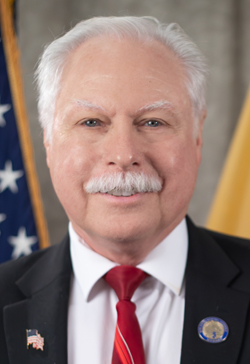
Ask Maddy about Robert Karabinchak
Scope: new-jersey
Hi! I can help you understand Robert Karabinchak's legislative record. What would you like to know?
Try one of these
i
Maddy answers using official bill text and legislative records. Always verify before sharing.
Sources cited inline