

Maddy summaryThis bill prohibits businesses in New Jersey from selling, manufacturing, or distributing personal flotation devices (PFDs) like lifejackets, water wings, or puddle jumpers that lack U.S. Coast Guard approval. It directly affects businesses selling PFDs designed for children under 12 years old. Violators face tiered fines: up to $100 for a first offense, $250 for a second, and $500 for subsequent offenses, enforced by the Division of Consumer Affairs. The law aims to remove unapproved, potentially unsafe PFDs from the market to ensure consumers can access reliable safety equipment.
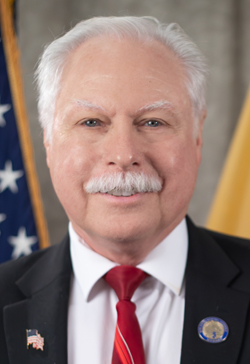
Asm. Robert Karabinchak
Sponsored bills
Maddy summaryNew Jersey's Bill A 3961 authorizes the Department of Agriculture to regulate the sale and distribution of hemp-derived consumable products (like edibles, beverages, and inhalables) containing no more than 0.3% delta-9 THC. It directly affects hemp producers, manufacturers, distributors, and retailers by requiring product testing by independent labs, mandating child-resistant "exit packages" for retail sales, and defining strict standards for hemp-derived products. Key provisions include setting a 0.3% THC limit for products, requiring batch tracking for traceability, and clarifying that hemp products are agricultural commodities, not controlled substances. The bill aims to create a regulatory framework while distinguishing hemp products from higher-THC cannabis items.
Maddy summaryThis bill (A 3911) simplifies zoning rules for installing small electric battery storage systems at homes and businesses in New Jersey. It makes such installations a "permitted use" at residential properties, meaning homeowners don’t need special variances to install them. For commercial/industrial sites, it requires only a basic zoning permit (not site plan reviews) if the installation meets safety codes and doesn’t violate existing property rules. The bill also directs the state to create a model ordinance for installation standards within 30 days, which municipalities may adopt or adapt but cannot override with extra review requirements. The bill is pending before the Assembly Telecommunications and Utilities Committee.
Maddy summaryThis bill requires New Jersey telecommunications companies to automatically provide prorated bill credits or refunds to customers experiencing service outages lasting more than 72 hours. It directly affects all telecom providers regulated by the state board, including traditional phone services and VoIP providers, and their customers. The key mechanism mandates that companies adjust bills proportionally for the outage duration without requiring customers to request the refund. The law specifies that refunds must be applied automatically to the next billing cycle, with no customer action needed. This applies to both local exchange carriers and interexchange telecommunications companies providing regulated services.
Maddy summaryThis New Jersey bill (A1539, "Safe Mobility Education Act") requires public schools to teach pedestrian, cycling, and motor vehicle safety to all students in grades K-12. It mandates the State Board of Education to update curriculum standards to include age-appropriate lessons on topics like bike safety rules, helmet use, visibility gear, legal responsibilities, and consequences of traffic violations. School districts must implement this curriculum starting in the first full school year after the standards are updated, and teachers must complete a required professional development module on the topic. The bill directly affects New Jersey public school students, educators, and school districts through mandatory curriculum changes.
Maddy summaryThis bill requires public water systems in New Jersey to provide specific notices when issuing or lifting a boil water advisory. It mandates that water systems notify municipal officials (mayors/clerks) within one hour, schools (districts, charter, nonpublic) and customers within 24 hours, and post updates on their websites/social media. Notices must include affected areas, corrective actions, and contact information for questions. Water systems must also collect customers' preferred contact methods (phone, email, text) via water bills to improve future notifications. The law directly affects public water systems, local governments, schools, and residential customers during water safety emergencies.
Maddy summaryThis New Jersey bill (A 3585) makes it a crime to knowingly share manipulated videos or audio that falsely depict a candidate or election issue within 90 days of an election, with penalties including up to a fourth-degree offense (or third-degree for repeat violations). It directly affects voters (by aiming to prevent deception), candidates (who can seek legal relief for false depictions), and content creators (who face criminal or civil liability). Key provisions require clear disclaimers for minor edits or news/satire content, and exempt social media platforms, traditional media, and news outlets under federal law. The law does not apply to accidental edits, news reporting, or content with prominent disclaimers identifying manipulation.
Maddy summaryThis bill requires businesses or individuals receiving New Jersey Economic Development Authority (EDA) incentives - such as grants, tax credits, or loans - to pay a penalty if they fail to meet program requirements. The penalty equals the recipient’s applicable tax rate multiplied by the total value of the incentive received up to that point, paid to the state’s General Fund. The EDA must annually verify compliance with incentive agreements and notify the Division of Taxation about noncompliant recipients. It applies to new incentives awarded after the bill’s effective date, ensuring recipients fulfill obligations tied to economic development programs. The bill does not affect existing contracts or reduce current contractual rights under active incentive agreements.
Maddy summaryThis bill (A 2066) establishes the "New Jersey STEM Scholars Grant Pilot Program" to provide competitive grants to public school districts, renaissance schools, and charter schools. The program funds three specific STEM education approaches: project-based learning, after-school STEM activities, and out-of-school STEM experiences. Schools applying must detail how funds will enhance existing programs or create new ones, recruit students, support educators, and ensure long-term sustainability. Grants must supplement, not replace, existing STEM funding and are subject to annual state appropriations. The program runs for four years, with funding sourced from state appropriations and private donations.
Maddy summaryThis bill removes an exemption in New Jersey's Smoke-Free Air Act that previously allowed smoking in casinos and casino simulcasting facilities. Currently, these venues could permit smoking in areas used for gambling (like slot machine rooms or table games), but the bill would eliminate that exception. After passage, all indoor areas of casinos and simulcasting facilities open to the public for gambling would be required to be smoke-free. This change aligns these venues with the state's general indoor smoking ban, which applies to most public workplaces and spaces.