

Maddy summaryHF 3494 creates a new "safe schools aid" program in Minnesota to fund school safety initiatives for public school districts, charter schools, and cooperative school units. It replaces the previous "student support personnel aid" with specific funding rates: $34.32 per pupil unit for districts (minimum $40,000), $1.60 per pupil unit for cooperative units (minimum $40,000), and $20,000 for charter schools. The funds must be used directly for school safety purposes, including hiring security personnel, implementing violence prevention programs, providing mental health support staff, enhancing facility security, and improving school climate. This aid applies to fiscal year 2027 and beyond, with all school entities required to use the funds for specified safety-related expenses.
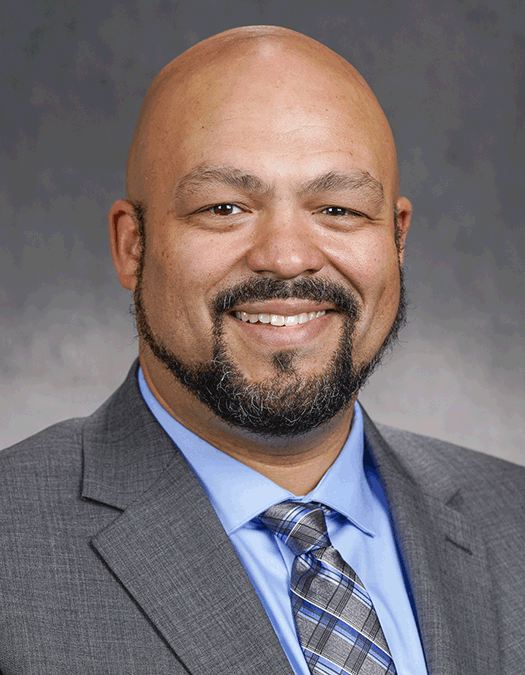
Rep. Walter Hudson
Sponsored bills
Maddy summaryHF 3491 authorizes Minnesota to participate in a federal tax credit program that allows scholarship-granting organizations (SGOs) to provide scholarships to students. These SGOs must be tax-exempt nonprofits that spend at least 90% of funds on scholarships, verify household income, prioritize returning students and siblings, and avoid earmarking funds for specific students. The bill requires SGOs to annually report compliance to the Minnesota Department of Education, which must then post a list of qualified organizations online. The law explicitly states it does not grant schools or districts additional control over nonpublic schools or students.
Maddy summaryHF 3380 requires longer prison sentences for violent offenders who used firearms in their current crime and at least two prior violent crimes. It mandates that judges impose the maximum possible sentence for these offenders (instead of standard sentencing guidelines) and eliminates parole eligibility for them. The bill also requires that sentences for these offenders be served consecutively to any prior prison terms. This affects repeat violent offenders with firearm involvement, directly changing their sentencing outcomes under Minnesota Statutes § 609.1095.
Maddy summaryHF 29 suspends the scheduled 2030-2031 review of Minnesota's social studies academic standards and repeals requirements for schools to include ethnic studies content in their curriculum. It also cancels funding allocated for ethnic studies programs. The bill modifies existing education statutes by removing mandates for schools to integrate ethnic studies or Indigenous education into social studies standards, effectively eliminating these curriculum components. This directly affects Minnesota public schools and students by removing specific educational content requirements and associated funding. The changes take effect upon final enactment.
Maddy summaryHF 2883 restricts the use of state funds for abortions within Minnesota's state-sponsored health programs. It prohibits the commissioner of human services from using state money for abortion services, except when necessary to maintain eligibility for federal health programs. The bill applies specifically to state health programs administered by the human services commissioner and references Minnesota's legal definition of abortion. This policy change directly affects how state health funds can be allocated for reproductive care services.
Maddy summaryHF 1894 delays the implementation of new payment rates for family residential services and life sharing services until January 1, 2029 (or federal approval, whichever is later). It establishes an Advisory Task Force on Family Residential Services to evaluate proposed rate changes and their impact on providers, including adult family foster care agencies and recipients. The Task Force, composed of providers, agency representatives, and service recipients, must analyze multiple rate models and provide case studies and median rate estimates before issuing a report. The bill also appropriates funds for the Task Force’s work and requires the Department of Human Services to provide necessary data and support.
Maddy summaryHF 15, the "Safe Haven In Every Local District (SHIELD) Act," requires all Minnesota public school districts and charter schools to include specific student and staff safety measures in their long-term facility plans by August 2025. The bill creates new grants to fund comprehensive security systems, including features like bullet-resistant doors, emergency alert systems, and staff training, with priority given to schools serving the most students. School districts must apply for these grants through the Minnesota School Safety Center, which will rank applicants and provide lists of approved vendors. The law appropriates funds from the general fund for fiscal year 2026 to support these security upgrades and plan updates.
Maddy summaryHF 1052 modifies Minnesota's student discipline laws to protect younger students. It prohibits school dismissals (including suspensions) for preschool/pre-K programs and kindergarten through grade 3 students, limiting K-3 dismissals to no more than three school days. The bill requires schools to first use alternative disciplinary approaches and provide educational services before considering dismissal, and mandates districts to track student progress during any dismissal period. These changes apply to all Minnesota public schools and take effect July 1, 2025. The bill repeals outdated sections related to student discipline (121A.425 subd. 2 and 121A.611).
Maddy summaryHF 3329 requires that if a defendant has a public defender or court-appointed attorney in a criminal case, that same attorney must represent the defendant's property in related civil forfeiture litigation. The bill mandates that civil forfeiture cases must be paused ("stayed") until after the criminal case concludes. Defendants have up to 90 days after the criminal conviction to respond to the civil forfeiture complaint, and failure to respond before conviction does not automatically result in a default. This applies directly to individuals facing both criminal charges and civil forfeiture of property under Minnesota Statutes § 609.531, subdivision 6a.
Maddy summaryHF 3318 requires the Capitol Area Architectural and Planning Board to create a commemorative work honoring Minnesota's first recorded Italian immigrant on Capitol grounds, with design completion by December 2026 and installation by December 2027. The bill appropriates funds from the general fund for the project, allocating $ for the Board in fiscal year 2026 (available until June 2028) and similar funding for the Department of Administration. This procedural bill directly affects state agencies responsible for Capitol design and funding, recognizing Italian-American contributions through a physical memorial.