

Maddy summarySF 3210 prohibits discrimination against individuals with disabilities by public or private entities receiving state funding in Minnesota. The bill requires these organizations to provide reasonable accommodations and ensures people with disabilities cannot be excluded from services or denied benefits due to their disability. It specifically bans the denial of access to service animals in public places like restaurants and hotels, and prohibits charging extra fees for service animals. This law directly affects state-funded organizations and individuals with disabilities across Minnesota.

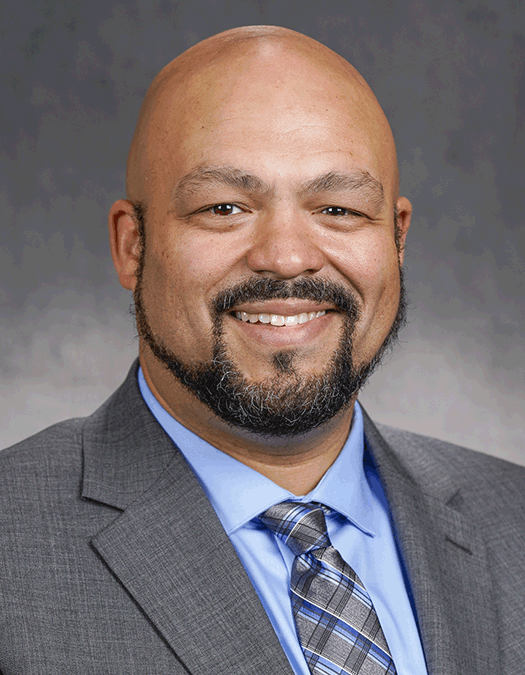
Rep. Walter Hudson
Sponsored bills
Maddy summaryThis bill repeals existing affirmative action requirements for state agencies in Minnesota, removing the mandate for the state to establish specific goals and programs to increase the employment of members of protected groups. While the legislation eliminates these targeted initiatives, it retains the policy that state hiring and performance evaluations must be based on merit and free from discrimination based on race, gender, disability, or other protected characteristics. The law also keeps in place a requirement for agency managers to receive training on identifying and mitigating bias in the hiring and evaluation processes. Ultimately, the bill shifts the state's approach from proactive affirmative action plans to a focus on equal opportunity and nondiscrimination without setting numerical targets for diverse representation.
Maddy summaryThis bill temporarily suspends the state motor fuels tax in Minnesota for a specific period in 2026, directly affecting drivers, fuel retailers, and businesses that purchase gasoline and diesel. Under the legislation, the tax rate is set to zero cents per gallon or per thousand cubic feet for all fuel types during the designated timeframe, which begins shortly after the bill is enacted and ends in early September 2026. To offset the lost revenue from this suspension, the state will transfer money from its general fund to the Department of Transportation to cover the costs that would have been collected from fuel taxes. The bill also allocates a one-time appropriation to the Department of Revenue to cover the administrative expenses required to implement this temporary tax pause.
Maddy summaryHF 3490 authorizes Minnesota to participate in a federal tax credit program by establishing rules for scholarship-granting organizations (SGOs). These SGOs must be 501(c)(3) nonprofits that spend at least 90% of funds on student scholarships, verify household income, prioritize returning students/siblings, and avoid targeting specific students. Organizations must report annually to the Minnesota Department of Education, which will post a public list of approved SGOs. The bill clarifies it does not grant schools additional control over nonpublic schools or their students.
Maddy summaryHF 2380 prohibits discrimination against individuals with disabilities in services, programs, or activities receiving state funding in Minnesota. It directly affects public and private entities (like schools, hospitals, and businesses) that receive state money. The bill requires these entities to provide reasonable accommodations and bans exclusion or denial of benefits due to disability. It also specifically prohibits businesses from banning service animals or charging extra fees for them, defining "disability" broadly to include conditions substantially limiting major life activities.
Maddy summaryThis bill amends Minnesota statutes to update pension contribution rates and annuity calculation formulas for teachers in the state's retirement systems. It establishes specific employer contribution percentages for certain districts like Minneapolis and Duluth while adjusting the rates for other districts. Additionally, the legislation modifies how retirement annuities are computed based on years of service, distinguishing between different periods of employment and membership types. These changes directly affect teachers and school districts in Minnesota by altering the financial terms of their retirement benefits.
Maddy summaryThis bill prohibits Minnesota municipalities from signing nondisclosure agreements that prevent them from sharing information about projects funded with public money. It directly affects local governments, including cities, counties, school districts, and other political subdivisions that manage public funds. The law makes any such restrictive contracts automatically unenforceable and requires municipalities to publicly disclose any agreements that violate this rule. The provision specifically covers projects involving land development, economic initiatives, tax revenues, bonds, and other debt obligations.
Maddy summaryThis bill designates January of each year as "Snow Professionals Appreciation Month" in Minnesota to honor individuals and businesses who clear snow, maintain road safety, and manage winter weather. It recognizes snow professionals - including residential shoveling services, commercial plowing companies, and municipal crews - who keep streets and paths safe during winter. The bill allows the governor to promote public awareness of this observance but does not create new regulations, funding, or obligations. It is a ceremonial designation focused solely on recognition, with no direct policy changes affecting residents or businesses.
Maddy summaryHF 3563 requires Minnesota licensing boards to automatically suspend or revoke licenses, or deny license applications, when a licensee or applicant is convicted of specific theft or fraud crimes listed in Minnesota law (including offenses under sections like 609.23, 609.496, and 609.52). This directly affects licensed professionals - such as healthcare providers, contractors, and financial advisors - who face criminal convictions for these offenses. The bill mandates that boards take formal action upon conviction, rather than allowing licenses to remain active despite criminal findings. It amends Minnesota Statutes 214.10 to establish this requirement, effective immediately after enactment.
Maddy summaryThis bill modifies how disability benefits are reduced for Minnesota police, firefighter, and paramedic members who started receiving disability payments before July 1, 2023, when they return to work. It changes the calculation method for reducing disability benefits when these members earn income from other employment, ensuring the reduction applies consistently to those who began disability before the specified date. The legislation updates existing rules to clarify how much disability benefits decrease based on reemployment earnings, using a dollar-for-dollar reduction ratio for certain service levels and a tiered approach for others. This change affects only current disability recipients who started their benefits prior to the July 1, 2023 cutoff, while members who began receiving benefits on or after that date remain subject to previously established reduction rules.