

Maddy summaryThis bill modifies Minnesota law to allow county commissioners to enter into agreements with other government units for services that those units are authorized to provide themselves, even if the county does not currently have the specific power to perform that service. The legislation also mandates that county sheriffs must sign agreements with federal agencies to carry out authorized federal functions without needing prior approval from the county board. By creating these exceptions to the usual requirement that all parties in an agreement must share common powers, the bill expands the ability of local governments to collaborate on service delivery and fulfill federal mandates.
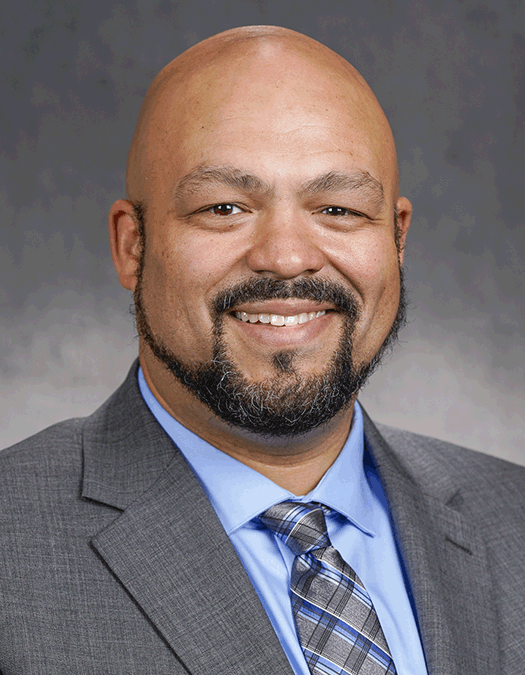
Rep. Walter Hudson
Sponsored bills
Maddy summaryHF 482 establishes "Choose Life" special license plates for Minnesota motor vehicle owners. To obtain these plates, applicants must pay a $25 initial fee and $25 annual contribution to a dedicated "Choose Life account," in addition to standard registration fees. Funds collected are deposited into this account and distributed by Choose Life Minnesota, Inc., to non-profit agencies within each county that assist pregnant women making adoption plans - excluding any agencies involved in abortion services or charging fees for services. The bill also specifies plate design requirements (featuring the "Choose Life" logo and inscription) and limits administrative costs for the program to 15% of funds. The program becomes effective January 1, 2026.
Maddy summaryThis bill creates a new 100% tax on money obtained through fraud by individuals or organizations, regardless of whether they have already paid fines or restitution. It applies to those convicted by a court, those identified by the state revenue commissioner as having committed fraud, and anyone paid to help facilitate such fraudulent activities. The revenue collected from this tax must be used exclusively to provide relief for state income or property taxes. The law takes effect retroactively for fraud cases determined after December 31, 2019.
Maddy summaryThis bill is a House resolution that formally impeaches Minnesota Governor Timothy J. Walz for alleged corrupt conduct in office. It directly affects the Governor by charging him with four specific articles of misconduct, including concealing fraud in state programs, obstructing oversight investigations, prioritizing political narratives over transparency, and failing to enforce laws protecting public funds. If adopted by the House, the resolution would immediately suspend the Governor's duties while the Senate conducts a trial to determine whether he should be removed from office. The bill also requires the Speaker of the House to serve formal notice of the charges to the Governor and directs the Chief Clerk to send copies of the resolution to relevant state officials.
Maddy summaryThis bill updates the wage calculation framework for staff working in family residential services in Minnesota, directly affecting service providers and employees in this sector. It establishes specific formulas for determining base wages for various staff roles, such as supervisors, nurses, and direct care workers, by tying their pay to median wages for comparable occupations. The legislation also introduces a temporary lower wage rate for asleep-overnight staff that applies until 2027 or federal approval, while other staff categories receive wage calculations based on weighted percentages of median wages for related job classifications.
Maddy summaryThis bill, known as the Minnesota Public Safety Radio Communications Funding and Interoperability Act, removes the requirement for Minnesota counties to pay for the expansion and maintenance of the ARMER public safety radio network. Instead, the legislation creates a new state-funded account to cover these costs, ensuring that local governments are not forced to use property taxes for this infrastructure. The law also establishes a voluntary program where the state and local jurisdictions can share project costs on an equal basis, with the state covering at least 75 percent of any such expenses. Additionally, the bill sets up a framework to improve interoperability, allowing different law enforcement, fire, and emergency medical agencies to communicate effectively across jurisdictional lines. A new reporting requirement mandates that the commissioner of public safety annually update the legislature on how the funds are being used and the progress of the network.
Maddy summaryThis bill directs the Minnesota School Safety Center to create and distribute evidence-based model safety plans for K-12 schools, requiring districts to adopt similar plans by May 2028. It establishes strict criteria for what counts as "evidence-based," mandating that safety strategies be backed by strong research or well-designed studies before they are implemented. The legislation also enables anonymous threat reporting systems in schools and requires the safety center to consult with licensed mental health professionals when developing these plans. Additionally, the bill modifies grant programs for school buildings and cybersecurity while increasing funding for safe schools initiatives.
Maddy summaryThis House resolution initiates the formal impeachment process against Keith Ellison, Minnesota's Attorney General, alleging corrupt conduct and crimes while in office. The bill directs the House to adopt six articles of impeachment that accuse Ellison of abusing his office to defend unlawful protest activity, undermining religious liberty protections, failing to enforce laws impartially, engaging in conflicts of interest, and soliciting political support in exchange for favorable treatment. If adopted, the resolution immediately bars Ellison from exercising his duties as Attorney General until the Senate conducts a trial and votes on his acquittal or conviction. The House Speaker must serve notice of the charges to Ellison, and the enrolled resolution must be transmitted to the Governor, Secretary of State, and Senate leadership to begin the constitutional impeachment proceedings.
Maddy summaryHF 3493 increases Minnesota's safe schools revenue funding to $36 per adjusted pupil unit for the 2027 fiscal year and later. It expands eligibility to include charter schools, cooperative units, nonpublic schools, and Tribal contract schools - previously limited to traditional public school districts. The bill requires funds to be used for specific safety purposes like security enhancements, counseling services, drug prevention programs, and cybersecurity measures. This policy change directly affects all Minnesota schools receiving state education funding, providing new resources for school safety initiatives. The bill takes effect for fiscal year 2027.
Maddy summaryHF 2804 modifies Minnesota law to allow grandparents or great-grandparents to seek court-ordered visitation with a minor child. It creates a new process where petitioners must prove they have a "substantial established relationship" with the child, visitation is in the child's best interests, and it won't harm the parent-child relationship. The bill requires courts to consider factors like prior contact and the child's benefit from maintaining the relationship, while prohibiting consideration of time apart between the grandparent and child. This change applies retroactively to cases filed on or after January 1, 2022, and repeals the previous, more restrictive provisions.