

Maddy summaryHF 3311 clarifies Minnesota's definition of gifted and talented students to explicitly include "twice-exceptional" students - those who are gifted and also have a learning disability, developmental disability, or autism spectrum disorder. The bill requires school districts to use multiple, objective, and fair assessment methods for identifying these students, with special attention to underrepresented groups like low-income students, minority students, English learners, and students with disabilities. It also mandates that districts establish clear procedures for academic acceleration and early kindergarten or first-grade admission that are inclusive and sensitive to these groups. These changes aim to ensure equitable access to gifted and talented programs for all qualifying students.
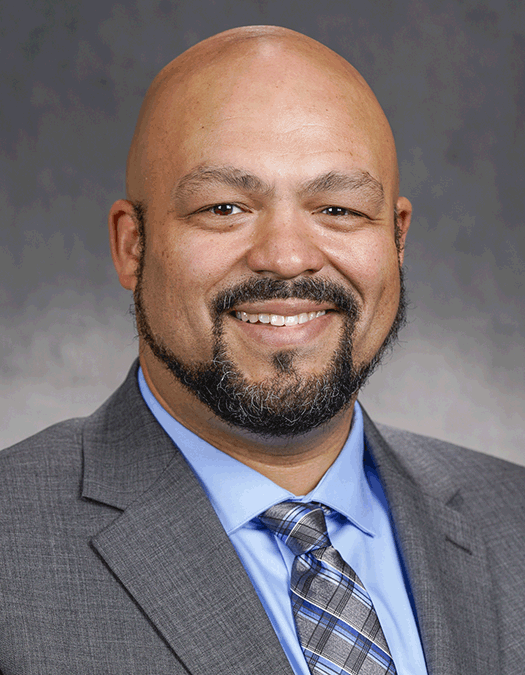
Rep. Walter Hudson
Sponsored bills
Maddy summaryHF 766 amends Minnesota Statutes section 609.2231 to increase penalties for assaulting police officers during lawful duties. It elevates simple physical assaults on peace officers to a gross misdemeanor felony (with up to 2 years in jail or $4,000 fine), and makes assaults causing bodily harm or involving bodily fluids/feces a felony (up to 3 years or $6,000 fine). The bill directly affects individuals who physically assault officers while they are performing official duties, as defined under Minnesota law. It becomes effective August 1, 2025, applying to offenses committed on or after that date. The change specifically modifies existing penalty levels without altering the definition of assault.
Maddy summaryHF 3276 appropriates $850,000 annually for fiscal years 2026 and 2027 from the general fund to the Minnesota Federated Humane Societies, established under Minnesota Statutes, chapter 343. The funds must support animal cruelty investigations, increase organizational capacity, and provide training and education. The commissioner of public safety must submit annual reports by January 15 detailing how the grant was used to relevant legislative committees. This bill directly affects the Humane Societies' operations and the Department of Public Safety's budget administration.
Maddy summaryHF 733 removes restrictions on handheld electronic devices used for bingo and pull-tab games in Minnesota. The bill amends state law to allow these devices, which must meet specific requirements like a $0.25 minimum ticket price, a limit of 36 bingo faces per game, and no slot machine-style features (e.g., spinning reels or bonus screens). It also requires devices to support visually impaired players and maintain transaction records. This change directly affects bingo and pull-tab operators by enabling new electronic gameplay options while maintaining key safeguards.
Maddy summaryHF 2339 increases Minnesota's income threshold for the child tax credit, allowing more families to qualify for the full benefit before credits begin phasing out. The bill raises the phaseout threshold from $35,000 to $45,490 for married couples filing jointly and from $29,500 to $38,340 for other filers. This change directly affects Minnesota taxpayers with children who file individual income tax returns, as it prevents the credit from decreasing at lower income levels. The bill also requires future annual inflation adjustments to these thresholds starting in 2026.
Maddy summaryHF 3151 prohibits health care providers in Minnesota from offering gender-affirming medical care (like hormone therapy or puberty blockers) or certain counseling to minors under 18. It directly affects minors seeking such care, their health care providers, and public health programs that could fund this care. Exceptions include treatment for precocious puberty or intersex conditions when medically necessary, and mental health counseling that doesn't affirm a gender identity differing from biological sex. Violations carry severe penalties, including $500,000 fines per violation, license revocation, up to 10 years in prison, and civil lawsuits by guardians. The bill takes effect July 1, 2025.
Maddy summaryHF 3205 appropriates $235,000 from Minnesota's arts and cultural heritage fund for the 2026 fiscal year to reinstall the Christopher Columbus statue on the State Capitol Mall. The funds are directed to the commissioner of administration, who must work with the Capitol Area Architectural and Planning Board to complete the reinstallation. This bill is procedural, allocating existing funds for a specific physical display without creating new laws or affecting citizens.
Maddy summaryHF 3209 increases criminal penalties for "swatting" in Minnesota, which involves making false emergency calls to trigger police responses to someone's home. The bill amends Minnesota Statutes § 609.78 to impose harsher punishments: up to life imprisonment if someone dies, up to 15 years for great bodily harm, or up to 3 years for substantial bodily harm. It also adds specific penalties for swatting targeting officials (elected leaders, judges, prosecutors, correctional staff, or police officers), with sentences up to 10 years or $20,000 fines. The changes apply to offenses committed on or after August 1, 2025. This directly affects individuals who make false emergency calls, particularly those causing injury or targeting public officials.
Maddy summaryHF 3152 prohibits healthcare providers in Minnesota from administering gene-based vaccines, defined as those using mRNA, modified mRNA, self-amplifying mRNA, or DNA technology. The bill directly affects medical professionals and facilities that administer such vaccines within the state. Violations carry a misdemeanor penalty of $500 per incident, and licensing boards must review licenses of violators. The law aims to ban the use of these specific vaccine technologies through a statutory prohibition and financial penalty.
Maddy summaryHF 3168 establishes a pool of alternate members for Minnesota's three ethnic councils: the Council on Latino Affairs, Council for Minnesotans of African Heritage, and Council on Asian-Pacific Minnesotans. Each council must maintain two alternates for every regular member, with alternates filling in when regular members are absent and gaining full voting rights during those periods. The governor appoints alternates using the same criteria as regular members, prioritizing diversity and relevant expertise, and alternates are capped at eight total years of service across all councils. Councils must report annually on alternate usage, participation, and how alternates impact their ability to maintain quorum and fulfill duties.