

Maddy summaryThis bill updates Minnesota's paid family and medical leave insurance program to explicitly include foreign-licensed physicians as eligible health care providers. It also establishes stricter rules for certifying these providers by requiring the state to suspend certification processing when there are credible allegations of fraud, such as verified complaints or audit findings. Additionally, the legislation disqualifies foreign-licensed physicians from certification if they have been convicted of specific fraud-related offenses listed in Minnesota statutes or equivalent laws in other jurisdictions. These changes aim to strengthen fraud prevention measures while expanding the pool of eligible providers for the state's insurance program.
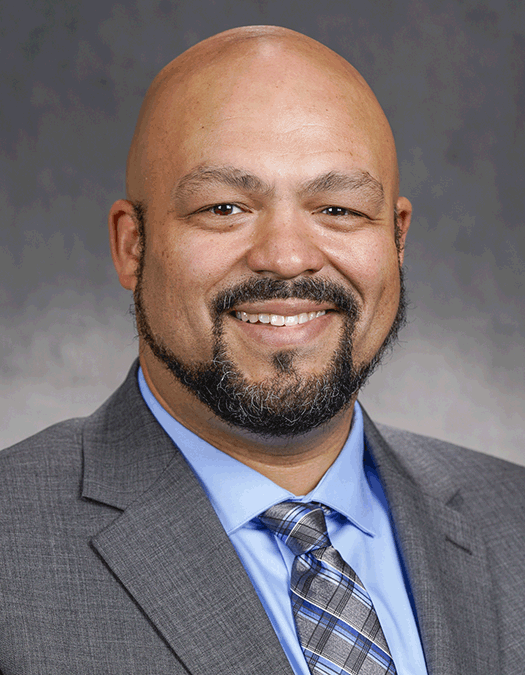
Rep. Walter Hudson
Sponsored bills
Maddy summaryHF 952 modifies Minnesota's sales and use tax law to expand exemptions for land clearing services and equipment. It adds land clearing equipment (like machinery for removing trees, bushes, and stumps) to the list of exempt items used in taxable services, and creates a new exemption for land clearing contracts sold to contractors or subcontractors. The bill specifically excludes equipment with a useful life over 12 months and does not apply to standard landscaping, gardening, or lawn care services. These changes take effect for sales after June 30, 2025.
Maddy summaryHF 7 modifies multiple public safety laws in Minnesota. It requires law enforcement agencies to make bail/bond information public and mandates county attorneys to publicly report reasons for dismissing charges. The bill establishes mandatory minimum sentences for certain sex trafficking offenses and requires individuals subject to stays in sexual conduct cases to register as predatory offenders. It also increases penalties for assaulting police officers, obstructing highway/airport traffic, and expands law enforcement's use of tracking devices on fleeing vehicles. These changes apply directly to law enforcement agencies, prosecutors, and individuals involved in criminal cases.
Maddy summaryThis bill modifies Minnesota's "Read Act" to require literacy instruction based on "science of reading" research, emphasizing evidence-based methods like phonics and decoding while explicitly excluding the three-cueing system. It establishes a new Office of Achievement and Innovation within the Department of Education to support literacy implementation and creates a statewide school performance reporting system. The bill also allows school boards to opt out of complying with certain recently enacted state education laws or rules and authorizes fund transfers for education programs through fiscal year 2029. These changes directly affect all Minnesota public school districts, educators, and students by reshaping literacy instruction requirements and school accountability systems.
Maddy summaryHF 2219 regulates surrogacy in Minnesota by making traditional surrogacy arrangements invalid (meaning parental rights automatically remain with the birth mother unless she voluntarily terminates them) and establishing enforceable rules for gestational surrogacy. It requires gestational surrogacy contracts to be in writing, signed by all parties including the surrogate's spouse, notarized, and accompanied by separate legal counsel for all parties and written acknowledgment of rights/obligations. The bill also creates a new criminal offense for operating a for-profit surrogacy agency (defined as entities connecting intended parents with surrogates, excluding licensed attorneys handling contracts). This directly affects intended parents, gestational surrogates, and surrogacy agencies seeking to facilitate such arrangements in Minnesota.
Maddy summaryHF 21 would require a three-fifths supermajority vote in both the Minnesota House and Senate to extend a peacetime emergency declaration beyond 14 days. Currently, such extensions beyond 14 days could be approved by the Executive Council, but this bill would shift that authority to the legislature. The bill directly affects governors seeking to prolong emergency powers and the legislative process for reviewing those requests. It does not change the initial 14-day emergency declaration period or the governor's authority to declare emergencies under existing criteria. Note: This bill was introduced but not passed during the 2025 legislative session.
Maddy summaryHF 2809 establishes a new crime for protesting directly in front of or about a person's home (excluding homes used as businesses). It makes this a misdemeanor, escalating to a gross misdemeanor if the person has a prior conviction under this law or ignores court orders like protection orders. The bill specifically allows peaceful protests about community meetings or assemblies held at locations commonly used for public discussion. This law applies to residential properties only and takes effect August 1, 2025.
Maddy summaryHF 3550 allows Minnesota school districts to develop their own health education standards instead of using statewide requirements. Currently, districts must follow state-mandated health standards, but this bill gives them the option to create local standards that meet their community's needs. When statewide health standards become available (expected after 2025), districts must choose between adopting the state standards or continuing with their locally developed ones. The bill becomes effective July 1, 2025, and applies to all public school districts in Minnesota.
Maddy summaryHF 1567 extends Minnesota's existing personal information protections for judicial officials to peace officers (including police officers). The bill defines protected information as residential addresses, family details, non-work contact information, and children's names/schools attended. It requires peace officers to submit written notification to request protection, which expires after five years unless renewed. The law prohibits government entities and others from publicly sharing this protected information online or through other means, with limited exceptions for news reporting. This directly affects Minnesota peace officers by safeguarding their personal details from public disclosure.
Maddy summaryHF 1 establishes a centralized Office of Inspector General (OIG) for Minnesota state government, replacing existing agency-specific inspector general offices. The OIG will oversee state spending, require agencies to halt payments when fraud is suspected, and mandate a fraud reporting hotline for employees and contractors. It directly affects all state agencies and recipients of state funds (such as contractors and organizations administering state programs) by requiring them to report suspected fraud and prohibiting retaliation against whistleblowers. The bill also specifies the OIG must coordinate with the legislative auditor and amends statutes related to fraud detection, waste prevention, and oversight.