

Maddy summaryThis bill requires state agencies to disclose information about investigations into potential overpayments of public funds within 30 days of a request, provided the agency has already taken action to reduce, suspend, or withhold payments. It affects the Department of Human Services and the Department of Children, Youth, and Families by mandating transparency about ongoing investigations into service providers and recipients. The law also expands access to investigative data for the ombudsman for mental health and developmental disabilities, allowing them to request both active and inactive case information including reporter names. Additionally, the bill clarifies when certain investigative data becomes public by classifying it as such once submitted to a court or administrative law judge.
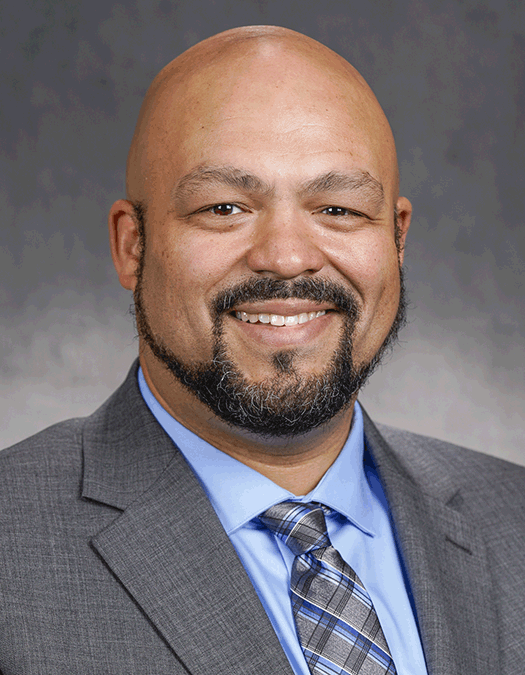
Rep. Walter Hudson
Sponsored bills
Maddy summaryHF 3353 expands personal information protections currently available to Minnesota judges and court staff to also cover state legislators. It defines "covered official" to include current and former lawmakers, protecting their residential addresses, phone numbers, email addresses, and children's school names from public posting. The bill requires entities to remove such protected information within 30 days of a valid request, with legal action available for non-compliance. It also creates a 12-member legislative task force (including members from the Legislative Commission on Data Practices and appointed officials) to study and report on privacy protections for all government officials by 2027. The bill appropriates funds for these efforts.
Maddy summaryHF 3000 creates a new exoneration compensation account in Minnesota's special revenue fund to provide preliminary monetary damages to certain exonerated individuals. It authorizes $5,000 per year of incarceration (or $2,500 per year of supervised release) to people who were wrongfully convicted and whose prosecutors agreed before the exoneration petition that the case likely shouldn't have been filed. The bill appropriates $250,000 from the general fund to the account in fiscal year 2026, with additional funds replenishing the account after payments are made. These preliminary payments reduce the final compensation amount awarded under existing exoneration laws.
Maddy summaryHF 704 requires mortgage lenders and servicers in Minnesota to provide a "satisfaction of mortgage" document to borrowers within 45 days after full loan payment or receipt of a payoff statement. The bill adds rules for when lenders must send corrected payoff statements if an initial amount was too low, protecting borrowers who relied on the incorrect figure. It also specifies that lenders who fail to provide the satisfaction document within 45 days after payment are liable for actual damages suffered by borrowers. This directly affects homeowners who pay off mortgages and the lenders handling those transactions.
Maddy summaryHF 2937 regulates how parenting consultants can be used in Minnesota family court cases involving custody and parenting time disputes. The bill requires consultants to meet specific qualifications (similar to parenting time expeditors or marriage and family therapists) and clarifies they cannot modify court orders or change parenting time percentages. Crucially, it states that parenting consultants' recommendations and decisions are not binding on parents or courts, and their evidence cannot be used in family court proceedings. This directly affects parents, family courts, and consultants by setting clear boundaries for their role in resolving disputes without altering legal custody arrangements.
Maddy summaryThis bill restructures the Minnesota Sentencing Guidelines Commission by changing its membership composition and appointing process. It designates the commissioner of corrections as a nonvoting member and adds new voting positions for a peace officer representing municipal police chiefs and a county sheriff or deputy sheriff. The legislation also requires appointing authorities to make reasonable efforts to include members from protected groups and mandates that certain organizations submit candidate slates for governor consideration. These changes aim to diversify the commission's representation while maintaining its role in developing sentencing guidelines for the state.
Maddy summaryThis bill requires cannabis business license applications in Minnesota to be available in both English and Spanish, making the application process more accessible to Spanish-speaking applicants. The amendment updates state statutes to mandate that all required application forms and information be provided in these two languages, while also clarifying the specific details that must be included in applications. The law takes effect on January 1, 2027, and applies to all individuals and businesses seeking to obtain or renew cannabis licenses in the state.
Maddy summaryThis bill clarifies how Minnesota counties can take over state correctional services and outlines how benefits are handled for employees during the transition. It requires counties that assume jurisdiction to file a formal resolution with the commissioner of corrections and specifies that displaced probation officers and other staff must retain their salary, seniority, and accrued benefits like sick leave and vacation. The legislation also establishes that the state pays benefits earned during state employment before the transition, while counties are responsible for benefits earned during county employment before the state took over. Additionally, the bill appropriates $150,000 in 2027 to reimburse counties for fringe benefit costs related to state collective bargaining agreements and requires a report by January 2028 detailing how the funds were distributed.
Maddy summaryHF 3562 modifies Minnesota's motor vehicle registration tax for passenger cars and hearses. It reduces the tax rate from 1.54-1.575% to 1.25-1.285% of a vehicle's manufacturer's suggested retail price (MSRP), depending on whether the vehicle was first registered in Minnesota before or on/after November 16, 2020. The tax amount decreases each year based on the vehicle's age (e.g., 100% of MSRP in year one, dropping to 10% in year ten), then becomes a flat $20 annually after the 10th year. This bill directly affects Minnesota vehicle owners paying registration fees for passenger cars and hearses, effective for registrations starting January 1, 2027.
Maddy summaryThis bill strengthens penalties for misconduct by public officers and employees in Minnesota by increasing potential fines and prison sentences. It directly affects government officials and employees who fail to perform required duties, exceed their legal authority, harm others under false pretenses, or knowingly submit false official documents. Under the new provisions, first-time offenders could face up to one year in prison or a $5,000 fine, while repeat offenders could be sentenced to up to five years in prison or a $10,000 fine. The changes take effect on August 1, 2026, and apply to crimes committed on or after that date.