

Maddy summaryHF 2447 establishes a dedicated account for financial assurance funds collected from gas development permits. It requires the commissioner of natural resources to deposit these funds into an account managed by the State Board of Investment, with earnings credited back to the account. The funds can only be used for financial assurance purposes related to specific gas permits under chapters 93 and 103I of Minnesota Statutes. This bill directly affects gas development permit applicants and the commissioner's office, creating a new mechanism for handling and investing these required funds.
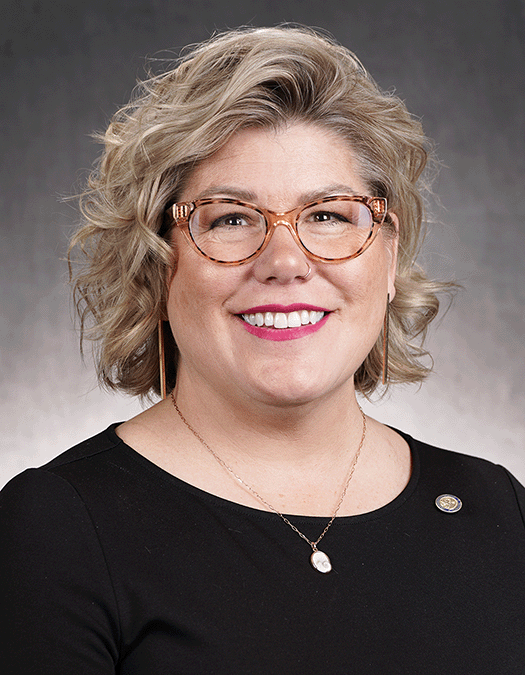
Rep. Dawn Gillman
Sponsored bills
Maddy summaryHF 4 proposes a constitutional amendment requiring Minnesota to return budget surplus funds to taxpayers. If approved, it would create a "Minnesota tax relief account" funded by revenue exceeding 105% of projected spending, using those funds to refund or reduce property and income taxes. Taxpayers would receive direct refunds or tax reductions, but only up to the amount they owe in taxes, with the account funded annually from the state's general fund surplus. The amendment must be voted on by voters in the 2026 general election.
Maddy summaryHF 23 amends Minnesota Statutes section 181.932 to strengthen whistleblower protections for public employees. It expands the list of protected disclosures to include reporting gross mismanagement or waste of public funds (subsection 7), clarifies protections for health care quality concerns (subsection 4), and adds specific scenarios like reporting truthful scientific studies (subsection 5) or classified service communications about state services (subsection 6). These changes directly affect state and local government employees who report violations of law, safety risks, or financial misconduct. The bill modifies existing anti-retaliation language to explicitly cover these new disclosure types while maintaining that protected disclosures cannot override other legal data protections.
Maddy summaryHF 1845 expands Minnesota's definition of "veteran" to include two specific groups: (1) Hmong veterans naturalized under the federal Hmong Veterans' Naturalization Act of 2000, and (2) individuals who served honorably with secret guerrilla units or irregular forces operating from Laos in support of U.S. forces between February 28, 1961, and May 14, 1975. The bill amends Minnesota Statutes section 197.447 to add these categories to the existing definition, ensuring these veterans qualify for state benefits. It also creates an advisory task force of veterans, experts, and community members to help determine eligibility under the new definition. This change directly affects Hmong veterans and Laotian-based veterans who previously may not have met Minnesota's veteran criteria.
Maddy summaryHF 75 modifies Minnesota's renewable energy standard to clarify which hydroelectric facilities qualify as "eligible energy technology." The bill specifies that hydroelectric projects must either have a capacity under 100 megawatts or, if 100+ megawatts, have been operational since February 8, 2023. This directly affects electric utilities generating hydroelectric power seeking to comply with the state's renewable energy requirements. The change maintains existing eligibility rules without altering the 100-megawatt threshold or operational date criteria. (Amends Minn. Stat. § 216B.1691, subd. 1.)
Maddy summaryHF 25 establishes a state grant program administered by Minnesota's Department of Health to fund nonprofit women's pregnancy centers and maternity homes. The program provides financial support for services like housing, medical care, parenting education, and mental health resources to help pregnant women and new mothers - particularly those facing homelessness or crisis - carry pregnancies to term and care for their children. Eligible organizations must be nonprofits offering free or low-cost services without promoting abortion, providing abortion care, or referring women to abortion providers. Grant funds cannot be used for abortion-related activities, and strict privacy rules require written consent before sharing personal information about clients. The bill appropriates state funds for this program while reducing other health-related appropriations.
Maddy summaryHF 2363 grants residents of long-term care facilities in Minnesota the right to have one designated support person (such as a family member, partner, or close friend) physically present with them while receiving care. The bill amends Minnesota Statutes 2024, sections 144.651 and 144G.91, requiring facilities to allow this support person unless restricted for medical reasons (like during surgery) or if the person poses a safety threat. Facilities must follow internal grievance procedures if a support person is denied. This directly affects long-term care residents and facilities, ensuring they can choose a comfort person without facility interference, except in specific safety or clinical circumstances.
Maddy summaryHF 2313 prohibits installing smartphone software that secretly tracks another person's location, microphone, camera, or text messages without their consent. It requires such apps to be clearly visible on a device and mandates two-factor authentication at installation and monthly to prevent unauthorized use. The bill directly affects individuals whose smartphones might be monitored without permission, while allowing exceptions for parents tracking minors, employers with written notice for business purposes, and law enforcement with proper authorization. Key provisions include requiring conspicuous app displays, mandatory identity verification for monitoring apps, and banning unauthorized collection of geolocation or device data.
Maddy summaryThis bill appropriates $375,000 for fiscal year 2026 and $375,000 for fiscal year 2027 from Minnesota's arts and cultural heritage fund to The Sanneh Foundation. The funding supports three specific programs: family nutritional distribution in the seven-county metropolitan area, senior community programming, and multicultural women's athletic programming. The Sanneh Foundation directly receives these funds to implement these community services.
Maddy summaryHF 2191 modifies Minnesota's licensing and certification rules for child care and family service programs. It allows the commissioner to issue two-year licenses to new programs that aren't yet operational, provided they meet all other requirements and have necessary records available later. The bill also adds provisions for renewing licenses for programs with past disqualifications or license revocations, requiring the commissioner to assess community needs and program compliance before approval. This directly affects child care centers, foster care agencies, and similar providers seeking or renewing state licenses. The changes streamline licensing for new operations while maintaining safety standards and community impact considerations.