

Maddy summaryHF 3453 amends Minnesota Statutes section 152.027 to raise the legal age for possessing kratom from 18 to 21 years. It makes it a gross misdemeanor to sell kratom to anyone under 21 and a misdemeanor for anyone under 21 to possess it. The bill directly affects minors under 21 and businesses selling kratom, prohibiting sales to this age group and restricting their possession. The change applies to crimes committed on or after August 1, 2026. This is a substantive policy change altering age restrictions under Minnesota's controlled substances law.

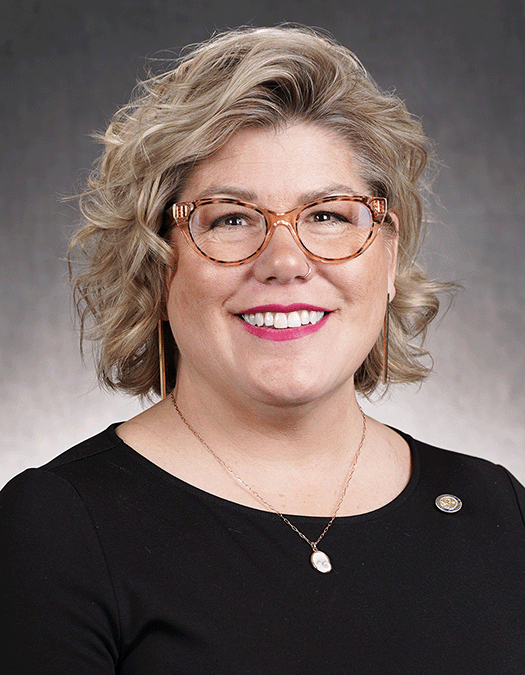
Rep. Dawn Gillman
Sponsored bills
Maddy summaryHF 1724 establishes legal definitions and regulatory exemptions for direct primary care service agreements in Minnesota. The bill clarifies that these agreements - where patients pay a direct fee for primary care services (like check-ups and chronic disease management) instead of using insurance - are not considered insurance or health plans under Minnesota law. This means primary care providers (such as physicians or nurse practitioners) offering these agreements do not need insurance licenses or comply with insurance regulations (chapters 60A, 62A, 62C, 62D, or 62N). The bill directly affects primary care providers seeking to offer subscription-based care and patients choosing this alternative to traditional insurance.
Maddy summaryThis bill modifies an existing appropriation for the Camp Craig Training Facility in Hutchinson to authorize funding for the Civil Air Patrol. The legislation allocates $3.7 million to the city of Hutchinson to cover costs for predesigning, designing, constructing, equipping, and furnishing a hangar and statewide training center. By amending a 2023 law, the bill ensures these funds are available immediately upon enactment to support the facility's development.
Maddy summaryHF 3379 repeals provisions related to "housing stabilization services" in Minnesota law. The bill removes references to these services from multiple statutes governing provider enrollment, background checks, and fee structures for home and community-based waiver programs. This change directly affects providers who previously offered housing stabilization services and their clients, as it eliminates the program's legal framework. The repeal applies to sections of Minnesota Statutes covering background studies, cost recovery fees, and provider requirements. The bill does not create new requirements but formally ends the existing housing stabilization services program.
Maddy summaryHF 82 clarifies the scope of practice for licensed athletic trainers in Minnesota. The bill defines "athletic training" to include specific activities like injury prevention, emergency care, assessment, rehabilitation, and clinical decision-making within the trainer's expertise. It requires athletic trainers to work under a primary physician's direction, with documented protocols updated yearly, and limits initial treatment of undiagnosed injuries to 30 days (or less as specified by the physician). This directly affects athletic trainers, primary physicians, and healthcare facilities employing them, ensuring clear boundaries for their practice while preventing overlap with other licensed professions like physical therapy or medicine.
Maddy summaryHF 1270 updates Minnesota's licensing rules for acupuncture and herbal medicine practitioners. The bill adds specific definitions clarifying that acupuncture includes techniques like dry needling and herbal medicine involves using herbs as part of a patient's treatment plan. It also sets new standards for continuing education, requiring courses to directly relate to acupuncture practice, have qualified instructors, last at least one hour, and maintain attendance records for four years - while excluding practice management courses. Additionally, the bill establishes an advisory council for the licensing board with defined membership criteria, including licensed practitioners and public members.
Maddy summaryHF 4949 establishes a new state program to provide financial reimbursement for hosting major sports and events in Minnesota. The bill defines eligible events to include high-profile competitions such as the Super Bowl, NCAA championships, World Cup matches, and various All-Star games. Funding is intended for local organizing committees that successfully attract these events to the state, with money drawn from a newly created account in the state treasury. The legislation also requires the commissioner of revenue to submit reports regarding the program's operations.
Maddy summaryThis bill allows Minnesota counties to create official lists of agricultural lands that should be protected from electric power facility development. Counties can designate parcels as agricultural priority land if they have high crop productivity ratings or have been classified as prime farmland by the Natural Resources Conservation Service. Once a county submits its list to the state Public Utilities Commission, the commission cannot issue site permits for large power plants on those designated lands unless the county board specifically approves an exception. Landowners have the right to opt out of having their property included on the list before the county submits it to the state. The new rules would take effect on January 1, 2027.
Maddy summaryHF 1266 appropriates $25.7 million from state bonds to fund the design, construction, and equipment of a new nonsecure juvenile detention facility in Moorhead, Clay County. The bill authorizes the state to issue bonds up to this amount to cover the costs, with funds directed to Clay County through the commissioner of public safety. This bill directly affects Clay County and the operation of its juvenile detention system by providing funding for a specific facility project.
Maddy summaryThis bill modifies the requirements for marriage and family therapists to obtain a Minnesota license through reciprocity with other states. It allows the state licensing board to issue licenses to out-of-state therapists who meet specific criteria, including holding a valid license in good standing elsewhere, passing a Minnesota jurisprudence exam, and having no criminal convictions or disciplinary actions. The changes streamline the application process by clearly outlining five conditions that applicants must satisfy, such as completing the required application and fees. Therapists seeking to practice in Minnesota from other jurisdictions would need to demonstrate their qualifications meet these new standards before receiving a state license.