

Maddy summaryThis bill creates a new Human Services Systems Steering Committee to oversee and improve the information technology systems used by Minnesota's human services agencies, including the Departments of Human Services, Children, Youth, and Families, and county governments. The committee will be composed of representatives from these agencies and county organizations, who will meet at least quarterly to review system goals, allocate resources, and make recommendations on major system changes. Before any new major system changes or new systems are implemented, the relevant commissioners must receive the committee's recommendations and consult with counties. The committee must also provide public testimony opportunities during meetings and submit annual reports to legislative committees, which will hold public hearings on those reports. Additionally, the bill appropriates funding to update county information technology systems and expand certain data tools to all interested counties and Tribal Nations.
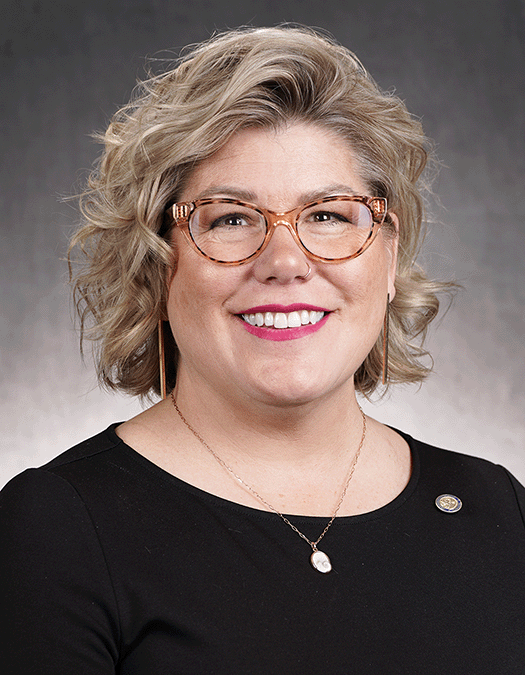
Rep. Dawn Gillman
Sponsored bills
Maddy summaryThis bill authorizes the issuance of up to $2.79 million in state bonds to fund road improvements on Trunk Highway 24 in Wright County. The funds will be used to design and build two roundabouts at specific intersections near the city of Clearwater. Once the bonds are sold, the money will be placed in a dedicated fund to cover the eligible costs of the construction project. The legislation takes effect immediately upon final passage by the legislature.
Maddy summaryThis bill authorizes the state of Minnesota to use a lease-purchase agreement and the sale of certificates of participation to fund improvements or replacement of its MAXIS system. Under this plan, the state would lease the project from a vendor or financing source and pay for it in installments over a period of up to ten years. The legislation establishes specific rules for how the state must manage the funds, including requirements for insurance, liability, and financial reporting within a dedicated project fund. It also allows the state to transfer money from its general fund to cover expected costs before the financing proceeds are received.
Maddy summaryThis bill allocates $1,000,000 from the state's general fund to hire eight additional school safety specialists at the Minnesota School Safety Center for fiscal years 2026 and 2027. The funding is designated as a one-time appropriation that can be used until fully spent, with no restrictions on how the money is distributed among the new positions. This legislation directly affects the Minnesota School Safety Center and the public safety system by increasing the number of available safety personnel. The bill takes effect immediately upon final passage by the legislature.
Maddy summaryHF 5 modifies Minnesota's tax structure by repealing the retail delivery fee and establishing an "unlimited Social Security subtraction," allowing taxpayers to subtract all their Social Security benefits from state taxable income. It redirects transportation funding by creating a "transportation advancement account" and requires specific distribution percentages: 36% to metropolitan counties, 28% to county highway funds, 23% to larger cities, 34% to small cities, 15% to town roads, and 1% to food delivery support. The bill also mandates tax analysis and reporting requirements for transportation funding impacts and modifies several tax statutes, including those governing Social Security benefit subtractions. These changes directly affect Minnesota taxpayers, local governments, and transportation agencies, effective July 1, 2025.
Maddy summaryThis bill amends Minnesota law to allow counties to adopt local ordinances permitting residents to keep up to 24 chickens on their property. The change adds a new provision to existing feedlot zoning regulations, giving local governments authority to approve small-scale backyard chicken keeping through their own ordinances. The bill does not require counties to allow chickens but enables those that choose to do so by updating state statutes. This policy change affects rural and suburban residents who may wish to raise chickens for personal use or small-scale production.
Maddy summaryThis bill increases reimbursement rates for mental health services provided by psychologists and other masters-prepared professionals under Minnesota's medical assistance program. Starting in 2027, the state will pay 100 percent of the Medicare rate for neuropsychological assessments, testing, and psychological testing, matching the higher rates previously paid to doctoral-level professionals. The law also requires managed care organizations and county purchasing plans to reimburse providers at least as much as the fee-for-service rate, with provisions to adjust capitation payments if federal approval is delayed. Additionally, the bill repeals an existing statute that previously set lower payment rates for masters-prepared mental health professionals.
Maddy summaryHF 3687 modifies Minnesota's medical assistance and MinnesotaCare coverage for chiropractic services. The bill removes the previous age restriction (limiting coverage to those under 21) and establishes new rules: chiropractic care for spinal pain, chronic conditions, and related services is covered for all ages, but limited to 24 visits per year without prior authorization. It also restricts x-ray coverage to specific spine examinations necessary for diagnosing subluxation. This affects all MinnesotaCare and medical assistance recipients seeking chiropractic care, changing coverage from age-limited to broadly applicable with visit and x-ray restrictions. The changes take effect January 1, 2027, or after federal approval.
Maddy summaryHF 12 restricts participation on female-designated sports teams in Minnesota K-12 schools to students identified as female at birth, based on specific medical criteria. It requires students in disputes about sex to provide a physician's statement confirming their sex using three factors: reproductive anatomy, natural testosterone levels, and chromosome analysis. The bill directly affects public and private schools offering girls' sports teams and students seeking to join them. It amends Minnesota education law to take effect July 1, 2025.
Maddy summaryThis bill proposes a constitutional amendment that would exempt Minnesota local governments and school districts from complying with state mandates unless the state provides funding to cover the costs of compliance. The bill defines a state mandate as any requirement that affects daily operations, changes resource allocation, or alters spending priorities for these entities. If passed, it would allow local governments to formally refuse compliance through a resolution if they believe funding is insufficient, while also creating a process for agencies to contest these decisions through hearings. The amendment would be submitted to voters at the 2026 general election and would take effect on January 1, 2027, if approved.