

Maddy summaryHF 1794 repeals a requirement that advanced practice registered nurses (APRNs), including nurse practitioners and clinical nurse specialists, complete 2,080 hours of postgraduate practice under a collaborative agreement with physicians in hospital or integrated clinical settings. This change removes the need for APRNs to submit written evidence of this collaborative practice experience when applying for licensure in Minnesota. The repeal applies to all licensure applications submitted on or after August 1, 2025. It directly affects new APRN license applicants in Minnesota by eliminating a specific postgraduate practice requirement previously mandated by state law.
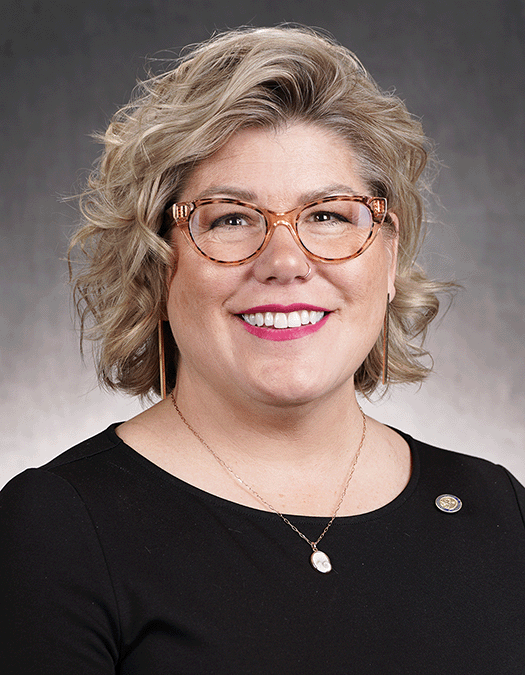
Rep. Dawn Gillman
Sponsored bills
Maddy summaryThis bill makes it a felony to force or coerce a pregnant minor under 18 into seeking or obtaining an abortion, defining coercion broadly to include threats, isolation, financial pressure, and exploiting vulnerabilities. It requires hospitals and other facilities to screen and report suspected cases of human trafficking involving minors. Additionally, the law adds wrongful death as a cause of action for deaths resulting from abortions and mandates the creation of specific rules by the state health commissioner.
Maddy summaryHF 482 establishes "Choose Life" special license plates for Minnesota motor vehicle owners. To obtain these plates, applicants must pay a $25 initial fee and $25 annual contribution to a dedicated "Choose Life account," in addition to standard registration fees. Funds collected are deposited into this account and distributed by Choose Life Minnesota, Inc., to non-profit agencies within each county that assist pregnant women making adoption plans - excluding any agencies involved in abortion services or charging fees for services. The bill also specifies plate design requirements (featuring the "Choose Life" logo and inscription) and limits administrative costs for the program to 15% of funds. The program becomes effective January 1, 2026.
Maddy summaryThis bill would allow nursing homes and assisted living facilities in Minnesota to permit residents to consume and display alcoholic beverages under specific conditions. The changes require that alcohol be consumed only by residents during resident-focused activities, with no one under 21 allowed to drink and all staff serving alcohol being at least 18 years old. Additionally, the bill prohibits selling alcohol or treating it as part of a commercial transaction within these facilities. The legislation directly affects nursing home operators, assisted living facility managers, and the residents who live in these care settings.
Maddy summaryHF 3767 allocates $35 million in state bond proceeds to fund Minnesota town roads and bridges, with $25 million specifically for road improvements and $10 million for bridge projects. The bill authorizes the state to issue bonds up to $35 million to cover this funding, which will be distributed by the commissioner of transportation under existing state law. This provides direct financial support for local infrastructure maintenance and upgrades across Minnesota towns. The funding mechanism is procedural, focusing on capital investment rather than changing eligibility or eligibility rules.
Maddy summaryThis bill establishes the SAVE Minnesota Act, which requires voters to present a specific photo identification card to register to vote and to cast their ballots. To obtain this new voter identification card, applicants must provide proof of their U.S. citizenship and may receive certain vital records, such as birth certificates, without a fee. The legislation also creates a new voter identification card program, modifies existing driver's license requirements, and sets up a process for handling provisional ballots. Additionally, the bill includes funding provisions to support the administration of these new election procedures and establishes a children's trust fund.
Maddy summaryThis bill updates the wage calculation framework for staff working in family residential services in Minnesota, directly affecting service providers and employees in this sector. It establishes specific formulas for determining base wages for various staff roles, such as supervisors, nurses, and direct care workers, by tying their pay to median wages for comparable occupations. The legislation also introduces a temporary lower wage rate for asleep-overnight staff that applies until 2027 or federal approval, while other staff categories receive wage calculations based on weighted percentages of median wages for related job classifications.
Maddy summaryThis bill modifies Minnesota's African American Family Preservation and Child Welfare Disproportionality Act to strengthen protections for children of color in the child welfare system. It requires social services agencies to make "active efforts" rather than just "reasonable efforts" to keep African American and disproportionately represented children in their homes, reunify them with families, and involve families in all service decisions. The law mandates that agencies consider cultural and social values when providing services, ensures community members from communities of color serve as court advocates, and requires ombudspersons to monitor compliance with these new standards. Additionally, the bill expands placement options to include relatives and community members before removing children from their homes.
Maddy summaryThis bill modifies Minnesota's existing African American Family Preservation and Child Welfare Disproportionality Act to require more detailed data collection and reporting on child welfare cases involving African American and other disproportionately represented children. It mandates that the commissioner of children, youth, and families conduct annual reviews of child welfare cases, collecting specific data on maltreatment reports, service access, removals, reunifications, and permanency outcomes broken down by race. The bill also requires agencies to identify barriers to family reunification and develop remediation plans with measurable goals when disparities are found in child welfare outcomes. Additionally, the legislation appropriates funding to support staffing and service provision for implementing these requirements, with the first report due by October 1, 2031.
Maddy summaryThis bill amends Minnesota's gross receipts tax law to explicitly include hospitals and health care providers as taxable entities while excluding licensed chiropractors from the list of providers subject to the tax. The legislation defines "health care provider" to include various medical service providers such as doctors, dental professionals, and ambulance services, while listing specific exclusions like pharmacies, nursing homes, and home health agencies. A new provision adds licensed chiropractors to the list of excluded providers, clarifying that they will not be required to pay the gross receipts tax on their services. The changes will take effect for gross revenues received after December 31, 2026, and apply to the state's existing gross receipts tax framework.