

Maddy summaryHF 2150 requires tire collectors who need a permit in Minnesota to maintain a $150,000 surety bond with a state-authorized company. This bond must be continuous until canceled (with 30 days' written notice to the collector and commissioner) and ensures compliance with tire collection laws (sections 115A.90-115A.914). The bond protects citizens by covering potential damages if collectors fail to follow regulations, though collectors remain liable for damages exceeding the bond amount. It directly affects businesses collecting tires that require state permits.
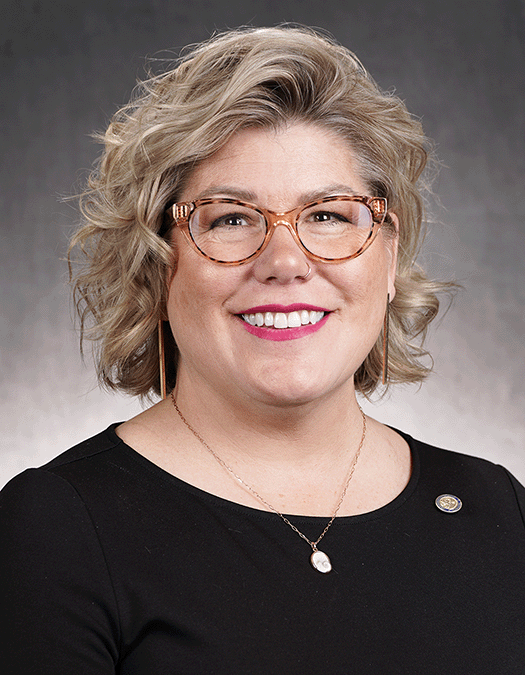
Rep. Dawn Gillman
Sponsored bills
Maddy summaryHF 11 delays the implementation of Minnesota's Paid Leave Law from 2026 to 2027, affecting employers, employees, and state agencies responsible for administering the program. The bill amends multiple statute sections to adjust key dates, including the start of employer premium payments (now January 1, 2027) and administrative requirements like public outreach and annual reporting. This one-year delay provides additional time for businesses to prepare for the new paid leave program without changing the law's core requirements. The law's substance - such as premium rates and fund management - remains unchanged, only the rollout timeline is extended.
Maddy summaryHF 3 requires Minnesota's legislative auditor to annually report to the legislature by February 1 on whether state agencies have implemented audit recommendations from the prior five years. The bill mandates that agencies' commissioners must also submit detailed reports by September 1 each year, specifically itemizing unaddressed recommendations and explaining why they weren't implemented. This directly affects all state agencies subject to legislative auditor reviews and their commissioners, who must now document progress on audit findings. The law creates a structured process for tracking accountability without altering agency funding or creating new programs.
Maddy summaryHF 1968 appropriates $419,000 from state bonds to connect Dassel-Cokato Middle and High School to Cokato's municipal water system. The funds will cover designing, building, and equipping a new water main extension from Cokato's existing system to the school campus. This directly affects the school's water supply, ensuring safe drinking water and improving fire suppression capabilities. The bill authorizes the state to issue bonds up to $419,000 to cover these infrastructure costs.
Maddy summaryHF 89 amends Minnesota Statutes section 147A.02 to modify requirements for physician assistant collaborative agreements. Currently, the law requires physician assistants to complete 2,080 hours of practice under a collaborative agreement in a hospital or integrated clinical setting, with specific conditions like shared patient care experience between the PA and collaborating physician. This bill changes those requirements, though the exact modifications are not detailed in the provided text. The bill directly affects physician assistants and the physicians they collaborate with in Minnesota.
Maddy summaryHF 22, titled "Parent's Bill of Rights," establishes specific rights for parents of minor children (under 18) in Minnesota. It requires schools and healthcare institutions to respect parental authority over education, access to school/medical records, moral/religious training, and consent for medical procedures or recordings of minors. The bill prohibits employees from coercing children to withhold information from parents or discriminating against parents who exercise these rights. It explicitly states these rights do not override child abuse laws or court orders, and does not limit other existing parental rights. This bill directly affects parents, schools, and healthcare providers serving minors.
Maddy summaryHF 10 prohibits Minnesota state-funded financial assistance, including health coverage and college scholarships, for undocumented noncitizens. The bill explicitly excludes undocumented noncitizens (defined as those residing without U.S. Citizenship and Immigration Services approval) from MinnesotaCare (state health insurance) and the North Star Promise scholarship program. It amends state statutes to require that these programs deny eligibility to individuals without lawful immigration status. The policy change takes effect upon final enactment, with scholarship eligibility applying to awards beginning in the 2025-2026 academic year.
Maddy summaryHF 17 amends Minnesota's handgun permit law to create lifetime permits for carrying concealed handguns, replacing the previous temporary permits. It also reduces the application fee for these permits, capping it at $100 or the actual processing cost (whichever is lower), with $10 of each fee deposited into the general fund. The bill maintains existing requirements, including proof of firearm safety training (via certified courses or peace officer employment) and in-person application submissions with specific documents like training certificates and photo ID. This directly affects Minnesotans seeking or renewing concealed carry permits, streamlining the process by eliminating renewal fees and duration limits.
Maddy summaryThis bill modifies Minnesota's renewable energy standards by expanding which hydroelectric projects count toward clean energy goals (including facilities over 100 megawatts if operating since 2023). It allows electric utilities to request delays in meeting renewable, solar, or carbon-free energy requirements if the commission determines it serves the public interest, considering factors like cost impacts and system reliability. The bill also expands sales tax exemptions for residential heating fuels and electricity, and prohibits demolition of fossil-fuel power plants under specific conditions. Additional provisions include supporting carbon capture technology and removing barriers to new nuclear power plants.
Maddy summaryHF 1806 requires Minnesota health insurance plans to cover nonopioid prescription drugs and non-drug pain treatments, such as physical therapy, as alternatives to opioids. Specifically, plans must cover at least two FDA-approved nonopioid drugs (not controlled substances) and three nonpharmacologic modalities, while prohibiting preferential coverage for opioids or stricter rules for nonopioid options than for opioids. This affects all health plans operating in Minnesota, including those offered to individuals and employers, with requirements effective January 1, 2026. Plans must also provide annual educational materials about these covered options to both healthcare providers and enrollees.