

Maddy summaryHF 1590 establishes mandatory minimum prison sentences for individuals who maliciously punish children, specifically targeting cases involving severe physical injury. It affects parents, legal guardians, or caretakers who cause substantial or great bodily harm to children, with penalties increasing based on the child's age (under 4) and the injury's severity. For example, causing head/neck injuries to a child under 4 mandates at least one year in prison, while causing great bodily harm requires a minimum two-year sentence. The bill amends Minnesota Statute 609.377 and takes effect August 1, 2025.
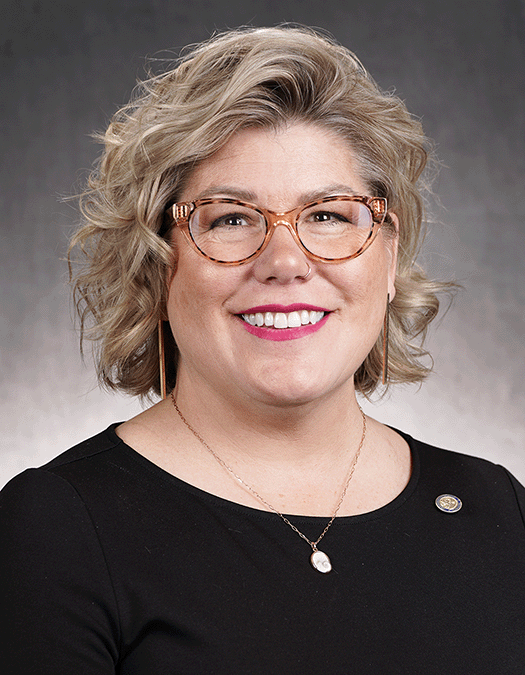
Rep. Dawn Gillman
Sponsored bills
Maddy summaryHF 1807 requires health insurance plans in Minnesota to treat nonopioid drugs approved by the FDA for pain treatment equally with opioids in their coverage. Specifically, it prohibits insurers from designating nonopioid pain drugs as "nonpreferred" when opioids are preferred or imposing stricter requirements (like prior authorization) on nonopioid drugs than on opioids. This applies immediately upon FDA approval of a nonopioid drug for pain management. The bill directly affects health insurance plans managing drug formularies and ensures patients seeking pain treatment have equal access to nonopioid options without unnecessary barriers.
Maddy summaryHF 1359 increases funding for solid waste management by changing how fees collected from waste management are allocated. Starting in 2026, 7% of these fees will go to a resource management account (rising to 20% in 2027 and 30% after 2028), instead of the general fund. The funds must be distributed to counties for waste management programs under state law. This directly affects counties receiving these allocations and changes the percentage of fees dedicated to environmental resource management over time. The bill takes effect July 1, 2025.
Maddy summaryHF 981 appropriates $500,000 for fiscal year 2026 and $500,000 for fiscal year 2027 from the general fund to the Minnesota Commissioner of Health. This funding is directed to the nonprofit organization "Change the Outcome" to implement opioid prevention and education programs. The bill requires these programs to provide data-driven school and community education on opioid dangers, prevention strategies, overdose recognition, emerging drug trends (like fentanyl and xylazine), and access to substance use disorder support resources. The primary beneficiaries are Minnesota middle and high school students, communities, and individuals struggling with substance use disorders.
Maddy summaryHF 1422 appropriates $5 million from state bonds to fund the construction, equipment, and furnishings of a community recreation facility for the Dassel-Cokato School District (Independent School District No. 466). The facility will include a walking track, field house, ice rink, gymnastics space, and community center. The state will issue bonds up to $5 million to provide the funding, with the money directed to the district through the commissioner of education. This bill directly affects the Dassel-Cokato community by enabling the development of new public recreational infrastructure.
Maddy summaryHF 98 modifies supervision and training rules for mental health professionals in Minnesota. It requires case managers with less experience to complete 40 hours of approved training and receive 38 hours of annual supervision (including monthly clinical sessions), while case management associates must meet specific education or experience criteria and complete 40 hours of preservice training. The bill also exempts intensive residential mental health treatment providers from certain client rights requirements and updates critical incident reporting timelines for residential programs. These changes directly affect mental health service providers, case managers, behavioral aides, and residential treatment facilities.
Maddy summaryThis bill expands Minnesota's sales tax exemption to include additional baby products, directly affecting parents and caregivers who purchase these items. It adds baby wipes, cribs and bassinets (including mattresses and sheets), changing tables and pads, strollers, car seats and bases, baby swings, bottle sterilizers, and infant eating utensils to the list of tax-exempt items. The exemption applies to sales and purchases made after June 30, 2025. This change removes sales tax from these specific baby products, aligning with the existing exemption for items like breast pumps and baby bottles.
Maddy summaryHF 1476 appropriates $1.65 million from state bond proceeds to fund the rehabilitation of the Salisbury Bridge in Meeker County. This bill directly affects Kingston Township, Forest City Township, or both, by providing grants for designing and constructing the bridge work. The key mechanism involves authorizing the state to issue up to $1.65 million in bonds, following standard state bond procedures, to cover these costs. The funding is specifically for the bridge's rehabilitation, not for other projects.
Maddy summaryHF 1423 amends Minnesota Statutes section 273.124, subdivision 8, to increase the maximum number of shareholders, members, or partners allowed for certain agricultural entities to qualify for homestead property tax treatment from 12 to 18. This change directly affects family farm corporations, joint farm ventures, limited liability companies (LLCs), and partnerships operating farms, allowing them to have up to 18 qualifying members while still qualifying for class 1b or class 2a property tax classifications. The bill does not alter tax rates but expands eligibility for existing homestead tax benefits by raising the shareholder cap. It takes effect for homestead applications filed in 2025 and later.
Maddy summaryHF 946 allows approved third-party programs (such as driving schools) to conduct the behind-the-wheel road test for class D driver's licenses (standard driver's licenses) in Minnesota. It establishes requirements for these programs and testers, mandates regular audits of third-party programs, and permits applicants to appeal decisions made by the Commissioner of Public Safety. The bill also updates website rules to show real-time appointment availability, display next available dates/times by location, and allow address-based searches without requiring personal information. This directly affects driver's license applicants and third-party testing programs seeking to administer road tests.