

Maddy summaryHF 1421 prohibits state or local governments from closing or restricting operating hours of gun ranges during a declared state of emergency, unless the same closure applies equally to all businesses. This bill directly affects gun range businesses and their operators by preventing emergency-related shutdowns that would not apply to other commercial establishments. The key provision (amending Minnesota Statutes § 624.7192, subd. (c)(4)) explicitly states that no governmental entity may close ranges "unless such closing or limitation of hours applies equally to all forms of commerce." The law applies only during emergencies proclaimed by the governor related to public disorder or disaster, ensuring gun ranges maintain operational continuity under emergency conditions.
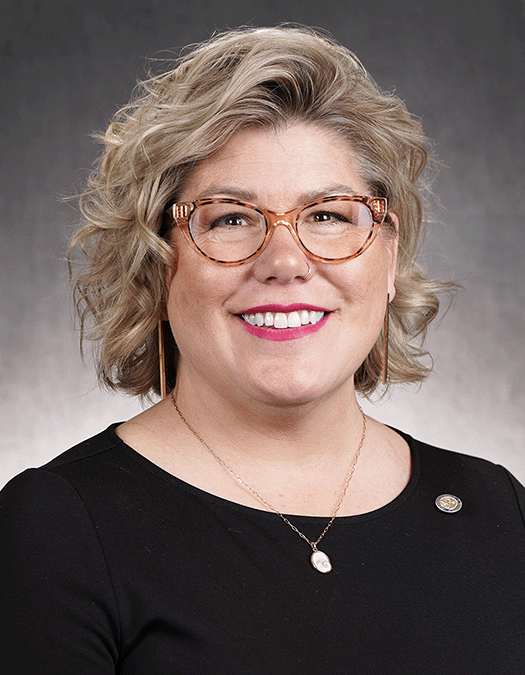
Rep. Dawn Gillman
Sponsored bills
Maddy summaryHF 2 requires state agency employees to immediately report suspected fraud to law enforcement and legislative committee leaders when they have reason to believe fraud exists in agency programs. It mandates that all state agencies post current organizational charts online with contact details for leadership and division heads. The bill strengthens grant management by requiring agencies to conduct unannounced monitoring visits before final payments for grants over $50,000 (and annually for grants over $250,000), perform financial reconciliations prior to disbursement, and withhold funds from grantees failing to submit required progress reports. Violating these grant management requirements constitutes a misdemeanor under the bill.
Maddy summaryHF 14 proposed a temporary moratorium on most light rail transit project development spending by the Metropolitan Council in seven Minnesota counties (Anoka, Carver, Dakota, Hennepin, Ramsey, Scott, and Washington). The bill prohibited funds for planning, design, environmental analysis, land acquisition, and construction of new light rail projects, but exempted the Southwest Light Rail (Green Line Extension) and prior contractor payments. The moratorium would have expired once the Green Line Extension began revenue operations. The bill was introduced, amended, and ultimately not passed by the legislature.
Maddy summaryHF 499 extends the validity period for temporary nursing permits in Minnesota from 60 to 90 days. It directly affects nurses applying for licensure by endorsement (from another state) or reregistration after completing a refresher course, who currently hold temporary permits. The bill amends Minnesota Statutes section 148.212 by changing the permit duration in two specific scenarios: (1) for out-of-state licensed nurses awaiting board action, and (2) for nurses in structured refresher programs. This change provides a longer grace period for these applicants to secure full licensure without interruption. The bill makes a specific, concrete change to permit timelines with no additional provisions.
Maddy summaryThis bill appropriates $3.5 million from Minnesota's clean water fund for Phase 2 of lake restoration in Hutchinson. The funds will go directly to the city of Hutchinson to finance capital improvements at Otter Lake, Campbell Lake, and the south fork of the Crow River, including predesign, engineering, construction, and a forebay installation. The project aims to improve water quality by addressing tributaries and lake systems. This is a funding authorization with no new regulatory requirements, solely providing state financial support for existing restoration work.
Maddy summaryHF 941 appropriates $8,268,000 in state bond funds to upgrade Ridgewater College's Hutchinson campus. The money will specifically fund renovations and new facilities for electrician, automation, nursing, allied health, and early childhood education programs, plus general classrooms and student services. The funds are sourced through state bond sales authorized under Minnesota law, with the Minnesota State Colleges and Universities Board of Trustees managing the projects. This directly affects Ridgewater College students and staff by improving facilities for these academic programs.
Maddy summaryThis bill appropriates $9.5 million from state bond proceeds to fund infrastructure improvements in Silver Lake, Minnesota. It directly affects the city of Silver Lake and its residents by providing funds for predesign, construction, and equipment of stormwater, wastewater, and drinking water systems. The key mechanism involves authorizing the state to issue bonds up to $9.5 million, with the money used to upgrade wastewater ponds, storm sewers, sanitary sewers, and water main distribution systems to improve water quality, flow, fire protection, and accountability. The funding covers specific infrastructure replacements and improvements outlined in the bill text.
Maddy summaryThis bill defines "animal feedlot" in Minnesota law. It specifies that an animal feedlot is a confined area (either designed for manure accumulation or with animal density preventing vegetation) used for raising or holding animals. The definition explicitly excludes pastures and small poultry operations (12 or fewer chickens). This is a procedural definition change with no new regulations or requirements.
Maddy summaryHF 1043 appropriates $10.5 million from state bond proceeds to fund capital improvements at Wright Technical Center in Buffalo, Minnesota. The funds will cover predesign, construction, renovation, and equipment for mechanical, electrical, security systems, utility infrastructure, and site upgrades at the center and its affiliated facilities. The state will issue up to $10.5 million in bonds to provide this funding, following standard state bond procedures. This bill directly affects Wright Technical Center's physical infrastructure and operations.
Maddy summaryHF 728 modifies Minnesota's rules for providing out-of-home respite care services for children in unlicensed residential settings. It allows licensed providers to offer this care in homes that aren't licensed for such services, but only if they meet strict requirements: background checks for all household members, annual assessments of the home's suitability by a case manager, annual authorization from a child's legal representative, and limits on the number of children (max four, with siblings allowed to share a room) and service duration (max 46 days per year). These rules do not apply to children in foster care under chapters 260C or 260D. The bill requires providers to maintain detailed documentation of all assessments and authorizations, effective January 1, 2026.