

Maddy summaryHF 2518 appropriates $8 million from the general fund for WomenVenture to support two specific groups: child care providers (through business training, shared services, and startup materials) and women food entrepreneurs (through business expansion, technical assistance, and supply chain development). The funds can be used for leasehold improvements, equipment, working capital, and other eligible business expenses, with up to 5% allocated for WomenVenture's administrative costs. By December 15, 2028, WomenVenture must report to the legislature on how the funds were distributed, including the number of entrepreneurs assisted, county breakdowns, and details on loans versus grants. This is a one-time appropriation available until June 30, 2028.
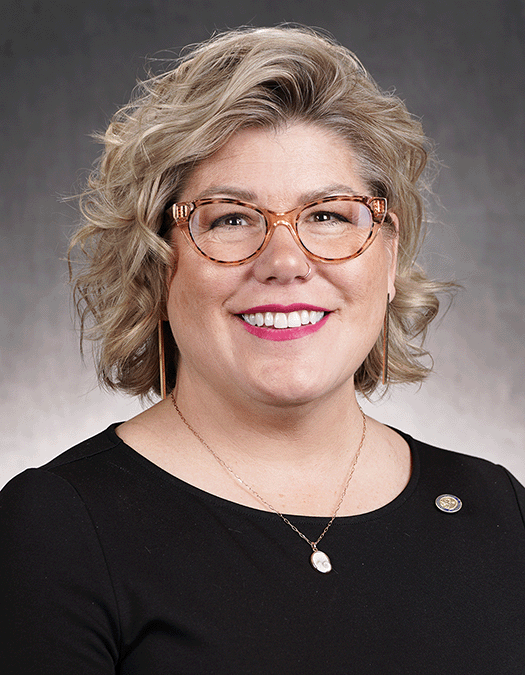
Rep. Dawn Gillman
Sponsored bills
Maddy summaryThis bill modifies Minnesota law to clarify and limit optometrists' authority to prescribe or administer certain drugs. It specifically sets new time limits: oral antivirals may not be prescribed for more than 10 days, oral steroids for more than 14 days (requiring physician consultation), and oral carbonic anhydrase inhibitors for more than seven days. These changes apply directly to licensed optometrists in Minnesota who prescribe medications for eye conditions under the Board of Optometry's rules. The bill maintains existing restrictions on intravenous injections, invasive surgery, and Schedule II/III oral drugs.
Maddy summaryHF 1934 modifies how dental services are administered for MinnesotaCare and medical assistance recipients. It changes the start date for a new dental administrator contract from 2026 to 2030, requires the dental administrator to meet a 55% annual dental visit rate for continuously enrolled members by 2032, and establishes a task force to assess impacts on critical access dental providers. The task force must evaluate financial effects on providers, access to care, and disruptions to integrated medical-dental services. This bill directly affects dental administrators, critical access dental providers, and patients enrolled in MinnesotaCare or medical assistance programs.
Maddy summaryHF 1379 creates a formal "nonopioid directive" process in Minnesota, allowing patients (or their health care agents) to submit written instructions stating they must not receive opioids from health professionals or prescribers. Health care providers must include these directives in patient records and follow them, except in emergency hospital settings where a prescriber deems opioid use medically necessary. The bill also grants legal immunity to health professionals, facilities, and emergency medical services providers who comply with these directives in good faith. The Minnesota Department of Health will develop a standard form for these directives and post it online. This directly affects patients seeking opioid avoidance and all healthcare providers interacting with patient records.
Maddy summaryHF 918 appropriates $3.75 million from state bond proceeds to fund a sewer separation project in Litchfield, Minnesota. The funds will be provided to the city through the Public Facilities Authority to design, construct, and equip infrastructure that isolates industrial process water from sanitary sewage at the city's sewer connection point and expands its wastewater treatment facility. The bill authorizes the state to issue up to $3.75 million in bonds under Minnesota Statutes to cover this appropriation. The project directly affects the city of Litchfield by enabling upgrades to its wastewater infrastructure. The measure becomes effective upon final enactment.
Maddy summaryHF 2548 creates the Outdoor School for All grant program to fund immersive, multiday outdoor educational experiences for Minnesota students in grades 4-8. The program provides grants to accredited overnight outdoor schools and nonprofit learning centers meeting specific criteria, including research-based curricula, integration with school standards, skill development (like leadership and critical thinking), and accessibility for underserved students. It appropriates $2.5 million for fiscal years 2026 and 2027 from the general fund. The bill directly affects public school students and providers offering equitable outdoor education, aiming to address declining outdoor engagement and access disparities.
Maddy summaryThis bill appropriates $10 million from the general fund to the Public Facilities Authority for a grant to the First District Association (a Litchfield dairy cooperative). The funds will directly support designing, constructing, and equipping a new wastewater industrial pretreatment facility in Litchfield. The bill specifically targets this facility project, building on prior funding for the same purpose, and becomes effective upon enactment. It does not alter existing regulations or affect broader public policy beyond this specific infrastructure project.
Maddy summaryHF 944 amends Minnesota's trespass law to allow landowners to use purple paint markings as a legal alternative to traditional "no trespassing" signs for restricting outdoor recreation on their property. The bill specifies that purple markings must be vertical lines (at least 8 inches long, 1 inch wide) placed 3-5 feet from the ground, spaced no more than 100 feet apart on forest land or 1,000 feet apart elsewhere. This directly affects landowners seeking to manage recreational access and users who might enter marked areas without permission. The change provides a standardized, visible method for landowners to communicate trespass restrictions without requiring physical signs.
Maddy summaryHF 1120 establishes Minnesota's "Keep it Clean" program to prevent water pollution from garbage and human waste left on ice during winter activities on state waters. The bill directly affects local governments and nonprofit organizations by creating a grant program to fund projects like installing winter-ready waste stations, providing seasonal waste disposal services, increasing winter patrols, and running education campaigns. Key provisions include funding for infrastructure (e.g., dumping stations), enforcement support, and community outreach to promote responsible winter use. The bill appropriates state funds for the program's administration and grants, with at least a portion dedicated to local projects.
Maddy summaryHF 1903 modifies Minnesota's "Safe Place for Newborns" law to clarify and expand where newborns can be safely left anonymously. The bill specifically adds detailed requirements for approved "newborn safety devices" (like secure boxes in hospitals or fire stations), including FDA approval, monthly alarm testing, and 24-hour staffing visibility. It also strengthens protections by stating safe places (hospitals, fire stations, or devices) cannot ask for the parent's identity, call police, or report the parent to authorities if the infant is unharmed. The law grants immunity from criminal or civil liability to staff who follow these procedures in good faith, including those who are mandated reporters under child welfare laws.