

Maddy summaryHB 4213 eliminates restrictions on concealed carry in specific locations by removing existing prohibitions from Michigan's concealed carry law. The bill removes restrictions that previously barred licensed concealed pistol permit holders from carrying in places like schools (with a parent drop-off/pick-up exception), child care centers, sports arenas, bars/taverns, places of worship, large entertainment venues (2,500+ seats), hospitals, and college dorms/classrooms. Licensed permit holders would no longer be prohibited from carrying concealed weapons in these locations under this amendment. The bill does not change security requirements for venues that choose to prohibit concealed carry (e.g., metal detectors).
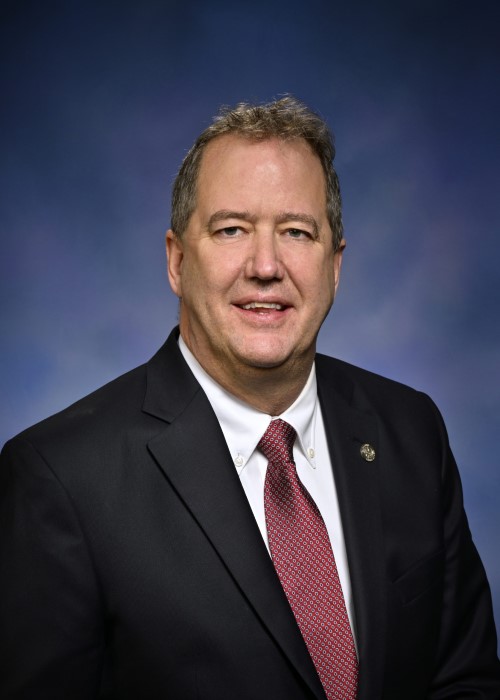
Rep. Cam Cavitt
Sponsored bills
Maddy summaryHB 4199 allocates $6.7 million from the general fund for public and nonpublic schools to implement mobile panic alert systems, as required by existing law (MCL 380.1308c). The funds are designated as a "work project" for the 2024-2025 fiscal year, with unspent amounts carried forward to 2025-2026. Schools must complete installation of these systems by September 30, 2027. The bill directly affects all schools covered by Michigan's revised school code, providing dedicated funding for emergency alert infrastructure.
Maddy summaryHB 4176 amends Michigan's Natural Resources and Environmental Protection Act (MCL 324.73102) to allow property owners to use purple paint marks as a legal alternative to posted signs for marking "no trespassing" areas. Specifically, it requires purple paint marks to be vertical lines 8 inches long, placed 3-5 feet high on trees or posts, spaced no more than 100 feet apart, and visible from all approaches. This change directly affects property owners who can now use this method to legally prohibit recreational activities or trapping on their land without physical signs. The bill does not alter existing exceptions for farm property, fishing, or retrieving lost dogs, and it requires companion bill HB 4177 to also pass for full implementation.
Maddy summaryHB 4177 amends Michigan's Natural Resources and Environmental Protection Act to strengthen rules about purple paint marks used to indicate no-trespassing areas for recreation. It prohibits removing, defacing, or destroying existing purple paint marks (Sec. 73104) and bans placing new marks on others' property without written permission from the owner, lessee, or agent (Sec. 73105). The bill directly affects property owners, recreational users (like hunters or anglers), and land managers who use these marks to restrict access. It creates a clear legal requirement for written authorization before marking private property, ensuring property rights are respected during recreational activities.
Maddy summaryHB 4188 amends Michigan's Vehicle Code to clarify that operating a vehicle "in a careless or negligent manner likely to endanger any person or property, but without wantonness or recklessness" would be classified as a civil infraction. This change directly affects drivers whose behavior meets this specific standard - non-reckless, careless driving - by treating it as a civil matter rather than a criminal offense. The bill modifies Section 626b of the Michigan Vehicle Code (MCL 257.626b) to explicitly exclude cases involving "wantonness or recklessness," which would remain subject to more severe penalties. The amendment is procedural and aims to refine the legal definition of the infraction. The bill was introduced on March 6, 2025, and referred to the Judiciary Committee.
Maddy summaryHB 4190 prohibits physicians in Michigan from performing gender reassignment surgery on minors or prescribing cross-sex hormones or puberty-blocking drugs with the intent of assisting gender transition. The bill directly affects minors under 18 seeking gender-affirming medical care, including hormone therapy or puberty suppression. Exceptions apply only to minors already receiving such treatment before the law's effective date, if the physician documented that stopping treatment would cause harm. The law defines key terms like "gender reassignment surgery" (including genital and non-genital procedures) and "puberty-blocking drugs" to clarify the scope of the prohibition.
Maddy summaryHR 37 is a symbolic resolution passed by the Michigan House of Representatives to officially recognize March 2025 as Women’s History Month within the state. It does not create new laws or policies but formally declares the month to honor women’s historical contributions to Michigan and the nation. The resolution encourages community participation in events celebrating women’s achievements in fields like science, politics, and education. It directly affects Michigan residents by promoting statewide awareness and reflection on women’s roles in society, without imposing any legal requirements or funding changes.
Maddy summaryThis resolution urges Congress to freeze the Adverse Effect Wage Rate (AEWR) for H-2A agricultural workers at the 2023 level ($15.10/hour) through 2025. It directly affects Michigan farmers who rely on the H-2A program, as the current 2025 AEWR in Michigan is $18.15/hour - a 34% increase since 2019. The resolution seeks to prevent further wage hikes for temporary farm workers, aiming to reduce rising labor costs amid broader farm expense increases. It does not change existing law but calls on Congress to pass legislation implementing this freeze.
Maddy summaryHB 4138 amends Michigan's civil procedure code to remove references to the Extreme Risk Protection Order (ERPO) Act, which was repealed. It specifically revises Sections 1908, 2529, and 2559 of the Revised Judicature Act (1961 PA 236) to eliminate exemptions and provisions that previously applied to ERPO-related cases. This change affects court procedures for service of process and filing fees, ensuring the code no longer includes outdated references to the repealed ERPO law. The bill makes no new policy changes to fees or procedures - only aligns the civil code with the ERPO repeal.
Maddy summaryHB 4139 removes references to "extreme risk protection orders" from Michigan's firearm licensing requirements. Specifically, it amends sections of the state's firearms law (MCL 28.422, 28.422b, 28.425b, and 28.428) by deleting the provision that previously required applicants to disclose if they were subject to such orders. This change directly affects individuals applying for firearm licenses, as they will no longer need to certify whether they are under an extreme risk protection order. The bill does not repeal extreme risk protection orders themselves but modifies the licensing process to exclude this specific requirement. The change reflects the repeal of the Extreme Risk Protection Order Act as noted in the bill's title.