

Maddy summarySB 39 establishes a workgroup to develop a sustainable reimbursement rate methodology for Maryland's Certified Community Behavioral Health Clinics (CCBHCs) and Outpatient Mental Health Centers (OMHCs), directly affecting behavioral health providers facing financial strain due to outdated rates. The bill requires the Maryland Department of Health to conduct a cost study of OMHC services, form an advisory panel to review rate recommendations, and increase Medicaid reimbursement rates for OMHCs in fiscal years 2026 and 2027. Key provisions include evaluating provider costs, workforce needs, and alignment with somatic health care parity, while addressing closures like those in Frederick County. The workgroup must report findings by December 2027, aiming to stabilize provider finances and ensure continued access to community mental health care.
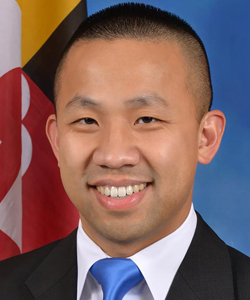
Sen. Clarence Lam
Sponsored bills
Maddy summarySB 417 (Maryland Worker Freedom Act) prohibits most private employers from firing, disciplining, or refusing to hire employees who decline to attend or participate in employer-sponsored meetings about religious or political matters. The bill requires employers to notify workers about these protections and allows employees to file complaints with the Maryland Commissioner of Labor and Industry within 180 days of a violation. If violations are found, the Commissioner may impose civil penalties up to $10,000 for first offenses or $25,000 for repeat violations, and issue cease-and-desist orders. Exemptions include religious organizations, political groups, schools, government entities, and mandatory compliance training.
Maddy summarySB 326 expands the authority of physician assistants (PAs) in Maryland by allowing them to perform specific healthcare actions currently restricted to physicians. The bill directly affects PAs, patients requiring guardianship, inmates needing infirmary care, and mental health facilities by adding PAs to certification requirements for treatment incapacity (Section 5-606), guardianship petitions (Section 13-705), and inmate infirmary admissions (Section 9-601.1). It also requires the Maryland Department of Health to cover PA examinations for emergency evaluations and adds PAs to the Statewide Advisory Commission on Immunization. These changes aim to align PA practice with other licensed healthcare professionals in defined clinical scenarios.
Maddy summaryThis bill expands Maryland's child abuse reporting requirements by explicitly including female genital mutilation in the legal definition of abuse, which directly affects healthcare providers, educators, and other mandated reporters. It mandates that these professionals report suspected cases of female genital mutilation to authorities and increases penalties for violations while allowing individuals subjected to the procedure to file civil lawsuits for relief. The legislation also requires the Maryland Department of Health to create and distribute educational materials about female genital mutilation in partnership with various public and private organizations. Additionally, the bill authorizes health licensing boards to revoke licenses of individuals who commit violations related to female genital mutilation under specific circumstances.
Maddy summarySB 54 prohibits the State Board of Veterinary Medical Examiners from disciplining veterinarians who discuss or recommend cannabis or CBD products for therapeutic or health purposes in animal care. It amends Maryland law (specifically Section 2-310 of the Agriculture Article) to explicitly block license suspensions, revocations, reprimands, or probation solely for this type of professional communication. The bill directly affects licensed veterinarians in Maryland, protecting their ability to discuss these options with pet owners. It takes effect October 1, 2026, and does not change other disciplinary grounds like malpractice or criminal convictions.
Maddy summarySB 385 (The Vax Act) requires Maryland’s Secretary of Health to issue evidence-based recommendations for immunizations, screenings, and preventive services, aligning with guidance from major medical organizations like the CDC and U.S. Preventive Services Task Force. It expands pharmacists’ authority to administer vaccines (including those recommended by CDC or the Secretary) to patients aged 3+ after completing specific training and certification, while mandating health insurers to cover these services without cost-sharing. The bill also repeals outdated pertussis-related provisions and updates reporting requirements for pharmacists. This directly affects pharmacists, health insurers, and patients seeking preventive care, aiming to improve access to vaccinations and screenings.
Maddy summarySB 7 repeals the expiration date for the Douglas J. J. Peters Veterans of the Afghanistan and Iraq Conflicts Scholarship, removing the June 30, 2030 cutoff that previously prevented new awards after that date. This change allows the scholarship to be awarded indefinitely to eligible veterans, active service members, or their dependents who meet Maryland residency and educational requirements. The bill also removes restrictions on renewing scholarships for recipients who received their initial award before 2030. The scholarship covers up to 50% of tuition, fees, and room/board at Maryland public universities, requiring a 2.5 GPA and 5 years of full-time study. It takes effect July 1, 2026.
Maddy summarySB 790, the Public Health Reform Act, requires the Maryland Department of Health to organize the Maryland Medical Reserve Corps - a statewide volunteer network for emergencies like disease outbreaks or disasters. It allows county health directors to hire staff without state approval if positions are fully funded locally and to enter contracts if the state fails to respond within a set timeframe. The bill creates the Public Health Workforce Development Fund (using interest earnings and transfers from another fund) to support workforce training, and mandates health equity impact assessments for new legislation. These changes directly affect county health departments, state health agencies, and public health emergency response systems.
Maddy summarySB 504 prohibits businesses from selling consumer personal data to buyers who intend to use it for immigration enforcement. It defines "sensitive data" to include immigration status, racial origin, health information, and sexual orientation, requiring businesses to handle such data more carefully. The bill also mandates public record custodians to prevent unauthorized disclosure - especially for immigration enforcement - and requires message switching systems to implement access controls. These changes aim to strengthen privacy protections for Maryland residents while modifying existing data privacy laws in the state code.
Maddy summarySB 626 (Birth Certificate Modernization Act) updates Maryland law to simplify changing sex designation on birth certificates and identification documents. It removes the prior requirement for medical documentation (such as surgery or hormone treatment) to update a birth certificate, instead allowing a written request under penalty of perjury. The bill also expands options for sex designation on driver's licenses, ID cards, and moped permits beyond male/female. It specifically includes intersex conditions as a valid basis for changing sex designation on records, while maintaining court orders as an alternative path. This directly affects individuals seeking to update their sex designation on official state-issued documents.