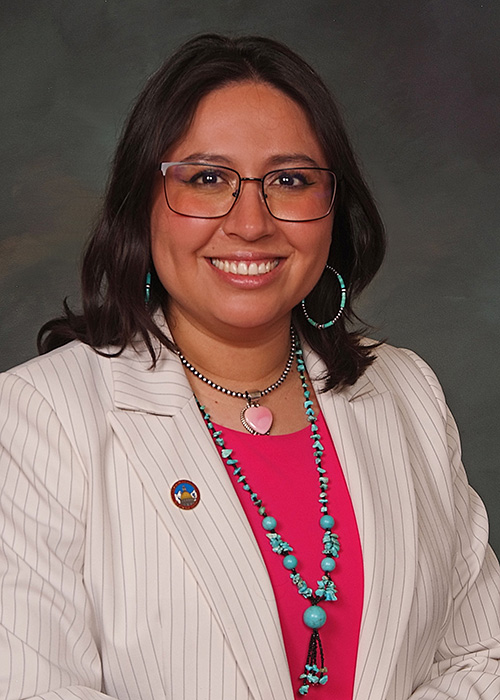
Photo of Elizabeth Velasco
D Colorado House · District 57 On the 2026 ballot

Rep. Elizabeth Velasco

Compare
Total votes
3,785
all sessions
Attendance
97%
104 missed
Near the chamber average
With party
97%
of cast votes
Higher than 75% of chamber peers
Bipartisan score
2%
crosses aisle rarely
Near the chamber average
Sponsored
318
bills & resolutions
Near the chamber average
Committees
6
assignments
318 bills and resolutions

Sponsored bills

Total
318
Primary
114
Co-sponsor
204
This page
318
matching current filters
Co-sponsor HJR 25-1025
Passed · Colorado House · Co-sponsor
Crime Victim Awareness Week

Maddy summaryHouse Joint Resolution 25-1025 is a commemorative resolution by the Colorado General Assembly. It officially recognizes the week of April 6-12, 2025, as National Crime Victims' Rights Week in Colorado. The resolution aims to honor crime victims and those who serve them, and encourages Colorado citizens to seek justice and show compassion for victims.

Passed Apr 24, 2025 1 co-sponsor
Co-sponsor HJR 25-1024
Passed · Colorado House · Co-sponsor
Sand Creek Massacre Memorial

Maddy summaryHouse Joint Resolution 25-1024 authorizes the installation of a memorial on the State Capitol Grounds to honor the victims of the Sand Creek Massacre of November 29, 1864. The bill designates the former location of the "Union Soldier" statue on the west grounds of the capitol as the appropriate site for this memorial. Its purpose is to respect and memorialize the Cheyenne and Arapaho people and their ancestors, promote cross-cultural understanding, and educate the public about the massacre.

Passed Apr 24, 2025 1 co-sponsor
Co-sponsor HJM 25-1001
Passed · Colorado House · Co-sponsor
Memorialize Former Representative Rodney Bockenfeld

Maddy summaryHouse Joint Memorial 25-1001 serves to memorialize former Representative Rodney Bockenfeld, who passed away on February 13, 2025, at the age of 69. The resolution pays tribute to his years of dedicated public service as both an Arapahoe County Commissioner and a State Representative and extends sympathy to his family.

Passed Apr 24, 2025 1 co-sponsor
Co-sponsor HJR 25-1022
Passed · Colorado House · Co-sponsor
Motorcycle Safety Awareness Month

Maddy summaryHouse Joint Resolution 25-1022 designates May 2025 as "Motorcycle Safety Awareness Month" in Colorado. This resolution, affecting motorcycle riders and all motorists, aims to promote safety through education and training and encourages motorists to "share the road."

Passed Apr 24, 2025 1 co-sponsor
Co-sponsor SB 25-129
Signed into law · Colorado Senate · Co-sponsor
Legally Protected Health-Care Activity Protections

The act clarifies that requirements for out-of-state telehealth providers do not alter or limit the rights and protections afforded to a person concerning a legally protected health-care activity. Current law requires a prescription drug label to include the name of the prescribing practitioner. At the practitioner's request, the act authorizes a prescription label for mifepristone, misoprostol, and the generic alternatives to those prescriptions to include only the name of the prescribing health-care practice instead of the name of the practitioner, provided the practitioner includes the name of the health-care practice on the paper or electronic form of the prescription. The act requires any person requesting a subpoena to affirm under penalty of perjury that the subpoena: Is not related to, and any information obtained will not be used in, any investigation or proceeding that seeks to impose civil or criminal liability or professional sanctions against a person or entity that engaged in or attempted or intended to engage in a legally protected health-care activity or that provided insurance coverage for gender-affirming health-care services or reproductive health care; or Is related to such an investigation or proceeding, but the investigation or proceeding is brought under tort law or contract law by the person who engaged in or attempted or intended to engage in a legally protected health-care activity, gender-affirming health-care services, or reproductive health care, and is actionable in an equivalent or similar manner under Colorado law. If a person or entity brings an out-of-state civil or criminal action, or attempts to enforce any order or judgment issued in connection with an action, against another person or entity for engaging in or attempting or intending to engage in a legally protected health-care activity or for providing insurance coverage for gender-affirming health-care services or reproductive health care, the person or entity subject to the out-of-state civil or criminal action has a private right of action against the person or entity and may institute a civil action in district court within 6 years after the date the out-of-state action is commenced or enforcement is attempted. Current law authorizes a private person to arrest a person without a warrant upon reasonable information that the person is charged in another state with a crime punishable by death or imprisonment for a term exceeding one year. The act creates an exception if the person is charged in another state for engaging in a legally protected health-care activity in Colorado. Current law prohibits a public agency from expending government resources or providing information or data in furtherance of any out-of-state investigation or proceeding seeking to impose civil or criminal liability or professional sanction upon a person or entity for engaging in a legally protected health-care activity. The act expands the prohibition to include public entities, which include state and local governments, and a person or entity licensed or regulated by the state. The act grants the attorney general the authority to enforce the provisions of the act. The act prohibits the department of public health and environment (CDPHE) from collecting a patient's name, date of birth, address, employer, spouse's name, or parent's or legal guardian's name, or the city or town where the termination of pregnancy occurred, as part of any required reporting of induced terminations of pregnancy. Reports of induced terminations of pregnancy collected by CDPHE must only be used for compilation of statistical reports, must not be incorporated into the official records of the office of the state registrar of vital statistics, and are confidential. The state registrar is required to dispose of any reports of induced terminations of pregnancy when all statistical processing of the reports is complete. A person who releases or discloses confidential information related to reporting of induced terminations of pregnancy commits a data privacy breach. (Note: This summary applies to this bill as enacted.)


Signed into law Apr 24, 2025 1 co-sponsor
Co-sponsor SB 25-183
Signed into law · Colorado Senate · Co-sponsor
Coverage for Pregnancy-Related Services

During the 2024 general election, Colorado voters approved Amendment 79, which: Repealed the state constitutional amendment prohibiting the use of public funds to pay for abortions; and Added a state constitutional amendment recognizing the right to an abortion and prohibiting Colorado state and local governments from denying, impeding, or discriminating against the exercise of that right, including prohibiting health insurance companies from excluding coverage for abortion. The act makes conforming changes to state law relating to abortion care as a result of Amendment 79. Current law requires the executive director of the department of health care policy and financing to authorize medicaid reimbursement for family-planning-related services. The act expands the definition of "family-planning-related services" to include abortion care. The act requires the medical services board to include abortion care in the schedule of health-care services available for pregnant persons enrolled in the children's basic health plan. $2,928,800 is appropriated to the department of health care policy and financing from the general fund for other medical services, including abortion care. (Note: This summary applies to this bill as enacted.)
Signed into law Apr 24, 2025 1 co-sponsor
Primary HB 25-1260
Passed · Colorado House · Lead sponsor
Electrical Generation & Distribution Resiliency

The bill requires the public utilities commission (commission) to evaluate electrical generation and grid resilience against geomagnetic storms (evaluation) and report the findings of the evaluation to the general assembly. The bill requires each electrical utility that is subject to the jurisdiction of the North American Electric Reliability Corporation to annually submit a critical energy infrastructure information request to the federal energy regulatory commission. If the utility receives the permission, each of these electrical utilities must annually brief the general assembly on the utility's contingency action plan and any information necessary to: Evaluate the ability of and identify shortfalls to restoring electrical power operation, fuel delivery, and equipment function within specified time frames following certain types of geomagnetic storms; and Evaluate the certification of hardware and software monitoring and controlling systems for energy generation and distribution. The bill sets standards for the evaluation. Based on the evaluation, the commission shall adopt rules requiring an electrical utility to meet resiliency standards for geomagnetic storms. The rules include: Requiring the monitoring of the space weather prediction center of the national oceanic and atmospheric administration in order to isolate large power transformers and power generation from the grid; Mechanically isolating critical components if or when a coronal mass ejection is likely to cause geomagnetically induced currents; Restricting or closing fuel pipeline valves to mitigate damage in a sectional failure; Installing automatic neutral ground blocking devices in large power transformers; Ensuring that computer equipment can be mechanically isolated from the grid and sheltered from geomagnetically induced surges; Requiring all networked systems that operate electrical generation and distribution to be electronically and physically separable from the outside networks; and Requiring the cyber-certification of hardware and software that operate electrical generation and distribution. (Note: Italicized words indicate new material added to the original summary; dashes through words indicate deletions from the original summary.) (Note: This summary applies to the reengrossed version of this bill as introduced in the second house.)

Passed Apr 23, 2025 0 co-sponsors
Co-sponsor SB 25-062
Signed into law · Colorado Senate · Co-sponsor
Failure to Appear Charges in Municipal Court

The act prohibits a person's failure to appear from forming the basis of a municipal criminal charge against the person. The act clarifies that, for purposes of the act, failure to appear includes contempt of court for the failure to appear or any other term used by a municipality to refer to a person's failure to appear at a scheduled court date. (Note: This summary applies to this bill as enacted.)

Signed into law Apr 17, 2025 1 co-sponsor
Primary HB 25-1137
Signed into law · Colorado House · Lead sponsor
Adopt a Shelter Pet Account Community Cats

The act authorizes the Colorado pet overpopulation authority (authority) to distribute money to encourage a pet animal facility, a pet animal rescue, and a spay and neuter organization located in Colorado (animal welfare facility) to trap, neuter, and return to its habitat a free-roaming domestic cat that may have a caretaker and is not socialized to humans (community cat). The adopt a shelter pet account in the pet overpopulation fund (account) provides the funding for these services. The authority will allocate funding pursuant to the direction of the authority's board of directors (board). The authority must not favor a particular animal welfare facility's shelter model over another when allocating money to an animal welfare facility. A pet animal facility must be licensed and in good standing with the department of agriculture and located in Colorado to be eligible for money to support trapping, neutering, and returning to the community a community cat (trap-neuter-return). An animal welfare facility allocated money for trap-neuter-return may spend the money only on: Trapping, sterilizing, vaccinating, and ear-tipping community cats in Colorado; Veterinary care for the treatment and sterilization of community cats in Colorado; Training for community cat caretakers and animal control personnel in humane trapping and trap-neuter-return protocols in Colorado; and For an animal welfare facility that is a spay and neuter organization, veterinary materials and support for mobile clinics in Colorado. The act changes the composition of the board and board member qualifications as follows: Replaces the representative of the Colorado federation of animal welfare agencies or its successor organization with one representative of an animal shelter; Replaces the representative of an association organized for Colorado animal control officers with one representative of a Colorado animal control agency; Replaces the member of an animal rescue organization with one person who is a member of a pet animal rescue; Modifies the qualifications of the representative from western Colorado by requiring that the person represent an animal shelter or a pet animal rescue or be a veterinary professional licensed with the state board of veterinary medicine located in western Colorado; Adds one representative from southern Colorado and one representative from eastern Colorado, both of whom must represent either an animal shelter or a pet animal rescue or be a veterinary professional licensed with the state board of veterinary medicine located in their respective regions; and Adds one representative of a pet animal facility located in a county with a population of 50,000 or less. The board member who represents the general public must not also be on the board of any animal welfare organization. Any other board member may be a member of a board or subcommittee of a board of an animal welfare organization, but no more than one member of the board may be on the board or subcommittee of the board of the same animal welfare organization. A member of the board shall recuse themself from any board action or vote if they have a conflict of interest, including a vote on any allocation of funding to the board member. The board must annually publish on the pet overpopulation fund website the name of each grantee receiving money from the pet overpopulation fund, the amount of money provided to a grantee, when a grantee received a grant, and the names of each board member. The act requires at least 70% of all money awarded for grants from the pet overpopulation fund to be used for animal welfare facilities that are headquartered and located in a Colorado county with a population of 200,000 or less and requires the board to consider awarding at least 50% of the funds designated for these rural communities to counties with a population of 50,000 or less. (Note: This summary applies to this bill as enacted.)

Signed into law Apr 17, 2025 0 co-sponsors
Co-sponsor HB 25-1059
Signed into law · Colorado House · Co-sponsor
Food Waste Reduction in Public Schools

The act encourages each local education provider to adopt a policy to reduce food waste in school cafeterias and food preparation facilities (policy). The policy may address food waste diversion and aversion initiatives, including composting, donation of excess food to local nonprofits, or share table programs that permit students to return whole food or beverage items for redistribution to other students. A local education provider that implements a policy shall comply with all applicable sanitation and health requirements, including protocols to prevent student exposure to allergens, and shall require school personnel to complete related safety training. Current law establishes the Colorado circular communities enterprise (enterprise) to award grants and other funding and to provide technical assistance to certain entities throughout the state that pursue a circular economy for waste management, including waste diversion and aversion. The act requires the enterprise to consider reducing food waste by incentivizing public schools to develop and implement effective composting, excess food donation, or share table programs. The act extends limited immunity from civil and criminal liability to school personnel and local education providers that supervise food and beverage redistribution in accordance with policies that include share tables. (Note: This summary applies to this bill as enacted.)

Signed into law Apr 17, 2025 1 co-sponsor
Showing 211 to 220 of 318 bills
Previous 1 … 21 22 23 … 32 Next