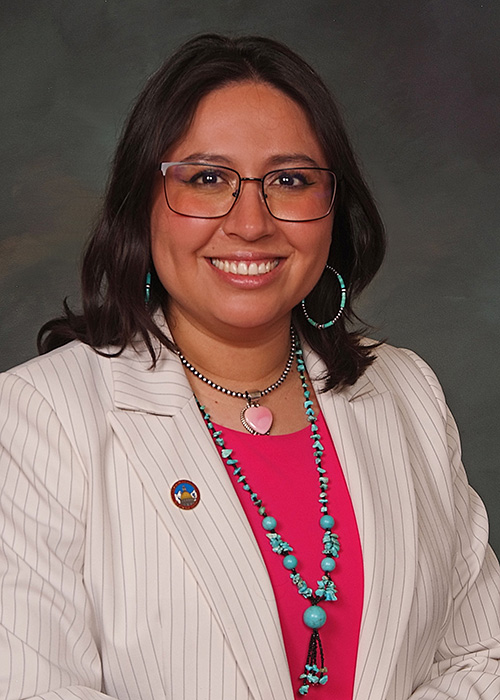
Photo of Elizabeth Velasco
D Colorado House · District 57 On the 2026 ballot

Rep. Elizabeth Velasco

Compare
Total votes
3,785
all sessions
Attendance
97%
104 missed
Near the chamber average
With party
97%
of cast votes
Higher than 75% of chamber peers
Bipartisan score
2%
crosses aisle rarely
Near the chamber average
Sponsored
318
bills & resolutions
Near the chamber average
Committees
6
assignments
318 bills and resolutions

Sponsored bills

Total
318
Primary
114
Co-sponsor
204
This page
318
matching current filters
Co-sponsor SB 25-278
Signed into law · Colorado Senate · Co-sponsor
Epinephrine Administration in Schools

The act changes the term "epinephrine auto-injector" to "emergency-use epinephrine" in order to encompass alternatives to injecting epinephrine as a means to treat anaphylaxis in school settings. (Note: This summary applies to this bill as enacted.)

Signed into law May 30, 2025 1 co-sponsor
Co-sponsor SB 25-118
Signed into law · Colorado Senate · Co-sponsor
Health Insurance Prenatal Care No Cost Sharing

The act requires that, for health insurance policies providing maternity coverage, policies issued or renewed on or after January 1, 2027, must include prenatal care coverage without cost sharing for up to 3 office visits. (Note: This summary applies to this bill as enacted.)

Signed into law May 29, 2025 1 co-sponsor
Co-sponsor HB 25-1026
Vetoed · Colorado House · Co-sponsor
Repeal Copayment for Department of Corrections Inmate Health Care

Current law requires the department of corrections (department) to assess a copayment for inmate-initiated visits to providers of medical, dental, mental health, and optometric care services. Current law permits a waiver or reduction of the copayment under a range of circumstances. The department's current administrative regulations assess fees when an inmate fails to attend or refuses a scheduled health-care appointment. The act eliminates the copayment and prohibits the department from assessing a fee when an inmate fails to attend or refuses a health-care appointment. The department is required to report during its 2026 "SMART Act" hearing on the number of times in the previous year that an inmate failed to attend a scheduled health-care appointment or requested an appointment when the request was not relevant to an actual medical condition. The act reduces appropriations to the department by a net of $165,682, which includes an increase of $157,179 appropriated from the general fund and a decrease of $322,861 from cash funds. VETOED by Governor 5/29/2025(Note: This summary applies to this bill as enacted.)

Vetoed May 29, 2025 1 co-sponsor
Co-sponsor HB 25-1088
Vetoed · Colorado House · Co-sponsor
Costs for Ground Ambulance Services

For ground ambulance services (ambulance services), the act: Allows a political subdivision or an ambulance service providing ambulance services on behalf of the political subdivision to submit to the division of insurance (division) the established rates for the ambulance services, if the rates meet specified conditions; Requires the division to publish reimbursement rates on the division's public-facing website; Establishes reimbursement rates for ambulance services that are out of network; and Prohibits an out-of-network ambulance service from billing an individual covered under a health insurance coverage plan (covered person) any outstanding balance for a covered service not paid for by an insurance carrier, except for any coinsurance, deductible, or copayment amount required to be paid by the covered person. If a covered person makes a payment for an out-of-network ambulance service, the payment must be applied to the covered person's in-network deductibles and in-network out-of-pocket maximum amounts. For the 2025-26 state fiscal year, $38,149 is appropriated from the division of insurance cash fund to the department of regulatory agencies for use by the division to implement the act. VETOED by Governor 5/29/2025(Note: This summary applies to this bill as enacted.)

Vetoed May 29, 2025 1 co-sponsor
Primary SB 25-007
Signed into law · Colorado Senate · Lead sponsor
Increase Prescribed Burns

Section 1 of the act creates the prescribed fire claims cash fund (fund) in the state treasury and requires the state treasurer to transfer $250,000 from the general fund to the fund on July 1, 2025. Subject to annual appropriation by the general assembly, the division of fire prevention and control (division) shall expend money from the fund to pay claims for damages related to prescribed burns that are certified by the division in accordance with new guidelines as specified in the act and as adopted by the director of the division. The division shall authorize a payment in the amount certified in a claim; except that the maximum payment that the division may authorize for a singular burn is equal to the greater of $20,000 or 10% of the amount of money in the fund at the time the claim is filed. Subject to annual appropriation by the general assembly of money for the division to administer the fund, the division shall certify a claim that meets the following guidelines: The claim demonstrates, in sufficient detail, the costs or damages that resulted from the prescribed burn; The prescribed burn that resulted in the costs or damages was conducted in full compliance with statutory and regulatory requirements for prescribed burning; Before conducting the prescribed burn, the certified prescribed burn manager registered the written prescription plan for the prescribed burn with the division and paid an administrative fee; and No more than 60 days have passed between the completion of the prescribed burn and the date upon which costs and damages were incurred. The act authorizes the director of the division to adopt rules and guidelines for the implementation and administration of the program and permits the division to contract with a third party to administer, certify, and pay the claims. The act also requires a claimant who accepts a payment that covers the full amount certified in the claim to waive all future claims related to the prescribed burn against the certified prescribed burn manager that conducted the burn; any organization, entity, or individual with whom the certified prescribed burn manager worked to conduct the burn; any individual or entity that provided funding for the burn; and any landowner on whose behalf the burn was conducted. Sections 2 and 3 expand the definition of a "certified burner" in the state to include an individual who has not completed the Colorado division's training and certification program but who meets reciprocity requirements and possesses a valid Colorado certification number. An individual seeking certification through reciprocity may receive a certification number from the division by: Applying for certification to the division, according to the rules and standards of the division, including the payment of any associated fee; and Submitting evidence to the division, according to the rules and standards of the division, that the individual holds a valid certification from a state government or other entity. The required rules and standards adopted by the director of the division, in consultation with the Colorado state forest service, pertaining to the qualification for and the terms and durations of certification, are required to include certification through reciprocity. Section 4 adds pretax costs associated with the implementation of an approved program or project to mitigate the effects of extreme weather, wildfires, climate change, or other hazards to the definition of Colorado energy impact costs. For the 2025-26 fiscal year: $250,000 is appropriated from the fund to the department of public safety for use by the division for prescribed fire claims; and $153,025 is appropriated from the general fund to the department of public safety for implementation of the act.(Note: This summary applies to this bill as enacted.)


Signed into law May 29, 2025 0 co-sponsors
Co-sponsor HB 25-1163
Signed into law · Colorado House · Co-sponsor
Free Access to State Parks for Colorado Ute Tribes

The act allows enrolled members of the Southern Ute Indian Tribe and enrolled members of the Ute Mountain Ute Tribe to enter state parks without having to pay an entrance fee. By June 1, 2026, the division of parks and wildlife (division) in the department of natural resources (department) shall build on existing efforts to conduct outreach to and engagement with the Southern Ute Indian Tribe, the Ute Mountain Ute Tribe, other tribal governments, American Indian communities, and Indigenous communities about opportunities related to state parks that are managed by the division. In January 2026 and January 2027, the department shall include, as part of its presentation during its "SMART Act" hearing, information concerning the division's outreach and engagement about opportunities related to state parks. (Note: This summary applies to this bill as enacted.)
Signed into law May 29, 2025 1 co-sponsor
Co-sponsor HB 25-1004
Vetoed · Colorado House · Co-sponsor
No Pricing Coordination Between Landlords

The act prohibits the sale or distribution for consideration of an algorithmic device if: The algorithmic device is sold or distributed with the intent that it will be used by 2 or more landlords in the same market or a related market to set or recommend the amount of rent, level of occupancy, or other commercial term associated with the occupancy of a residential premises; and The device sets or recommends the amount of rent, level of occupancy, or other commercial term associated with the occupancy of a residential premises based on data or a formula that is similar for each landlord. The act also prohibits the use of an algorithmic device by a person to set or recommend the amount of rent, level of occupancy, or other commercial term associated with the occupancy of a residential premises if: The person knew or should have known that another person used the algorithmic device to set or recommend the amount of rent, level of occupancy, or other commercial term associated with the occupancy of a residential premises; and The circumstances suggest that the person adhered to or participated in a scheme to fix the amount of rent, level of occupancy, or other commercial term associated with the occupancy of a residential premises. The act also prohibits a person engaged in the business of providing algorithmic device services or products that are used to set or recommend the amount of rent, level of occupancy, or other commercial term associated with the occupancy of a residential premises from using nonpublic competitor data pertaining to residential properties in Colorado in setting or recommending the amount of rent, level of occupancy, or other commercial term associated with the occupancy of a residential premises for residential properties in Colorado. A violation is deemed to be an illegal restraint of trade or commerce and is punishable in accordance with the "Colorado State Antitrust Act of 2023". VETOED by Governor 5/29/2025(Note: This summary applies to this bill as enacted.)

Vetoed May 29, 2025 1 co-sponsor
Co-sponsor HB 25-1057
Signed into law · Colorado House · Co-sponsor
American Indian Affairs Interim Committee

The act creates the American Indian affairs interim committee (committee). The purpose of the committee is to examine issues and challenges that impact American Indian Tribal Nations. The committee consists of 6 voting members of the general assembly who serve for the duration of the committee unless they resign, are removed, or are no longer in office and 2 nonvoting members, one from the Southern Ute Indian Tribe and one from the Ute Mountain Ute Tribe. The act allows the committee to meet up to 6 times and recommend up to 5 bills during each interim, but the committee does not meet or recommend legislation during the 2025 interim. On or before January 15, 2031, the act requires the committee to submit a report to the executive committee of the legislative council summarizing the work of the committee during the preceding 5 years. The committee is repealed, effective June 30, 2031. (Note: This summary applies to this bill as enacted.)

Signed into law May 28, 2025 1 co-sponsor
Co-sponsor HB 25-1271
Signed into law · Colorado House · Co-sponsor
Federal Benefits for Youth in Foster Care

Beginning on or before July 1, 2027, the act requires a county department of human or social services (county department) to determine whether a child or youth who is in foster care and who has a deceased parent (child or youth) may be eligible to receive survivor benefits administered by the United States railroad retirement board, social security administration, or veterans benefits administration (federal survivor benefits). The county department must make an initial eligibility determination within 90 days after assuming legal custody of or authority over the child or youth. Under current law, certain federal agencies appoint a representative payee or fiduciary (representative payee) to receive and manage federal benefits on behalf of a child or youth in foster care. If a child or youth may be eligible for federal survivor benefits and the county department is the most appropriate representative payee, the act requires the county department to apply for federal survivor benefits on behalf of the child or youth. If the county department determines that the child or youth may be eligible for federal survivor benefits but that the county department is not the most appropriate representative payee, the county department shall provide information to the prospective representative payee that the county department has identified about how to apply for federal survivor benefits on behalf of the child or youth and how to become the child's or youth's representative payee. Under current law, a county department serving as a representative payee may use federal benefits to offset the cost of providing basic care and services to a child or youth in foster care. The act prohibits this offset practice with respect to federal survivor benefits. Instead, the act directs a county department serving as a representative payee to establish an account for the federal survivor benefits (account). A county department serving as a representative payee must save money in the account for the needs of the individual child or youth. Once the child or youth leaves foster care, the county department is required to release funds in the account to the child or youth. The act sets forth various accounting and notice requirements related to federal survivor benefits and requires the department of human services (department), in consultation with interested stakeholders, to adopt rules providing guidance for county departments. The guidance extends to procedures for identifying a representative payee, county department responsibilities when federal survivor benefits are denied or when a child or youth leaves foster care, and policies governing the establishment and maintenance of an account for federal survivor benefit funds. The department must provide technical assistance to a county department about how to conserve federal survivor benefit funds in the best interests of an individual child or youth. (Note: This summary applies to this bill as enacted.)

Signed into law May 28, 2025 1 co-sponsor
Co-sponsor SB 25-020
Signed into law · Colorado Senate · Co-sponsor
Tenant and Landlord Law Enforcement

Section 1 of the act allows a person to access a suppressed court record if that person affirms that they are accessing the record on behalf of the attorney general for the purpose of investigating any violation of state law that the attorney general may enforce. Section 2 clarifies that the attorney general has the power to initiate and bring civil and criminal actions to enforce certain state landlord-tenant laws and that these actions must be initiated and brought within existing appropriations. Sections 4 and 5 grant counties, cities and counties, and municipalities the power to initiate and bring civil actions to enforce certain state landlord-tenant laws. Sections 4 and 5 also create requirements related to a county, city and county, or municipality retaining a private attorney to initiate or bring these civil actions. Section 6 establishes a receivership mechanism that is available as a remedy for violations of applicable laws and regulations by the landlord of multifamily residential property. The attorney general, a county, a city and county, and a municipality may all apply to a district court for the appointment of a receiver to operate a multifamily residential property if there is reasonable cause to believe that the landlord has engaged in a pattern of neglect, as defined in the Act, in connection with the property. The act establishes the process for a district court appointing a receiver, including requiring a hearing and an order of appointment that specifies the duties of a receiver, and the criteria for qualifying as a receiver. No sooner than 90 days after the district court appoints a receiver, the landlord of the relevant property, a lessee of the entire relevant property, the attorney general, or a county, city and county, or municipality may submit an application to the district court to terminate the receivership. As with the appointing of a receiver, section 6 establishes the process by which a district court may terminate a receivership. (Note: This summary applies to this bill as enacted.)

Signed into law May 28, 2025 1 co-sponsor
Showing 151 to 160 of 318 bills
Previous 1 … 15 16 17 … 32 Next