

The act refers 2 ballot issues to the voters at the November 2025 statewide election concerning funding for the healthy school meals for all program. Section 2 refers a ballot issue to the voters at the November 2025 statewide election to allow the state to retain and spend state revenue that would otherwise need to be refunded for exceeding the estimate in the ballot information booklet analysis for Proposition FF and to allow the state to maintain the increases in state taxable income established in Proposition FF that would otherwise need to be decreased. If voters reject the ballot issue, the state will both: Refund $12,430,388 to individuals who have a federal taxable income of $300,000 or more and claimed itemized or standard state income tax deductions greater than $12,000 for single tax return filers and $16,000 for joint tax return filers; and Adjust the limit on itemized deductions established in Proposition FF to a level that would have reduced the amount of income tax revenue attributable to these itemized deductions by $12,430,388. If voters approve the ballot measure: The state will not refund $12,430,388 to individuals who have a federal taxable income of $300,000 or more and claimed itemized or standard state income tax deductions greater than $12,000 for single tax return filers and $16,000 for joint tax return filers; and The increases in federal taxable income as a result of Proposition FF will stay at the levels established by Proposition FF. Section 3 refers a ballot issue to the voters at the November 2025 statewide election to allow the state to increase taxes by $95 million annually by increasing state taxable income to support the healthy school meals for all program. If voters approve the ballot issue: Income tax deductions for individuals who have a federal taxable income of $300,000 or more will be reduced from current levels to $1,000 for single filers and $2,000 for joint filers; and The state will allocate the additional revenue generated by the reduction in income tax deductions to the healthy school meals for all program. If voters reject the ballot issue, income tax deductions will not be reduced, and there will not be any additional revenue to be allocated to the healthy school meals for all program. In addition to the income tax changes and potential refunds that may result from voters approving or rejecting the ballot issues described in sections 2 and 3, the act also changes the healthy school meals for all program cash fund (fund) and healthy school meals for all programs. If voters approve the ballot issue submitted pursuant to section 2 and reject the ballot issue submitted pursuant to section 3, $1 million is transferred annually from the fund to local school food purchasing programs. If voters approve the ballot issue submitted pursuant to section 3, regardless of whether the voters approve the ballot issue submitted pursuant to section 2: The permissible distribution of local food purchasing grants is modified; Certain school food authorities are allowed to collaborate to implement advisory committees; The duties of an advisory committee are clarified; and The distribution of funds from the fund is changed so that the amounts distributed through local food purchasing grants for increasing wages or providing stipends for individuals whom the participating school food authority employs to directly prepare and serve food for school meals and through the local school food purchasing technical assistance and education grant program are modified based on the amount of money in the fund. NOTE: Certain provisions of the act are contingent on the results a measure concerning Proposition FF refunds or Proposition FF revenue increases being either approved or not approved by a majority of voters at the November 2025 statewide election.(Note: This summary applies to this bill as enacted.)
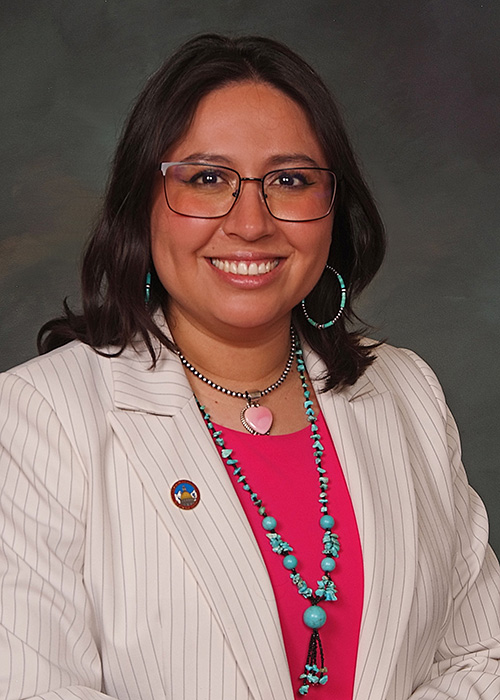
Rep. Elizabeth Velasco
Sponsored bills
The act creates a working group to make findings and recommendations concerning the use of colorimetric field drug tests in the various stages of criminal proceedings and carceral settings. The act specifies the working group's membership and appointing authority, as applicable. The working group is required to: Make findings concerning the prevalence of the administration of colorimetric field drug tests in Colorado and the potential harms that result from such administration; Make findings and recommendations for legislation or policy solutions to eliminate harms from the use of colorimetric field drug tests, administering the tests for presumptive purposes only, and how to prevent future harms resulting from administering such tests; and On or before December 1, 2025, submit a report of its findings and recommendations to the judiciary committees of the house of representatives and the senate. On or before June 13, 2025, the director of the legislative council shall use a request for proposal process to contract with and designate a nonprofit organization to provide staffing and facilitate the performance of the working group's duties, subject to the approval of the chair of the executive committee of the legislative council. The operation of the working group is contingent on awarding a contract and designating a nonprofit organization. If a contract is not awarded, then the working group does not operate. The act prohibits the use of the general fund money to contract with a nonprofit to facilitate the working group. (Note: This summary applies to this bill as enacted.)
In addition to individuals who may already request that their address included in certain records be kept confidential (address confidentiality) under certain circumstances, the act allows an individual or the spouse of an individual who is or has been a peace officer, firefighter, volunteer firefighter, emergency medical service provider, or emergency communications specialist (first responder) to also request address confidentiality for voter registration records that are in the custody of a county clerk and recorder or in the centralized statewide registration system maintained by the secretary of state (secretary) and financial disclosures that certain public officials are required to file with the secretary. A first responder may request address confidentiality with the county clerk and recorder of the county where the first responder who is making the request for address confidentiality resides. The secretary is required to approve the application form for a request for address confidentiality. Each county clerk and recorder is required to make the address confidentiality request application forms available in their office, provide the address confidentiality request application forms to interested persons by United States mail, email delivery, or facsimile transmission, and to process applications for address confidentiality without imposing a processing fee or any other charge. The custodian of any records specified in the act that concern a first responder who has requested address confidentiality is required to deny, with limited exceptions, the right of inspection of the first responder's address contained in the records on the ground that disclosure would be contrary to the public interest. (Note: This summary applies to this bill as enacted.)
The act codifies the federal "Indian Child Welfare Act of 1978" into state law as the "Colorado Indian Child Welfare Act" (CO-ICWA) and provides additional protections for Indian children and children known or determined to be Indian children under state law. (Note: This summary applies to this bill as enacted.)
The act requires the department of personnel (department), in partnership with the office of new Americans, to conduct or contract to conduct a statewide language access assessment of the readiness of principal departments to meet the language access standards outlined in the language access universal policy (assessment). The assessment covers all principal departments except the department of state, the department of the treasury, and the department of law (principal departments). The assessment must identify: The needs of principal departments to meet the language access standards outlined in the language access universal policy, including requests for guidance, training, and technical assistance; Relevant language access materials from principal departments, including language access plans, position descriptions related to language access, procedures related to language access, and technical assistance or training materials; Information on current language services contracts, expenditures, and funding sources related to language access; The public-facing responsibilities of principal departments, including designating which principal departments and their subcontractors do and do not have frequent contact with linguistically diverse individuals; and Other covered entities that may be subject to the standards outlined in the language access universal policy. The department may enter into an agreement with a third-party entity to conduct all or part of the assessment. The third-party entity must have demonstrated expertise in working with state governments on language access initiatives, such as developing language access policies or plans. At the conclusion of the assessment and not later than December 31, 2026, the department, the office of new Americans, or the third-party entity is required to create a report that summarizes the findings of the assessment and makes recommendations concerning: Improving efficiency, increasing quality of service, reducing cost, avoiding duplicative work, building on existing best practices, and minimizing administrative burden with respect to the provision of linguistically accessible government services and programs to linguistically diverse individuals; Addressing gaps and improving meaningful service through changes to language access services, practices, and procedures; Evaluating potential technological options for increasing language access, such as artificial intelligence; and Determining what infrastructure is needed to ensure full and sustainable implementation of the standards outlined in the language access universal policy. The department must also maintain a community of practice to focus on implementing the language access universal policy with ongoing observation of best practices in the principal departments. The department must include a summary of the report and assessment in its January 2027 presentation to legislative oversight committees required by the "State Measurement for Accountable, Responsive, and Transparent (SMART) Government Act". For the 2025-26 state fiscal year, $100,000 is appropriated from the general fund to the department for use by the Colorado equity office for personal services. Any money not expended by July 1, 2026, is further appropriated to the Colorado equity office through December 31, 2026. (Note: This summary applies to this bill as enacted.)
The act establishes a sales and use tax exemption for contractors and subcontractors that purchase, store, use, or consume construction and building materials for use in the building, erection, alteration, or repair of structures owned and used by a regional transportation authority (authority) to house authority employees or contractors. The act authorizes an authority or an authority's board to build, erect, alter, or repair such structures for the purpose of housing employees or contractors of an authority. (Note: This summary applies to this bill as enacted.)
The act adds statutory protections for in vitro fertilization and other assisted reproductive health-care procedures. Current law requires gamete banks and fertility clinics (donor banks) to maintain donor identifying information and update it every 3 years. The act requires donor banks to encourage donors to inform the donor banks of significant updates to the donor's medical history after the donor made a donation. The donor bank is then required to document that significant medical history update. Current law prohibits donor banks from interfering with an adult donor-conceived person communicating about the gamete donor with the donor-conceived person's friends, family, or other third parties. The act encourages donor banks to provide information to donor-conceived persons regarding the physical and emotional risks associated with releasing a donor's private information to outside parties. The act repeals certain provisions relating to gamete donor record stewardship in the event of donor bank dissolution, bankruptcy, or insolvency and eliminates the requirement that donor banks inform a recipient parent about future implications about a gamete donor's medical history or other persons conceived using the same gamete donor. Current law requires the department of public health and environment (department) to draft written materials that must be provided to individuals prior to donating or receiving gametes. The act maintains that requirement, but does not require donor banks to use the department's written material. Donor banks are permitted to develop their own written materials to meet the statutory requirement of providing certain information to an individual prior to donating or receiving gametes. The act eliminates the department's ability to perform on-site inspections or perform in-person investigations on donor banks located outside the state. (Note: This summary applies to this bill as enacted.)
The act removes the term "homosexuality" from the definition of sexual conduct in the sexually explicit materials harmful to children part of the "Colorado Criminal Code". (Note: This summary applies to this bill as enacted.)
The act creates the strategic outdoor recreation management and infrastructure cash fund (infrastructure cash fund), requires a specified percentage of lottery fund money to be distributed to the infrastructure cash fund in state fiscal years when available lottery fund money exceeds $20 million, and continuously appropriates the money in the cash fund to the division of parks and wildlife for specified outdoor recreation and management purposes. The act also creates the outdoor recreation economic development cash fund (development cash fund); requires a specified amount and, in state fiscal years when available lottery fund money exceeds $20 million, an additional specified percentage, of lottery fund money to be distributed to the development cash fund; subject to annual appropriation, allows the outdoor recreation industry office to spend money from the development fund; and requires the following transfers to be made to the development cash fund on June 30, 2025: $176,830 from the damage prevention fund; $83,839 from the dispute resolution fund; $6,784 from the youthful offender system surcharge fund; $118,741 from the professional development center cash fund; $21,278 from the immunization fund; $83,354 from the family support services fund; $5,348 from the department of military and veterans affairs fund; $9,648 from the publications fund; $85,901 from the tax lien certification fund; $4,413 from the wholesale and distributing subcontractor license fund; $5,963 from the moving outreach fund; and $121,389 from the disabled parking education and enforcement fund. Law in effect before the passage of the act distributed, to the extent available, the first $3 million of the lottery fund to the outdoor equity fund, the next $3 million to the public school capital construction assistance fund, and any remaining money as follows: 25% to the wildlife cash fund; 25% to the parks and outdoor recreation cash fund; and 50% to the public school capital construction assistance fund. For the 2024-25 state fiscal year and each state fiscal year thereafter, the act redistributes, to the extent available, the first $4 million of the lottery fund to the outdoor equity fund, the next $3 million to the public school capital construction assistance fund, the next $750,000 to the development cash fund, and any remaining money as follows: If the total amount of lottery fund money available is $20 million or less: 50% to the public school capital construction assistance fund; 20% to the parks and outdoor recreation cash fund; 20% to the wildlife cash fund; and 10% to the outdoor equity fund; or If the total amount of lottery fund money available is more than $20 million: 50% to the public school capital construction assistance fund; 15% to the parks and outdoor recreation cash fund; 15% to the wildlife cash fund; 10% to the outdoor equity fund; 5% to the development cash fund; and 5% to the infrastructure cash fund. For state fiscal year 2025-26, the act appropriates $723,488 from the development cash fund to the office of economic development for use by the outdoor recreation industry office. If not fully expended in state fiscal year 2025-26, the appropriation remains available for expenditure for state fiscal years 2026-27 and 2027-28. (Note: This summary applies to this bill as enacted.)
Beginning January 1, 2027, the act: Allows a pharmacy benefit manager (PBM) to earn income derived from the assessment of a flat-dollar service fee for the provision of a prescription drug; Prohibits a PBM from earning income based on the price or cost of a prescription drug; Prohibits a PBM from designing a formulary to favor a certain branded pharmaceutical or biologic; Requires a PBM to be reimbursed by a health benefit plan for lowering the plan's prescription drug spending over a given period of time and for the direct services the PBM provides to the plan; Sets the amount that a PBM shall reimburse an unaffiliated pharmacy or a PBM-affiliated retail, mail order, or specialty pharmacy for a prescription drug; and Requires a contract between a PBM and a health benefit plan to contain a provision where the PBM discloses prescription drug cost information to the health benefit plan and a provision authorizing the health benefit plan to execute an audit to validate compliance with the contract.(Note: This summary applies to this bill as enacted.)