

The department of public health and environment (department) is required to conduct a study of capital needs for rural and frontier hospitals throughout the state (study). The rural and frontier hospital capital needs study task force (task force) is created and is required to oversee the study. The study must measure the number of studied facilities that are not compliant with current and relevant design and building code standards for health-care facilities, identify the age of core facilities and any additions to those facilities, and estimate the costs for renovating or replacing facilities identified as having capital needs. No later than 18 months after the first meeting of the task force, the department is required to complete the study and compile the results of the study into a report. The department is required to present the report to the respective health and human services committees of the senate and house of representatives. The task force is made up of the following 7 members who must be appointed no later than 2 months after sufficient funding has been secured for the implementation of the act: 3 members who work in rural or frontier hospitals; One member who is an architect professional; One member who is a construction contractor professional; One member who represents hospitals; and One member of the general public who lives in a rural area or frontier area. In addition to overseeing the study, the task force is responsible for developing and approving the parameters of the study and overseeing the department's report. The task force may also facilitate contracting with a private sector consulting company to assist with data compilation, research, and outreach to rural and frontier hospitals. The task force is required to hold its first meeting within 2 months of all appointments being made to the task force and meet at least quarterly after the first meeting until the study and the report are complete. The requirements imposed on the department, the task force, and any third party in connection with the study are contingent upon money being available through gifts, grants, or donations for the purpose of conducting the study. (Note: This summary applies to this bill as enacted.)
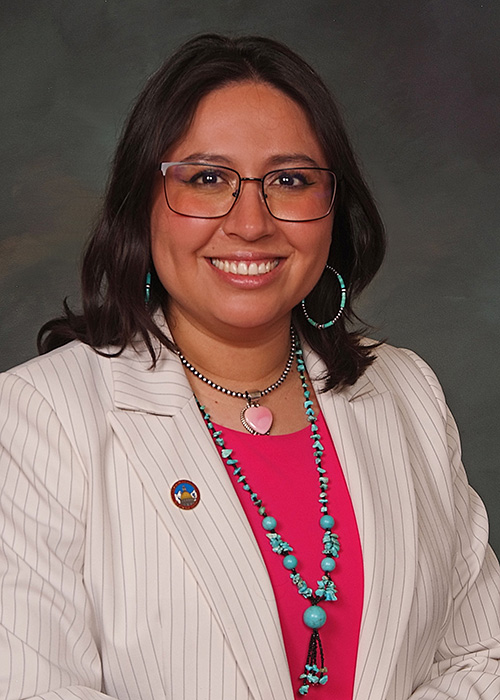
Rep. Elizabeth Velasco
Sponsored bills
The act requires that, immediately after a railroad notifies the state's watch center in the department of public safety (watch center) of an emergency involving a train, the watch center must notify the public utilities commission (commission) and the office of rail safety (office) of the incident. The commission is required to submit a report to specified committees of the general assembly on the information reported by railroads regarding an emergency involving a train. A crew member of a train operated by a railroad may communicate with first responders during an emergency situation after notifying the railroad dispatch. A crew member has discretion in determining the appropriate response to the emergency situation, including cutting the railroad crossing. A railroad employee or a crew member is immune from civil liability and is not liable in civil damages for actions taken in good faith in the course of a response to an emergency situation involving a train. The act eliminates the shared authority that the commission, the department of public safety, and the department of transportation had to inspect and investigate railroads and grants the commission alone the authority to engage in inspection, investigation, and enforcement activities regarding the following railroads: A class I railroad; A railroad operating on any line that was used by class I railroads as of July 1, 2024; and A passenger railroad. The act requires the office to gather, analyze, and assess information, including: Data to create a more comprehensive understanding of railroad safety; Wayside detector information; Information regarding blocked public crossing locations; Information regarding railroad maintenance activity; An assessment of the state's ability to respond to a large-scale release of hazardous materials from railroad transportation; The best practices for ensuring financial responsibility for response, cleanup, and damages from major rail events, including reviewing best practices from other states; and Communication issues impacting railroad lines in the state. Beginning on or before July 1, 2027, a railroad regulated by the commission is required to pay a fee to cover the costs incurred by the commission and the office in relation to the act. The commission shall determine a methodology for calculating the fee by rule, and the commission may include specified criteria in the calculation. The total amount collected pursuant to the annual fee must not exceed $2,900,000 in a calendar year. A railroad regulated by the commission must pay the fee in equal quarterly installments and is subject to penalties and interest if they fail to timely pay the fee. (Note: This summary applies to this bill as enacted.)
The act extends the Emily Keyes - John W. Buckner organ and tissue donation awareness fund indefinitely. (Note: This summary applies to this bill as enacted.)
Current law requires the division of administration (division) within the department of public health and environment to report annually to the water quality control commission (commission) and to include in the report any regulatory or legislative recommendations the division may have. The act requires the report to also include: Information on the division's timing in considering and issuing water quality permits (permits); and For the report submitted in 2026, a detailed discussion of how the division has prioritized reducing the permit backlog, implemented recommendations from water quality permittees (permittees) for permitting efficiency, and increased safe drinking water program inspections. The act requires the division, upon receipt of an application to modify a permit, to limit its review and its approval or denial of the application to the scope of the specific requests contained in the application. The act requires the commission to adopt rules on or before December 31, 2026, that establish procedures whereby the division, prior to giving public notice of a complete permit application for an individual permit and the division's preliminary analysis of the application, may provide a period of public notice and review of a preliminary draft prepared by the division. If a period of public notice and review is required by rules of the commission, the period of public notice and review may not exceed 14 days, and the purpose of the review is limited to identifying errors in the division's preliminary draft. On or before December 31, 2027, the division must propose rules to the commission that establish a time frame during which the division will either grant or deny applications for each type of permitting action. On or before June 30, 2028, the commission shall adopt rules based on the division's proposal. The rules must establish the time frames for permitting actions. The act requires the division to consider current debt service on existing local government water infrastructure when developing schedules of compliance for new effluent limits in local government permits. Any schedule of compliance for new effluent limits in local government permits must, consistent with state and federal law, consider the local government's financial capability to repay existing debt on water infrastructure or to fund water infrastructure upgrades before requiring new water infrastructure upgrades. To the extent allowable under federal law, the division may issue compliance schedules in a local government permit for a new effluent limit in excess of 20 years. The act states that, on and after May 1, 2026, after an application for permit modification or permit renewal has been pending before the division for 60 days, or for any application for permit modification or permit renewal that is pending before the division as of May 1, 2026, or if the division informs an applicant that the division will not process an application for preliminary effluent limitations, the applicant and the division may mutually agree to use a qualified and independent nongovernmental contractor (contractor) under the direction of the division to provide the division with technical assistance in completing the permit action. An applicant shall bear the contractor's costs for any technical assistance provided by the contractor and shall pay the contractor for such costs. The division may charge an applicant an additional fee in an amount not exceeding 10% of the contract amount for contract administration, technical review, and additional permit processing, which fee is credited to the clean water cash fund. The act requires the division, upon a permittee's request, to make available to the permittee all documents, data, and information the division relied upon in developing the permittee's permit modification or permit renewal, except to the extent that such materials are protected by an applicable privilege or exception. The act makes the following transfers of money: On July 1, 2025, $111,000 from the water quality improvement fund to the drinking water cash fund; On July 1, 2025, $3,518,564 from the perfluoroalkyl and polyfluoroalkyl substances cash fund to the clean water cash fund; On July 1, 2026, $3,002,435 from the perfluoroalkyl and polyfluoroalkyl substances cash fund to the clean water cash fund; and On July 1, 2026, $516,129 dollars from the perfluoroalkyl and polyfluoroalkyl substances cash fund to the drinking water cash fund. For the 2025-26 state fiscal year, the act appropriates $2,904,599 to the department of public health and environment. This appropriation consists of $446,315 from the drinking water cash fund and $2,458,284 from the clean water cash fund. For the 2025-26 state fiscal year, the act appropriates $160,611 to the department of law. This appropriation is from reappropriated funds received from the department of public health and environment. The act also makes and reduces certain appropriations as adjustments to the 2025 general appropriations act. (Note: This summary applies to this bill as enacted.)
The act requires a metropolitan district that is a party to a lease or rental agreement that was effective as of January 1, 2025, or later and was filed with the county assessor's office in support of a claim for a property tax exemption based on the use of the property for purposes of the metropolitan district to file with the county assessor's office a statement (statement) describing: The metropolitan district's use of the leased property; The metropolitan district's authority to use the leased property for the metropolitan district's purposes; Any use of the leased property by a private person for private purposes; and Any disclosure filed by a member of the board of directors of the metropolitan district in accordance with certain laws that govern disclosures of conflicts of interest. If the statement includes a disclosure that relates to the leased property and is filed by a member of the board of directors of the metropolitan district in accordance with certain laws that govern disclosures of conflicts of interest, the county assessor shall, within 14 days of receipt of the statement, submit the statement to the metropolitan district's governing body. Within 63 days of receipt of the statement, the governing body shall issue a written decision including findings of fact and a conclusion as to whether the leased property is used for a public purpose. If the governing body concludes that the leased property is not used for a public purpose, the leased property is not exempt from taxation, and the county assessor shall implement the governing body's decision. The decision of the governing body is not subject to appeal and does not give rise to any private right of action. The act clarifies that a leasehold interest in real or personal property that is owned by a private person and that has been leased to the state or a political subdivision of the state, the use and possession of which has been leased back to a private person for private purposes, is taxable to the owner. (Note: This summary applies to this bill as enacted.)
The act creates the regional planning roundtable commission (commission) within the department of local affairs (department). The commission is a 21-member appointed board with members who serve 3-year terms; except that specified members serve initial terms of 2 years. After an initial meeting to elect a chair and establish its procedures and operation framework, the commission will only meet when a local government requests assistance in addressing a regional opportunity or challenge. In so meeting, the commission shall: Define a region for purposes of establishing a regional roundtable to assist in addressing the regional opportunity or challenge; Considering local expertise, suggest who should serve on the regional roundtable established in connection with addressing the regional opportunity or challenge; and Identify state resources available to assist in addressing the regional opportunity or challenge. The commission may also assist in establishing an integrated planning framework that considers, at a minimum, specified topics. The commission must annually report to specified committees of the general assembly regarding any assistance that it has provided to local governments. The act allows the department to seek, accept, and expend gifts, grants, or donations to cover the costs of implementing the act. Only after the department has received sufficient gifts, grants, or donations to implement the act is the commission created and able to meet. (Note: This summary applies to this bill as enacted.)
The act requires a school district, a charter school, an institute charter school, a board of cooperative services, or the Colorado school for the deaf and the blind (local education provider) to satisfy certain requirements concerning installation, inspection, and maintenance of heating, ventilation, and air conditioning (HVAC) systems in schools if the local education provider undertakes HVAC infrastructure improvements using money from the "Infrastructure Investment and Jobs Act" cash fund. The requirements established in the act concern: Ventilation verification assessments, which include assessments of an HVAC system's filtration, ventilation exhaust, economizers, demand control ventilation, air distribution and building pressurization, general maintenance requirements, and operational controls ; The preparation of HVAC assessment reports; The review of HVAC assessment reports by mechanical engineers, who make recommendations regarding necessary repairs and improvements, suggest pathways to reduce emissions, and estimate associated costs; HVAC adjustments, repairs, upgrades, and replacements; and The preparation of HVAC verification reports, which must be maintained for at least 5 years and made available to the public upon request. The act establishes mandatory criteria that an HVAC contractor must satisfy in order to perform work described in the act. A local education provider that undertakes HVAC infrastructure improvements using money from the "Infrastructure Investment and Jobs Act" cash fund must do so using only contractors on the certified contractor list established by the department of labor and employment, unless the local education provider determines that there were no responsive, eligible subcontractors available to fulfill the mechanical, electrical, or plumbing portions of the contract. (Note: This summary applies to this bill as enacted.)
The act amends the definition of a "portable tenant screening report" (screening report) to specify that a prospective tenant using a housing subsidy is not required to include a credit history report, a credit score, or an adverse credit event with the tenant's screening report. The act also repeals language allowing a landlord to require a tenant to make a screening report directly available to the landlord through a consumer reporting agency or third-party website. (Note: This summary applies to this bill as enacted.)
The act extends the time frame within which a governing body of a city, town, or city and county with jurisdiction in an area within the wildland-urban interface is required to adopt wildfire codes and standards that meet or exceed the wildfire resiliency code board's wildfire codes and standards from 3 to 9 months after the board's adoption of wildfire codes and standards. The act allows a governing body to enter into a cooperative agreement with another entity, such as a third-party contractor or another governing body, in order to enforce wildfire codes and standards. (Note: This summary applies to this bill as enacted.)
The act requires the state board of education (state board) to adopt standards related to Black historical and cultural studies (standards). Local education providers shall incorporate the standards into courses for public elementary and secondary school students in the state no later than 2 years after the state board adopts the standards. The act aligns the timeline for the development, adoption, and integration of the standards with the 6-year cycle that the state board of education currently uses for revising the state academic standards. The act creates the Black historical and cultural studies advisory committee (committee) in the department of education (department) to recommend standards and related materials and to provide technical assistance at the request of local education providers implementing the standards. The committee's recommendations must include updates to the state's history and civics standards and must advance developmentally appropriate but comprehensive instruction that features factual accounts of the struggles and contributions of Black Americans in all fields of endeavor. Using the committee's recommendations, the department will create and maintain a resource bank of research-based, scholarly articles and promising program materials and curricula pertaining to Black historical and cultural studies. For the 2025-26 state fiscal year, the act appropriates $19,225 from the general fund to the department for costs related to content specialists. (Note: This summary applies to this bill as enacted.)