The act implements the recommendations of the department of regulatory agencies in its sunset review and report on the high cost support mechanism, established by the public utilities commission to support telecommunications service access, by continuing the high cost support mechanism indefinitely and continuing funding for rural telecommunications providers from the high cost support mechanism indefinitely. The act modifies the computation of fees for the public utilities commission fixed utility fund and the telecommunications utility fund. APPROVED by Governor May 28, 2024 EFFECTIVE August 7, 2024(Note: This summary applies to this bill as enacted.)
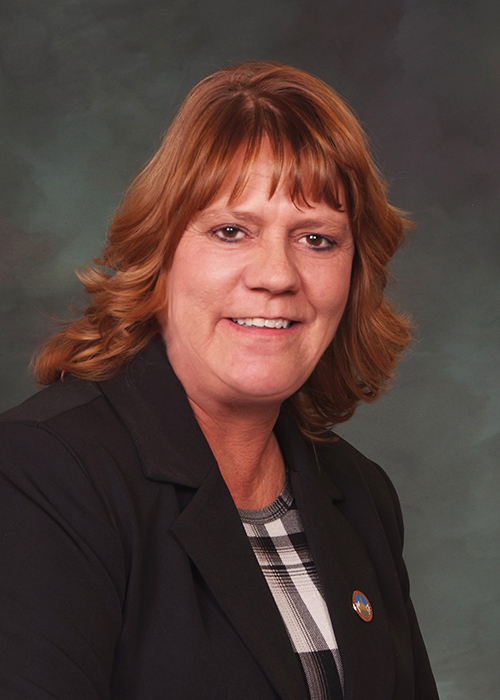
Rep. Tisha Mauro
Sponsored bills
Under current law, a corrections officer who works 12 or more hours in a single 24-hour period receives overtime pay for the hours worked in excess of 8.5 hours. The act creates an exception if the time is part of a corrections officer's normal shift that is longer than 8.5 hours and is part of a compressed, flexible, or alternative scheduling system. APPROVED by Governor May 28, 2024 EFFECTIVE May 28, 2024(Note: This summary applies to this bill as enacted.)
The act authorizes the reintroduction of the North American wolverine in the state by the division of parks and wildlife (division). As long as the North American wolverine remains on the list of threatened or endangered species pursuant to applicable federal law, the division must not reintroduce the North American wolverine in the state until a final rule designating the North American wolverine in Colorado as a nonessential experimental population pursuant to applicable federal law has taken effect. The act also creates certain requirements for the reintroduction of the North American wolverine. The parks and wildlife commission must adopt rules for the compensation of owners of livestock for losses caused by the North American wolverine. For the 2024-25 state fiscal year, $102,808 is appropriated from the wildlife cash fund to the department of natural resources for use by the division. To implement the act, the division may use the appropriation for wildlife operations. APPROVED by Governor May 20, 2024 EFFECTIVE August 7, 2024(Note: This summary applies to this bill as enacted.)
The bill requires the department of labor and employment (department), in consultation with the department of military and veterans affairs, to create and distribute a poster that provides information on services, resources, and benefits that are available to veterans of the armed services. Each employer in this state with more than 50 employees is required to display the poster created by the department in a conspicuous and accessible area in the workplace. (Note: This summary applies to this bill as introduced.)
The length of the bill summary for this bill requires it to be published on a separate page here: https://leg.colorado.gov/hb24-1030-bill-summary (Note: This summary applies to this bill as enacted.)
The bill creates the electric vehicle enterprise (enterprise) in the department of labor and employment (department). The business purpose of the enterprise is to synchronize electric vehicle charging protocols to create consistency and transparency for electric vehicle charging consumers. The enterprise constitutes an enterprise for purposes of section 20 of article X of the state constitution so long as it retains the authority to issue revenue bonds and receives less than 10% of its total annual revenue in grants from all Colorado state and local governments combined. So long as it constitutes an enterprise, the enterprise is not subject to section 20 of article X of the state constitution. The bill establishes a board of directors for the enterprise, including the board's membership, powers, and duties. The bill authorizes the enterprise to impose and collect a fee beginning July 1, 2025, to be paid by each electric vehicle charging station retailer based on the total number of retail electric vehicle charging stations operated by the retailer and the total number of power supply devices used at such stations. The bill creates the electric vehicle enterprise special revenue fund (fund) and continuously appropriates money in the fund to the enterprise to accomplish its duties. The bill requires the state treasurer, on July 1, 2024, to transfer $264,000 from the general fund to the fund and, on July 1, 2025, to transfer $160,000 from the general fund to the fund for the purpose of defraying expenses incurred by the enterprise before it receives fee revenue or revenue bond proceeds. The money is transferred as a loan to the enterprise, to be paid in full not later than December 31, 2028, with interest. The bill requires the enterprise, in consultation with the Colorado energy office and the division of oil and public safety within the department, to promulgate rules establishing minimum standards related to specifications and tolerances for retail electric vehicle charging equipment and methods of retail sale at publicly accessible electric vehicle charging stations to promote equity in the marketplace. The department must begin enforcing the rules on July 1, 2025, for all electric vehicle charging stations installed before, on, or after July 1, 2025. For the purposes of existing laws concerning fuel products, the bill amends the definitions of the terms "fuel products" and "motor fuel" to include electricity when used to fuel electric vehicles. (Note: This summary applies to this bill as introduced.)

To improve the operational efficiency of the front range passenger rail district (district): Section 1 of the act modifies: The requirement that the board of the district (board) hold annual joint meetings with the transportation commission, the board of directors of the I-70 coalition or any successor entity, and the board of directors of the regional transportation district to require the board to provide an annual update, which may be provided by district staff, at the meeting and to allow the meeting to be held in a manner that allows members of the board and the entity it is meeting with to attend the meeting by electronic means; and The boundaries of the district. Section 2 clarifies when the terms of board members begin and end; and prohibits an advisory nonvoting member of the board from participating in an executive session if the board determines that a particular matter to be discussed in the executive session concerns the appointing authority for the advisory nonvoting member and should not be discussed when the advisory nonvoting member is present; Section 3 establishes that the board exercises its powers by a majority vote of a quorum of its voting directors rather than by a majority vote of a quorum of its total membership and, in conjunction with section 4, clarifies that the board has discretion to delegate its power to enter into contracts and agreements other than intergovernmental agreements and contracts for public-private partnerships to the officers and employees of the district; and Section 5 changes the name of a state-required district plan for developing rail service to avoid potential confusion that could be caused by similarity between the current name of the plan and the name of a federally required plan and specifies requirements for the certification of ballot measures referred by the board to the registered electors of the district. APPROVED by Governor April 29, 2024 EFFECTIVE August 7, 2024(Note: This summary applies to this bill as enacted.)
The act requires insurance premium taxes, surplus lines taxes, and other associated state-specific insurance tax filings to be filed through a secure web-based application identified by the division of insurance. The act also authorizes the commissioner of the division of insurance (commissioner) to contract with a third party to provide a secure web-based application system that allows premium taxes, surplus lines taxes, and other state-specific filings to be filed for multiple states on a single web-based application system. The commissioner is authorized to promulgate rules to implement, operate, and enforce the requirements of the act. The act applies to tax filings submitted on or after January 1, 2025. APPROVED by Governor March 22, 2024 EFFECTIVE March 22, 2024(Note: This summary applies to this bill as enacted.)