

Colorado law allows a local government to establish local minimum wages in excess of the statewide minimum wage established in the state constitution. A local government that enacts a minimum wage must provide a tip offset for tipped employees in an amount equal to the tip offset amount described in the state constitution, which is $3.02. The act states that on and after January 1, 2026, a local government that has enacted a code or an ordinance imposing a minimum wage that exceeds the state minimum wage may increase the amount of the tip offset associated with the local minimum wage; except that a local government shall not impose a tip offset in an amount that allows a tipped employee to earn less than the state minimum wage minus $3.02. (Note: This summary applies to this bill as enacted.)
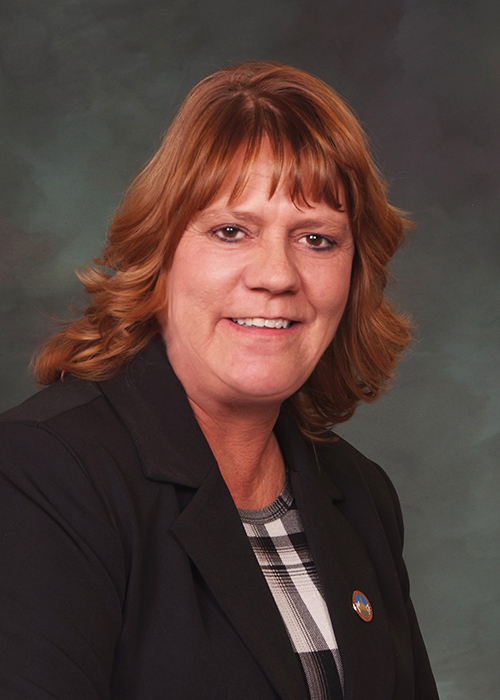
Rep. Tisha Mauro
Sponsored bills
Colorado law sets fees for the titling and registration of vehicles and authorizes county clerks, as authorized agents of the department of revenue (department), to retain a portion of these fees to cover their costs. The department must increase these fees to account for inflation, but the department must not increase a fee by more than 5% per year. Colorado law authorizes a county clerk to set fees for shipping and handling of license plates. The act authorizes the county clerk to set fees for the shipping and handling of motor vehicle documents. The county clerk is authorized to set and publish the fee by October 15 for registration periods beginning January 1 of the following year. The act allows an owner to select a vehicle registration period that is less than one year for any reason. The request for a shortened registration period may be made only one time in the 12 months after the transaction date. Colorado law requires a salvage vehicle's title to have a brand that says "rebuilt from salvage". The act requires this brand to include a disclosure statement, which must: Include the reason the vehicle is salvage, as listed in statute; Contain a statement from the owner stating the nature of the damage that resulted in the determination that the vehicle is a salvage vehicle; and Contain the signature of the seller and buyer to sell the salvage vehicle. Colorado law requires the seller of a salvage vehicle to provide a disclosure statement of the fact and have it signed, and, if the buyer does not know about the vehicle being rebuilt from salvage, the buyer is entitled to a refund. The act requires this disclosure statement and the buyer to be provided the refund only if the title of a salvage vehicle does not have the brand on the title or the vehicle is subject to multiple assignments. Colorado law provides the option to have a rebuilder's certificate of title when a motor vehicle is a collector's item, the applicant is unable to provide appropriate evidence of ownership, and the applicant posts a bond. The act authorizes the department to issue a rebuilder's certificate of title to people who can prove ownership and changes the process to require only one bond. (Note: This summary applies to this bill as enacted.)
The act authorizes the owner of a trailer to register the trailer for as long as the owner owns the trailer. The trailer must be class B or class D personal property. To register the trailer, the owner must pay: 2 years of annual specific ownership tax; and $55.82 to cover fees. Upon the transfer of ownership of the trailer, the owner is required to notify the department of revenue of the transfer. (Note: This summary applies to this bill as enacted.)
The division of water resources in the department of natural resources (division) is responsible for administering water rights and issuing water well permits, among other duties. Under current law, after having received a permit to appropriate designated groundwater or construct a well outside the boundaries of a designated groundwater basin, a permit holder is required to construct the well within one year after the date of issuance of the permit. If the well is not constructed within one year, the permit expires; except that the ground water commission (commission) in the division or the state engineer, as applicable, may grant a single one-year extension. The act extends the time frame for construction of a well to 2 years, eliminating the need for the commission or the state engineer to approve a one-year extension to the initial one-year construction time frame, except for permits issued for federally authorized water projects. The act also removes the requirement that the commission or state engineer must mail a certified letter to the permit holder before a permit can be formally expired. The act allows the commission or state engineer to reinstate an expired permit if the applicant for reinstatement of the permit can show that the well was completed in a timely manner and submits a $30 fee. Under current law, the division engineer of each water division is required to decennially present to the water court a list of water rights that meet the criteria for abandonment. The act splits this decennial abandonment process into 2 batches, grouped by water division and spaced 5 years apart, beginning with 2030 and 2035. The act maintains the requirement that the abandonment process be performed every 10 years in each water division. The act extends certain time frames relating to the well permitting process. Lastly, the act eliminates final permitting requirements for non-Denver Basin bedrock aquifer wells in the designated basins. (Note: This summary applies to this bill as enacted.)
The act requires the executive director of the department of revenue to allow a sales and use tax license and a sales and use tax exemption certificate to be searchable by the name and identification number of the sales and use tax licensee or the sales and use tax exemption certificate holder. (Note: This summary applies to this bill as enacted.)
The act creates the Colorado sexual assault forensic medical evidence review board (board), consisting of the attorney general, or their designee, as board chair; the executive director of the Colorado district attorneys' council, or their designee; and various members appointed by the attorney general or the governor. The board's duties include reviewing and monitoring processes related to sexual assault response, making recommendations to improve sexual assault response, and submitting an annual report concerning its duties. The act creates a notification requirement under the "Victim Rights Act" that requires a law enforcement agency to notify a victim every 90 days when the law enforcement agency has not received the results of the forensic medical evidence DNA analysis from an accredited crime laboratory. The act requires an accredited crime laboratory to endeavor to analyze forensic medical evidence within 60 days after its receipt. The act expands public reporting requirements concerning forensic medical evidence and DNA evidence backlogs. For the 2025-26 state fiscal year, the act appropriates $112,365 from the general fund to the department of law for use by the administration division to implement the act. (Note: This summary applies to this bill as enacted.)
The act requires the state board of education (state board) to adopt standards related to Black historical and cultural studies (standards). Local education providers shall incorporate the standards into courses for public elementary and secondary school students in the state no later than 2 years after the state board adopts the standards. The act aligns the timeline for the development, adoption, and integration of the standards with the 6-year cycle that the state board of education currently uses for revising the state academic standards. The act creates the Black historical and cultural studies advisory committee (committee) in the department of education (department) to recommend standards and related materials and to provide technical assistance at the request of local education providers implementing the standards. The committee's recommendations must include updates to the state's history and civics standards and must advance developmentally appropriate but comprehensive instruction that features factual accounts of the struggles and contributions of Black Americans in all fields of endeavor. Using the committee's recommendations, the department will create and maintain a resource bank of research-based, scholarly articles and promising program materials and curricula pertaining to Black historical and cultural studies. For the 2025-26 state fiscal year, the act appropriates $19,225 from the general fund to the department for costs related to content specialists. (Note: This summary applies to this bill as enacted.)
The act requires the office of just transition (office) in the department of labor and employment to prioritize awarding funding to support tier one and tier 2 coal transition communities experiencing socioeconomic impacts of coal closures and for opportunities for economic diversification, local community input, feasibility studies of specific proposed projects, and needs assessments. The office is required to use money appropriated to the just transition cash fund after July 1, 2025, to support programs that support targeted investment in coal transition communities by collaborating with coal transition communities and eligible entities, state and regionally recognized governmental and economic development entities, employee organizations that represent coal transition workers, and workers who are not affiliated with employee organizations to implement the most effective projects and programs for those communities. The act requires the office to annually report to the joint budget committee and at the annual "State Measurement for Accountable, Responsive, and Transparent (SMART) Government Act" hearings of the senate local government and housing committee and the house transportation, housing, and local government committee about the grants awarded by the office during the preceding state fiscal year, their recipients, and the purpose for which they were awarded. A public entity may invest public funds only as allowed by law. The act specifies that the investment of a payment or settlement to offset the socioeconomic impacts to a community or government from the closure of a coal mine or coal power generating station is not subject to these investment limitations. The act allows the executive director of the department of local affairs to establish a policy preference for awarding up to 70% of the money credited to the local government severance tax fund to just transition communities for a 3-year period beginning January 1, 2026. The act extends the deadline for the submittal by the director of the Colorado energy office of the findings and conclusions of assessments of advanced energy solutions in the northwestern and west end of Montrose county and in southeastern Colorado from July 1, 2025 to December 19, 2025, and makes the requirement that the findings and conclusion be submitted contingent on the director having sufficient federal money to support the submittal. (Note: This summary applies to this bill as enacted.)
The act authorizes an agency of government to incorporate a project labor agreement requirement for a public project in the amount of $1 million or more if the project labor agreement will promote successful project delivery by securing a skilled labor force for the project and if it will promote cost-efficiency, safety, quality, and timely completion of the project. (Note: This summary applies to this bill as enacted.)
The sunset law requires that new advisory committees and task forces be repealed and undergo a review before the repeal. The act changes the towing task force's scheduled repeal from September 1, 2025, to September 1, 2035. (Note: This summary applies to this bill as enacted.)