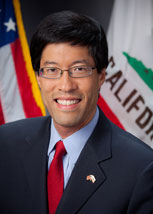
Photo of Richard Pan
D California Senate · District 6

Sen. Richard Pan

Compare
Total votes
26,098
all sessions
Attendance
98%
455 missed
Near the chamber average
With party
99%
of cast votes
Near the chamber average
Bipartisan score
0%
crosses aisle rarely
Lower than 76% of chamber peers
Sponsored
951
bills & resolutions
Lower than 78% of chamber peers
Committees
0
assignments
951 bills and resolutions

Sponsored bills

Total
951
Primary
341
Co-sponsor
610
This page
951
matching current filters
Co-sponsor ACR 147
Signed into law · California Assembly · Co-sponsor
Relative to California Agriculture Day.

This measure would recognize and honor the men and women of California agriculture for their dedication and productivity by observing March 15, 2016, as National Agriculture Day, and designating March 16, 2016, as California Agriculture Day.

Signed into law Apr 29, 2016 1 co-sponsor
Primary SB 686
Vetoed · California Senate · Lead sponsor
Public postsecondary education: Higher Education Employer-Employee Relations Act.

Existing law, known as the Higher Education Employer-Employee Relations Act, contains provisions relating to employer-employee relations between the state and the employees of state institutions of higher education, including the University of California and the California State University, as well as the Hastings College of the Law. These provisions assign major responsibilities for implementation to the Public Employment Relations Board. The Higher Education Employer-Employee Relations Act provides specified rights, provisions, and definitions for supervisory employees, as defined, of the University of California and the Hastings College of the Law, and excludes those employees from the general provisions of the act. This bill would provide that the general provisions of the act apply, instead of the specified rights, provisions, and definitions for supervisory employees, to supervisory employees who are employed as sworn peace officers by the University of California or the Hastings College of the Law, except as specified. The bill would prohibit supervisory employees who are employed as sworn peace officers by the University of California or the Hastings College of the Law from being placed in the same collective bargaining unit as nonsupervisory employees.

Vetoed Apr 25, 2016 0 co-sponsors
Primary SB 610
Vetoed · California Senate · Lead sponsor
Medi-Cal: federally qualified health centers: rural health clinics: managed care contracts.

Existing law provides for the Medi-Cal program, which is administered by the State Department of Health Care Services and under which qualified low-income persons receive health care benefits. The Medi-Cal program is, in part, governed and funded by federal Medicaid provisions. Existing law provides that federally qualified health center (FQHC) services and rural health clinic (RHC) services, as defined, are covered benefits under the Medi-Cal program to be reimbursed, to the extent that federal financial participation is obtained, to providers on a per-visit basis. Existing law authorizes an FQHC or RHC to apply for an adjustment to its per-visit rate, based on a change in the scope of services provided, as prescribed. Existing law establishes alternative ratesetting procedures with respect to a new entity that first qualifies as an FQHC or RHC in the year 2001 or later, a newly licensed facility at a new location added to an existing FQHC or RHC or an existing FQHC or RHC that is relocated. Two of the procedures are referred to as comparability approaches, based on the rates of 3 similarly situated FQHCs and RHCs. The 3rd procedure requires, at a new entity's one-time election, that the department establish the reimbursement rate, calculated on a per-visit basis, that equals 100% of the projected allowable costs to the FQHC or RHC of furnishing services during its first 12 months of operation as an FQHC or RHC. This bill would require the department to finalize a new rate within 1 year after an FQHC's or RHC's submission of a scope-of-service rate change. With respect to a new FQHC or RHC that has elected for the department to establish its reimbursement rate based on projected allowable costs as described above, this bill would require the department to finalize that rate within 1 year after the submission of the actual cost report from the first full 12 months of operation, as specified. This bill would revise the department's responsibilities with respect to a new entity or a relocated FQHC or RHC that selects either of the comparability approaches. The bill would require the department to review the comparable facilities to determine if any of them do not meet the comparability threshold and, if so, to notify the new entity, and request a supplemental submission, as prescribed. The bill would require the department to conduct an initial review of a scope-of-service rate change request within 30 days after submission by the FQHC or RHC, and notify the FQHC or RHC by the 31st day after submission if the department determines that additional information is necessary, as prescribed. The bill would require the department to finalize the FQHC's or RHC's rate within 1 year after receiving a submission the department determines to be complete. This bill would require the department to correct erroneous payments at least quarterly to reprocess past claims and ensure all claims are reimbursed at the appropriate finalized new rate. Existing law requires the department to administer a program to ensure that total payments to FQHCs and RHCs operating as managed care subcontractors comply with applicable federal law regarding payment for services provided by FQHCs and RHCs. Under the department's program, existing law requires FQHCs and RHCs subcontracting with specified managed care plans to seek supplemental reimbursement from the department through a per visit fee-for-service billing system. To be reimbursed under these provisions, existing law requires each FQHC and RHC to submit to the department for approval a rate differential based on the FQHC's or RHC's reasonable cost or the prospective payment rate. Within 6 months of the end of the FQHC's or RHC's fiscal year, existing law requires, to the extent feasible, the department to perform an annual reconciliation to reasonable cost, and make payments to, or obtain recovery from, the FQHC or RHC. This bill would impose various requirements on the department regarding the reconciliation process described above. The bill would require the department to complete the final reconciliation review and pay to the center or clinic any remaining amount owed within 18 months after the last date of the fiscal year for which the department is conducting the review. This bill would incorporate additional changes to Section 14132.100 of the Welfare and Institutions Code made by this bill and AB 858 to take effect if both bills are chaptered and this bill is chaptered last.

Vetoed Apr 25, 2016 0 co-sponsors
Primary SB 292
Vetoed · California Senate · Lead sponsor
Public employee retirement: contributions.

The California Public Employees' Pension Reform Act of 2013 (PEPRA) requires a public retirement system, as defined, to modify its plan or plans to comply with the act and, among other provisions, establishes new retirement formulas that may not be exceeded by a public employer offering a defined benefit pension plan for employees first hired on or after January 1, 2013. PEPRA requires new employees of public employers, as specified, who participate in a defined benefit plan to have an initial contribution rate of at least 50% of the normal cost rate for that defined benefit plan, rounded to the nearest 14 of 1%, or the current contribution rate of similarly situated employees, whichever is greater. PEPRA prohibits an employer from paying the employee contribution. The California Constitution generally limits ad valorem taxes on real property to 1% of the full cash value of that property. The California Constitution exempts from that limit an additional ad valorem property tax rate for, among other things, indebtedness approved by the voters of the local entity prior to July 1, 1978, including pension programs. This bill would exempt a city or county that pays its pension costs with revenues from a property tax rate approved by its voters to make payments in support of pension programs and levied in addition to the general property tax rate, and that city's or county's employees, from the above-described prohibition on employer payment of employee contribution, with respect to an employee whose pension is funded by these revenues.

Vetoed Apr 25, 2016 0 co-sponsors
Primary SB 1297
died · California Senate · Lead sponsor
Public employee retirement plans: automatic enrollment and escalation.

Existing federal law prescribes requirements for different types tax-qualified retirement plans that permit employees to contribute portions of their pretax wages to individual retirement accounts or that provide for deferred compensation. Existing law authorizes the Department of Human Resources to establish and administer tax-deferred saving plans in accordance with specified provisions of federal law. This bill would authorize a state or local public employer participating in an employee supplemental retirement savings plan, defined to include specified deferred compensation plans and payroll deduction individual retirement account plans, to make a deduction from the wages or compensation of an employee for contributions attributable to automatic enrollment and automatic escalation in the employee retirement plan. The bill would require an employer that provides for automatic enrollment in a supplemental retirement savings to provide a default investment option and default investment plan that meets a variety of specified criteria, including providing employees an opportunity to opt out or withdraw. The bill would provide that an employer that provides automatic enrollment or automatic escalation in an employee retirement plan subject to these provisions is not liable for the investment decisions made by the employer on behalf of any participating employee with respect to the default investment of contributions made for that employee to the plan. The bill would prohibit an employer from making deductions from the compensation of represented employees in the absence of a collectively bargained memorandum of understanding or other collective bargaining agreement authorizing those deductions. The bill would also prohibit an employer that makes employer contributions to an employee retirement plan that implements automatic enrollment of escalation from contributing at a greater rate for nonrepresented, managerial, or supervisory employees than that contributed for represented employees who are in related retirement membership classifications, except in specified instances. The bill would prohibit vendors for the default investment plan from using that relationship to market other products. The bill would prohibit personnel, including members of governing bodies, acting on behalf of an employer from receiving consideration from a vendor in exchange for the promotion of a vendor product.

died Apr 21, 2016 0 co-sponsors
Co-sponsor AJR 34
Signed into law · California Assembly · Co-sponsor
Relative to the Armenian Genocide.

This measure would, among other things, designate the year of 2016 as "State of California Year of Commemoration of the Anniversary of the Armenian Genocide of 1915–1923," would designate April 24, 2016, as "State of California Day of Commemoration of the 101st Anniversary of the Armenian Genocide of 1915–1923," and would call upon the President of the United States and the United States Congress to formally and consistently reaffirm the historical truth that the atrocities committed against the Armenian people constituted genocide.

Signed into law Apr 21, 2016 1 co-sponsor
Co-sponsor SB 3
Signed into law · California Senate · Co-sponsor
Minimum wage: in-home supportive services: paid sick days.

(1) Under existing law, the Healthy Workplaces, Healthy Families Act of 2014, an employee who, on or after July 1, 2015, works in California for the same employer for 30 or more days within a year from the commencement of employment is entitled to paid sick days, as specified. Existing law requires an employee to accrue paid sick days at the rate of not less than one hour per every 30 hours worked subject to specified use and accrual limitations. For the purposes of the act, an "employee" does not include a provider of in-home supportive services, as described. This bill, on and after July 1, 2018, would entitle a provider of in-home supportive services who works in California for 30 or more days within a year from the commencement of employment to paid sick days, subject to specified full amount of leave time amounts and that rate of accrual. The bill would require the State Department of Social Services, in consultation with stakeholders, to convene a workgroup to implement paid sick leave for in-home supportive services providers and to issue guidance in that regard by December 1, 2017. The bill would authorize the department to implement that paid sick leave without complying with the Administrative Procedure Act. (2) On and after July 1, 2014, existing law requires the minimum wage for all industries to be not less than $9 per hour. On and after January 1, 2016, existing law requires the minimum wage for all industries to be not less than $10 per hour. This bill would require the minimum wage for all industries to not be less than specified amounts to be increased from January 1, 2017, to January 1, 2022, inclusive, for employers employing 26 or more employees and from January 1, 2018, to January 1, 2023, inclusive, for employers employing 25 or fewer employees, except when the scheduled increases are temporarily suspended by the Governor, based on certain determinations. The bill would also require the Director of Finance, after the last scheduled minimum wage increase, to annually adjust the minimum wage under a specified formula. On or before July 28, 2017, and on or before every July 28 thereafter until the minimum wage is a specified amount for employers employing 26 or more employees, the bill would require the Director of Finance to annually determine, based on certain factors, whether economic conditions can support a scheduled minimum wage increase and certify that determination to the Governor and the Legislature. The bill would also require the State Board of Equalization to publish specified retail sales and use tax information on its Internet Web site to be used by the Director of Finance in making that determination. On or before July 28, 2017, and on or before every July 28 thereafter until the minimum wage is a specified amount for employers employing 26 or more employees, in order to ensure that the General Fund can support the next scheduled minimum wage increase, the bill would also require the Director of Finance to annually determine and certify to the Governor and the Legislature whether the General Fund would be in a deficit in the current fiscal year, or in either of the following 2 fiscal years.

Signed into law Apr 4, 2016 1 co-sponsor
Co-sponsor ACR 126
Signed into law · California Assembly · Co-sponsor
Relative to a Day of Remembrance.

This measure would declare February 19, 2016, as a Day of Remembrance in order to increase public awareness of the events surrounding the internment of Americans of Japanese ancestry during World War II.

Signed into law Mar 17, 2016 1 co-sponsor
Primary SB 13
Failed · California Senate · Lead sponsor
Public health: cigarette and tobacco products: electronic cigarettes: taxes: California Health Care, Research, and Prevention Tobacco Tax Act of 2015.

The Cigarette and Tobacco Products Licensing Act of 2003 requires the State Board of Equalization to administer a statewide program to license manufacturers, importers, distributors, wholesalers, and retailers of cigarettes and tobacco products. Under existing law, a violation of this act is a misdemeanor. This bill would expand the definition of tobacco products for purposes of that act to include electronic cigarettes, as defined, thereby subjecting manufacturers, importers, distributors, wholesalers, and retailers of electronic cigarettes to the same licensing requirements imposed pursuant to that act on manufacturers, importers, distributors, wholesalers, and retailers of tobacco products. By broadening the act to apply to manufacturers, importers, distributors, wholesalers, and retailers of electronic cigarettes, this bill would expand the scope of an existing crime, thereby imposing a state-mandated local program. The Cigarette and Tobacco Products Tax Law, the violation of which is a crime, imposes a tax on distributors of cigarettes at the rate of $0.87 per package of 20 cigarettes and a tax on distributors of tobacco products, based on wholesale cost, at a rate determined annually that is equivalent to the combined rate of all taxes imposed on cigarettes, and at a rate equivalent to $0.50 per package of 20 cigarettes. Revenues from taxes imposed under this law are deposited in specified accounts. These taxes are inclusive of the taxes imposed under the Tobacco Tax and Health Protection Act of 1988 (Proposition 99) and the California Families and Children Act of 1998 (Proposition 10) . This bill would, on or after the first day of the first calendar quarter commencing more than 90 days on or after the effective date of the bill, impose an additional tax on the distribution of cigarettes at the rate of $0.10 for each cigarette distributed, which would be $2 per pack; would require a dealer and a wholesaler to file a return with the State Board of Equalization showing the number of cigarettes in its possession or under its control on that date, and impose a related floor stock tax; and would require a licensed cigarette distributor to file a return with the board and pay a cigarette indicia adjustment tax at the rate equal to the difference between the existing tax rate and the tax rate imposed by this bill for cigarette tax stamps in its possession or under its control on that date. Because the bill would impose an additional tax on cigarettes under the Cigarette and Tobacco Products Tax Law, it would thereby increase the tax upon the distribution of tobacco products pursuant to Proposition 99, the revenues from which are required to be deposited in the Cigarette and Tobacco Products Surtax Fund. This bill would additionally, on or after the first day of the first calendar quarter commencing more than 90 days on or after the effective date of the bill, impose a tax on the distribution of electronic cigarettes, as defined, based on the wholesale cost, at a rate determined annually that is equivalent to the cigarette tax rate, which would be $2.87 per package of 20 cigarettes. This bill would expand the definition of "tobacco products" for purposes of the Cigarette and Tobacco Products Tax Law to include electronic cigarettes, thereby subjecting distributors, wholesalers, and transporters of electronic cigarettes to, among other things, the same licensing, bonding, and registration requirements imposed on distributors, wholesalers, and transporters of tobacco products. This bill would provide that the revenues collected from the taxes imposed on cigarettes and electronic cigarettes by this bill, less refunds, would not be considered General Fund revenues and would be deposited in the California Health Care, Research, and Prevention Tobacco Tax Act of 2015 Fund created by this bill. The bill would require moneys in the California Health Care, Research, and Prevention Tobacco Tax Act of 2015 Fund to be continuously appropriated without regard to fiscal year to the Controller, to be used to fund health care and prevention programs. Because this bill would impose new requirements under the Cigarette and Tobacco Products Tax Law, the violation of which is a crime, it would impose a state-mandated local program. The California Constitution requires the state to reimburse local agencies and school districts for certain costs mandated by the state. Statutory provisions establish procedures for making that reimbursement. This bill would provide that no reimbursement is required by this act for a specified reason. This bill would include a change in state statute that would result in a taxpayer paying a higher tax within the meaning of Section 3 of Article XIIIA of the California Constitution, and thus would require for passage the approval of 23 of the membership of each house of the Legislature.


Failed Mar 10, 2016 0 co-sponsors
Showing 381 to 390 of 951 bills
Previous 1 … 38 39 40 … 96 Next