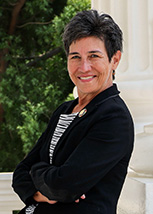
Photo of Susan Eggman
D California Senate · District 5 · Former member

Sen. Susan Eggman

Contact Email
Compare
Total votes
31,521
all sessions
Attendance
91%
1,943 missed
Near the chamber average
With party
99%
of cast votes
Near the chamber average
Bipartisan score
0%
crosses aisle rarely
Near the chamber average
Sponsored
1,487
bills & resolutions
Lower than 89% of chamber peers
Committees
0
assignments
1,487 bills and resolutions

Sponsored bills

Total
1,487
Primary
263
Co-sponsor
1,224
This page
1,487
matching current filters
Co-sponsor AJR 13
Signed into law · California Assembly · Co-sponsor
Relative to the National Aeronautics and Space Administration.

This measure would urge the President and the Congress of the United States to continue to place an emphasis on increasing funding to NASA's budget and encouraging the expansive use of public-private partnerships to propel the industry forward into the next generation of advancement.

Signed into law Sep 7, 2017 1 co-sponsor
Co-sponsor ACR 8
Signed into law · California Assembly · Co-sponsor
Adverse childhood experiences: post-traumatic "street" disorder.

This measure would recognize adverse childhood experiences (ACEs) , also known as post-traumatic "street" disorder in communities of color, as having lasting negative outcomes to both physical and mental health with growing implications for our state.

Signed into law Sep 7, 2017 1 co-sponsor
Co-sponsor AB 920
Passed · California Assembly · Co-sponsor
Electricity: procurement plans: integrated resource plans.

Under existing law, the Public Utilities Commission (PUC) has regulatory authority over public utilities, including electrical corporations, while local publicly owned electric utilities, as defined, are under the direction of their governing boards. The Public Utilities Act requires the PUC to review and accept, modify, or reject a procurement plan for each electrical corporation and requires the procurement plan to include specified elements, among them a showing that it will achieve certain objectives. Existing law requires the PUC to identify a diverse and balanced portfolio of resources needed to ensure a reliable electricity supply that provides optimal integration of renewable energy in a cost-effective manner, and specifies the respective roles of electrical corporations and community choice aggregators in satisfying the portfolio needs for renewable integration. This bill would specify that a "diverse and balanced portfolio of resources" includes an appropriate mix of renewable capacity, including peaking, dispatchable, baseload, firm, and as-available capacity. The bill would additionally require the PUC to assess the need for, and benefits of, existing and future renewable baseload generation, and determine whether a procurement requirement for renewable baseload generation is necessary to meet the portfolio needs for renewable integration. Existing law requires the PUC to adopt a process for each load-serving entity, defined as including electrical corporations, electric service providers, and community choice aggregators, to file an integrated resource plan and a schedule for periodic updates to the plan to ensure that load-serving entities accomplish specified objectives. Existing law requires each load-serving entity to prepare and file an integrated resource plan consistent with those objectives on a time schedule directed by the PUC and subject to PUC review. This bill would require that an integrated resource plan ensure that the load-serving entity procures a balanced resource portfolio with an appropriate mix of renewable capacity, including peaking, dispatchable, baseload, firm, and as-available capacity. Existing law requires that the governing board of a local publicly owned electric utility with an annual electrical demand exceeding 700 gigawatthours adopt an integrated resource plan and a process for updating the plan at least once every 5 years to ensure the utility achieves specified objectives. Existing law requires that the integrated resource plan and any updates be filed with the State Energy Resources Conservation and Development Commission (Energy Commission) , requires the Energy Commission to review the plans and plan updates, and, if the Energy Commission determines a plan or plan update is deficient, to provide recommendations to correct the deficiencies. This bill would require the governing board, when reviewing the local publicly owned electric utility's integrated resource plan, to evaluate the mix of resources in the utility's total resource and renewable resource portfolios to ensure balanced portfolios with an appropriate mix of renewable capacity, including peaking, dispatchable, baseload, firm, and as-available capacity. The bill would require the governing board to assess the need for, and benefits of, existing and new renewable baseload generation and consider whether to procure renewable baseload generation for the utility. By placing additional requirements upon local publicly owned electric utilities, the bill would impose a state-mandated local program. The California Constitution requires the state to reimburse local agencies and school districts for certain costs mandated by the state. Statutory provisions establish procedures for making that reimbursement. This bill would provide that no reimbursement is required by this act for a specified reason.

Passed Sep 1, 2017 1 co-sponsor
Primary AB 413
Signed into law · California Assembly · Lead sponsor
Confidential communications: domestic violence.

Existing law makes it a crime, subject to specified exemptions, for a person to intentionally eavesdrop upon or record a confidential communication by means of an electronic amplifying or recording device without the consent of all parties to the confidential communication. Existing law exempts from the prohibition the recording of a confidential communication made for the purpose of obtaining evidence reasonably believed to relate to the commission by another party to the communication of certain crimes, including any felony involving violence against the person making the recording. Existing law also allows a judge to include a provision in a domestic violence restraining order permitting a victim of domestic violence to record any prohibited communication made to him or her by the perpetrator. This bill would allow a party to a confidential communication to record the communication for the purpose of obtaining evidence reasonably believed to relate to domestic violence, as specified, and the evidence so obtained would not be rendered inadmissible in a prosecution against the perpetrator for domestic violence. The bill would also authorize a victim of domestic violence who is seeking a domestic violence restraining order from a court to record specified communications made by the perpetrator for the exclusive purpose and use of providing the evidence to the court.

Signed into law Sep 1, 2017 0 co-sponsors
Co-sponsor AB 763
Passed · California Assembly · Co-sponsor
Independent Living Centers: funding.

Under existing law, the Department of Rehabilitation is required to provide various services to individuals with physical or mental disabilities who are found to be eligible therefor, including independent living services. Existing law provides for the operation of independent living centers, which are private, nonprofit organizations that provide specified services to individuals with disabilities, in order to assist those individuals in their attempts to live fuller and freer lives outside institutions. Under existing law, the department has the responsibility and authority for the encouragement of the planning, developing, and funding of independent living centers. Under existing law, each independent living center, except those centers that have been both established and maintained using specified federal funding as a primary base grant, is required to receive, to the extent funds are appropriated by the Legislature, at least $235,000 in base grant funds allocated by the department. This bill would delete the above exception for centers that were previously established and maintained with federal funding, thereby requiring those centers to also receive at least $235,000 in base grant funds allocated by the department. The bill would make related findings and declarations.

Passed Sep 1, 2017 1 co-sponsor
Primary AB 1088
Passed · California Assembly · Lead sponsor
Multifamily residential housing: energy programs.

The Warren-Alquist State Energy Resources Conservation and Development Act establishes the State Energy Resources Conservation and Development Commission (Energy Commission) and requires the Energy Commission to carry out studies, technical assessments, research projects, and data collection directed to reducing wasteful, inefficient, unnecessary, or uneconomic uses of energy. The Energy Conservation Act of 2001 states the intent of the Legislature to establish incentives in the form of grants and loans to low-income residents, small businesses, and residential property owners for constructing and retrofitting buildings to be more energy efficient. The act requires the Energy Commission, in consultation with the Public Utilities Commission (PUC) , to undertake certain actions for the purpose of full or partial funding of an eligible construction or retrofit project. The Clean Energy and Pollution Reduction Act of 2015 requires the Energy Commission to establish annual targets for statewide energy efficiency savings and demand reduction that will achieve a cumulative doubling of statewide energy efficiency savings in electricity and natural gas final end uses of retail customers by January 1, 2030, including measures specific to disadvantaged communities, as specified. Existing law requires the Energy Commission, by March 1, 2010, to establish a regulatory proceeding to develop and implement a comprehensive program to achieve greater energy savings in California's existing residential and nonresidential building stock. The California Renewables Portfolio Standard Program requires the PUC to establish a renewables portfolio standard requiring all retail sellers, as defined, to procure a minimum quantity of electricity products from eligible renewable energy resources, as defined, so that the total kilowatthours of those products sold to their retail end-use customers achieves 25% of retail sales by December 31, 2016, 33% by December 31, 2020, 40% by December 31, 2024, 45% by December 31, 2027, and 50% by December 31, 2030, with the 2024 to 2030 requirements imposed by the Clean Energy and Pollution Reduction Act of 2015. This bill would require the Energy Commission, by January 1, 2020, and in consultation with relevant state agencies and the public, to establish nonbinding statewide targets that are cost effective and feasible for reducing energy consumption and emissions of greenhouse gases from multifamily residential properties by January 1, 2030, taking into consideration the state's requirements for reducing emissions of greenhouse gases and the climate equity, doubling of energy efficiency, and increased use of renewable energy resources requirements set forth in the Clean Energy and Pollution Reduction Act of 2015. The bill would require the Energy Commission, as part of its ongoing comprehensive program to achieve greater energy savings in California's existing residential and nonresidential building stock, to consult with relevant entities, including, among others, an expert advisory committee established by the Energy Commission pursuant to the bill. The bill would, pursuant to that consultation, require the Energy Commission to do all of the following: (1) by January 1, 2020, develop statewide strategies and recommendations to better leverage existing and new programs and funding resources to accelerate integrated distributed energy resource, water, and health and safety improvement programs available to multifamily residential properties and low-income multifamily properties to achieve the state's requirements for reducing emissions of greenhouse gases and the climate equity, doubling of energy efficiency, and increased use of renewable energy resources requirements of the Clean Energy and Pollution Reduction Act of 2015, (2) by January 1, 2020, identify best practices from model programs, funding mechanisms, workforce development strategies, and a recommended action plan, and (3) by January 1, 2020, identify and implement ways to enhance the Energy Upgrade California Web site, or other appropriate statewide Web sites, to create a statewide Web site subcomponent for owners of multifamily residential properties and for residents of multifamily residential properties that identifies applicable distributed energy resource and water programs and points of contact. The bill would require the Energy Commission, in consultation with the expert advisory committee, to report to the Legislature, by January 1, 2019, on the strategies developed pursuant to this requirement along with any recommendations for legislative action that may need to be taken to implement those strategies. The bill would require the Energy Commission, the Department of Housing and Community Development, the PUC, the State Water Resources Control Board, the Department of Community Services and Development, and other relevant entities, to develop strategies by January 1, 2019, for standardized income eligibility verification processes for distributed energy resources and water programs and would require the Energy Commission to include the strategies and progress made in implementing them in its report to the Legislature. The bill would enact other related provisions.


Passed Sep 1, 2017 0 co-sponsors
Co-sponsor ACR 22
Signed into law · California Assembly · Co-sponsor
Relative to the Detective Sergeant Thomas A. Smith, Jr. Memorial Highway.

This measure would designate a specified portion of Interstate 680 in the City of San Ramon in the County of Contra Costa as the Detective Sergeant Thomas A. Smith, Jr. Memorial Highway. The measure would also request that the Department of Transportation determine the cost of appropriate signs showing this special designation and, upon receiving donations from nonstate sources covering that cost, erect those signs.

Signed into law Aug 30, 2017 1 co-sponsor
Co-sponsor AJR 1
Signed into law · California Assembly · Co-sponsor
Presidential elections: electoral college.

This measure would urge the United States Congress to propose and send to the states for ratification a constitutional amendment to abolish the electoral college and provide for the direct election of the President and Vice President of the United States by the popular vote of all eligible citizens of the United States.

Signed into law Aug 28, 2017 1 co-sponsor
Showing 781 to 790 of 1,487 bills
Previous 1 … 78 79 80 … 149 Next