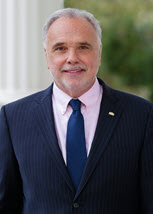
Photo of Mike Morrell
R California Senate · District 23

Sen. Mike Morrell

Compare
Total votes
18,326
all sessions
Attendance
95%
843 missed
Lower than 77% of chamber peers
With party
96%
of cast votes
Lower than 96% of chamber peers
Bipartisan score
3%
crosses aisle rarely
Higher than 93% of chamber peers
Sponsored
581
bills & resolutions
Lower than 87% of chamber peers
Committees
0
assignments
581 bills and resolutions

Sponsored bills

Total
581
Primary
183
Co-sponsor
398
This page
581
matching current filters
Co-sponsor ACR 27
died · California Assembly · Co-sponsor
Relative to César Chávez.

This measure would call upon all Californians to observe César Chávez's birthday, March 31, as a day of public service, to recognize the hard work and self-sacrifice that farmworkers go through to feed all the families in our state, and to learn from César Chávez's life and his mission of nonviolence, social justice, and selfless service to others.

died Nov 30, 2014 1 co-sponsor
Primary AB 2131
Failed · California Assembly · Lead sponsor
Pharmacy licenses: letters of reprimand.

Existing law, the Pharmacy Law, provides for the regulation and licensure of pharmacists by the California State Pharmacy Board. Existing law authorizes the board to refuse to license an applicant guilty of unprofessional conduct or to issue, at its sole discretion, a probationary license to an applicant who has met all other licensure requirements. This bill would authorize the board to issue a license to an applicant who has committed minor violations that the board deems, in its discretion, do not merit the denial of a license or require probationary status, and to concurrently issue a public letter of reprimand, as specified. The bill would require the letter of reprimand to, among other things, describe in detail the nature and facts of the violation and inform the licensee that he or she may accept the letter of reprimand without challenge or, within 30 days of service of the letter, submit a written request for an office conference to contest the letter of reprimand. The bill requires the executive director of the board, or his or her designee, to hold an office conference with the licensee and his or her legal counsel or authorized representative, if any, within 30 days of receipt of the request, as specified. The bill authorizes the executive officer, or his or her designee, to affirm, modify, or withdraw the letter of reprimand and requires the executive officer, or his or her designee, to provide the licensee with a written decision within 14 calendar days from the date of the office conference. The bill would require a letter of reprimand issued concurrently with a board license to be purged 3 years from the date of issuance, as specified. The bill would require a letter of reprimand to be disclosed to an inquiring member of the public and posted on the board's Internet Web site.

Failed Nov 30, 2014 0 co-sponsors
Primary AB 2524
died · California Assembly · Lead sponsor
County highways.

Existing law provides that a county highway, once established, shall continue to be a county highway until abandoned by order of the board of supervisors, by operation of law, or by judgment of a court. This bill would make nonsubstantive changes to this provision.

died Nov 30, 2014 0 co-sponsors
Co-sponsor SB 1379
Failed · California Senate · Co-sponsor
Political reform.

Existing law, the Political Reform Act of 1974, provides for the comprehensive regulation of campaign financing, including requiring the reporting of campaign contributions. The act imposes a contribution limit of $3,000 on contributions made to, and received by, candidates for elective state offices that are not statewide elective offices. The act is administered and enforced by the Fair Political Practices Commission, which is authorized to adjust the contribution limit to reflect changes in the Consumer Price Index, as specified. The act does not limit the amount of contributions that a person may make to a committee that is primarily formed to support or oppose one or more ballot measures. The act prohibits a candidate for elective state office or a committee controlled by that candidate from making a contribution to another candidate for elective state office in excess of the contribution limit for elective state offices. The act imposes various restrictions and reporting requirements on Members of the Legislature and candidates for either house of the Legislature, including prohibiting or restricting earned income from a lobbyist or lobbyist employer, restricting the receipt of gifts, and restricting the purposes for which campaign funds may be expended. This bill would prohibit a person from making to a committee controlled by a candidate for elective office that is primarily formed to support or oppose one or more ballot measures, and prohibit such a committee from receiving, a contribution in excess of the contribution limit for elective state offices, as specified. The bill would prohibit a candidate for any elective office, or the candidate's controlled committees, from making a contribution to another candidate for elective office or a committee controlled by a candidate that is primarily formed to support or oppose one or more ballot measures in excess of the contribution limit established for candidates for elective state office. This bill would prohibit a committee controlled by a candidate for elective office that is primarily formed to support or oppose one or more ballot measures from expending campaign funds to make a contribution or other transfer of campaign funds to a committee for a purpose other than supporting or opposing a ballot measure that the controlled committee was primarily formed to support or oppose. This bill would prohibit a lobbyist or lobbyist employer from providing any compensation to a spouse or dependent of a Member or candidate, except as specified. The bill would prohibit campaign funds from being used to compensate a spouse or dependent of a Member of the Legislature or of a candidate for either house of the Legislature. This bill would prohibit the expenditure of campaign funds for attorney's fees and other costs in connection with criminal litigation, and would limit the payment of criminal litigation attorney's fees and other related legal costs arising directly out of the conduct of an election campaign, the electoral process, or the performance of the officer's governmental activities or duties to funds deposited in a legal defense account created pursuant to other specified provisions of law. The bill would also prohibit a committee that is not a legal defense committee from making an expenditure of campaign funds to any legal defense account. This bill would require a Member of the Legislature or a candidate for either house of the Legislature to report to the Secretary of State a contribution of one thousand dollars ($1,000) or greater within three business days of receipt of the contribution. A violation of the act's provisions is punishable as a misdemeanor. By expanding the scope of an existing crime, this bill would impose a state-mandated local program. Existing law subjects any member of the Legislature or any member of the legislative body of a city, county, city and county, school district, or other special district, and every executive or ministerial officer, employee, or appointee of the state, a county or city, or political subdivision, who asks for or receives a bribe in exchange for influence over his or her official action to imprisonment in a state prison for 2, 3, or 4 years, and imposes prescribed restitution fines based on whether a bribe has actually been received. This bill would increase the punishment to 4, 6, or 8 years in state prison and would increase the restitution fines to twice the original amount. The California Constitution requires the state to reimburse local agencies and school districts for certain costs mandated by the state. Statutory provisions establish procedures for making that reimbursement. This bill would provide that no reimbursement is required by this act for a specified reason. The Political Reform Act of 1974, an initiative measure, provides that the Legislature may amend the act to further the act's purposes upon a 23 vote of each house and compliance with specified procedural requirements. This bill would declare that it furthers the purposes of the act. This bill would declare that it is to take effect immediately as an urgency statute.

Failed Nov 30, 2014 1 co-sponsor
Primary AB 2407
died · California Assembly · Lead sponsor
Elections: expenses.

Existing law provides that expenses authorized and necessarily incurred in the preparation for and conduct of elections are to be paid from the county treasuries, except as specified. This bill would make technical nonsubstantive changes to this provision of law.

died Nov 30, 2014 0 co-sponsors
Co-sponsor AB 1264
Failed · California Assembly · Co-sponsor
Comprehensive school safety plans: tactical response plans.

(1) Existing law provides that school districts and county offices of education are responsible for the overall development of comprehensive school safety plans for its schools operating kindergarten or any of grades 1 to 12, inclusive. Existing law requires the schoolsite council of a school to write and develop a school safety plan relevant to the needs and resources of the particular school, except as specified with regard to a small school district. Existing law requires the school safety plan to include specified strategies and programs that will provide or maintain a high level of school safety. Existing law authorizes a school district or county office of education to elect to not have its schoolsite council develop and write portions of its school safety plan that include tactical responses to criminal incidents, as defined, and instead develop those portions of the school safety plan with law enforcement officials and other specified persons. Existing law requires any vote to approve the tactical response plan to be announced in open session following a closed session. Existing law provides certain protections from disclosure for this tactical response plan. This bill would require a comprehensive school safety plan to include a tactical response plan, and would revise the definition of "tactical responses to criminal incidents" to include a plan to safeguard against incidents that include a firearm, explosive, or other deadly weapon. The bill would require any vote to approve or update the tactical response plan to be announced in open session following a closed session. The bill would prohibit the governing board of a school district or a county office of education from being required to disclose those portions of the tactical response plan that may be kept private. (2) By requiring school districts and county offices of education to perform additional duties in regards to their comprehensive school safety plans, the bill would impose a state-mandated local program. The California Constitution requires the state to reimburse local agencies and school districts for certain costs mandated by the state. Statutory provisions establish procedures for making that reimbursement. This bill would provide that, if the Commission on State Mandates determines that the bill contains costs mandated by the state, reimbursement for those costs shall be made pursuant to these statutory provisions.

Failed Nov 30, 2014 1 co-sponsor
Primary AB 1745
Failed · California Assembly · Lead sponsor
Personal income tax: credits: charitable contributions.

The Personal Income Tax Law allows various credits against the tax imposed by that law. This bill would allow a credit against that tax for each taxable year beginning on or after January 1, 2014, in an amount equal to the amount donated to a qualified charitable organization, as defined, not to exceed a specified amount per taxable year. This bill would require the Franchise Tax Board to certify that the organization is a qualified charitable organization and post a list of the certified qualified charitable organizations on its Internet Web site. This bill would take effect immediately as a tax levy.

Failed Nov 30, 2014 0 co-sponsors
Primary AB 2461
died · California Assembly · Lead sponsor
Employment: payroll records: right to inspect.

Existing law requires an employer to furnish each employee with an accurate itemized statement showing, among other things, the gross and net wages earned, the inclusive dates of the pay period, and all deductions. Existing law requires the employer to keep on file a copy of the statement for at least 3 years at a specified location. Existing law affords current and former employees the right to inspect or copy records pertaining to their employment, upon reasonable request to the employer. Under existing law, if the employer provides copies of the records, the employer is authorized to charge any actual costs of reproduction of the employee's records to the current or former employee. This bill would make a technical, nonsubstantive change to these provisions.

died Nov 30, 2014 0 co-sponsors
Co-sponsor AB 1536
Failed · California Assembly · Co-sponsor
Public transportation employees: strikes: prohibition.

Existing law prescribes procedures governing disputes between exclusive bargaining representatives of public transportation employees and local agencies, and authorizes the Governor, when it appears a strike will significantly disrupt transportation services and endanger public health, safety, and welfare, to appoint a board to investigate issues in connection with these labor negotiations and make a report. Existing law prohibits a strike during the period of investigation and permits the Governor, upon receiving a report from a board of investigation, to request the Attorney General to petition a court to enjoin the strike, as specified. This bill would repeal those provisions that authorize the Governor to appoint a board to investigate when it appears a strike will significantly disrupt transportation services, prohibit a strike during the period of investigation, and that authorize the Governor to request the Attorney General to petition a court to enjoin the strike. The bill would instead prohibit a state or local public transportation employee or public transportation employee organization from engaging in, causing, instigating, encouraging, or condoning a strike. The bill would also provide that a person who, on behalf of a public transportation employer, exercises authority, supervision, or direction over a public transportation employee shall not have the power to, and shall not purport to, authorize, approve, condone, or consent to a strike by a public transportation employee. The bill would establish a process for a public transportation employee to object to a determination by the chief executive officer of the public transportation employer that he or she violated these provisions by filing a sworn affidavit under penalty of perjury, thus expanding the definition of a crime. The bill would require the chief executive officer, if he or she determines that the objection raises a question of fact that if resolved in favor of the employee would establish that the employee did not commit the violation, to appoint an officer to conduct a hearing on the matter at which the employee would bear the burden of proving by a preponderance of the evidence that he or she did not commit the violation, as specified. The bill would require the Public Employment Relations Board to hold a hearing to determine whether an employee organization violated these provisions, and would require the employer and the employee organization to be permitted to be represented by counsel. The bill would provide that a public transportation employee who violates these provisions is subject to removal or other disciplinary action, and would authorize the chief financial officer of the employer to deduct from the compensation of a public transportation employee found to have violated these provisions an amount equal to twice his or her daily rate of pay for each day or part thereof that it was determined that he or she violated these provisions. The bill would also require the board, if it determines that an employee organization violated these provisions, to order forfeiture of specified rights granted by state law to recognized employee organizations. The bill would also require the chief executive officer of the employer, within 60 days of the end of a strike, to prepare a written report, to be made public, that contains specified information regarding the circumstances surrounding the strike, the names of those public transit employees who the chief executive officer has reason to believe were responsible for causing, instigating, or encouraging the strike, and the sanctions imposed or proceedings pending against those employees. Because the bill would expand the definition of a crime and require local officers to perform additional duties, the bill would impose a state-mandated local program. The California Constitution requires the state to reimburse local agencies and school districts for certain costs mandated by the state. Statutory provisions establish procedures for making that reimbursement. This bill would provide that with regard to certain mandates no reimbursement is required by this act for a specified reason. With regard to any other mandates, this bill would provide that, if the Commission on State Mandates determines that the bill contains costs so mandated by the state, reimbursement for those costs shall be made pursuant to the statutory provisions noted above.


Failed Nov 30, 2014 1 co-sponsor
Primary SB 1001
Failed · California Senate · Lead sponsor
Actions for damages: felony offenses.

Existing law provides for the time of commencing civil actions other than for the recovery of real property, as specified. Under existing law, unless a longer period is prescribed for a specific action, an action for damages against a defendant based upon the defendant's commission of a felony offense for which the defendant has been convicted is required to be brought within one year after the judgment has been pronounced. Existing law also authorizes an action for damages to be brought within 10 years of the date on which the defendant is discharged from parole if the conviction was for any of certain serious felonies, as specified. This bill would include a human trafficking offense as a serious felony for which an action for damages against a defendant may be brought within 10 years from the date on which the defendant is discharged from parole, and would make other nonsubstantive changes and update a cross-reference in these provisions.

Failed Nov 30, 2014 0 co-sponsors
Showing 261 to 270 of 581 bills
Previous 1 26 27 28 59 Next