

(1) Existing law tolls the periods of limitation to bring specific civil actions for up to 2 years, if during that time that the claimant is imprisoned on a criminal charge, as specified. However, under existing law these tolling provisions do not apply to an action brought against a public entity or public employee, as specified. This bill would, notwithstanding any other law, provide that the period for bringing an action for sexual assault against a public entity or public employee that is alleged to have occurred while the claimant was imprisoned on a criminal charge, or in execution under the sentence of a criminal court, is tolled during the entire period of the claimant's imprisonment or sentence. Under the bill, any claim for sexual assault against a public entity or public employee subject to that provision is exempt from all state and local government claim presentation requirements. (2) Existing law establishes the Office of the Sexual Abuse in Detention Elimination Ombudsperson with the authority to inspect all of the Department of Corrections and Rehabilitation institutions and to interview all inmates and wards. Under existing law, if an investigation confirms that any employee of the department has sexually abused an inmate or ward, that employee is required to be terminated. Existing law prohibits retaliation against an inmate or ward for making an allegation of sexual abuse. Existing law requires the department to keep statistics on the sexual abuse of inmates and wards and make that data available to the Office of the Sexual Abuse in Detention Elimination Ombudsperson. This bill would prohibit an employee who has been terminated after an investigation confirms that the employee has sexually abused an incarcerated person or ward from future employment with the department. This bill would require the department to monitor for 90 days an incarcerated person who reports sexual assault, and the incarcerated person reported to have suffered the sexual assault, by a staff member for possible retaliation. The bill would require the department to make specific notifications and reporting after an incarcerated person is reported to have suffered a sexual assault. The bill would require the department, on or before January 1, 2028, to develop and implement procedures for notifications of an incarcerated person's contact person, as defined. The bill would require the department to minimize the transfer of an incarcerated person who is reported to have suffered a sexual assault by a staff member for 90 days following the report, unless there is an operational need to do so or there are safety, security, or health concerns. The bill would define terms for its purposes and declare these provisions are severable.
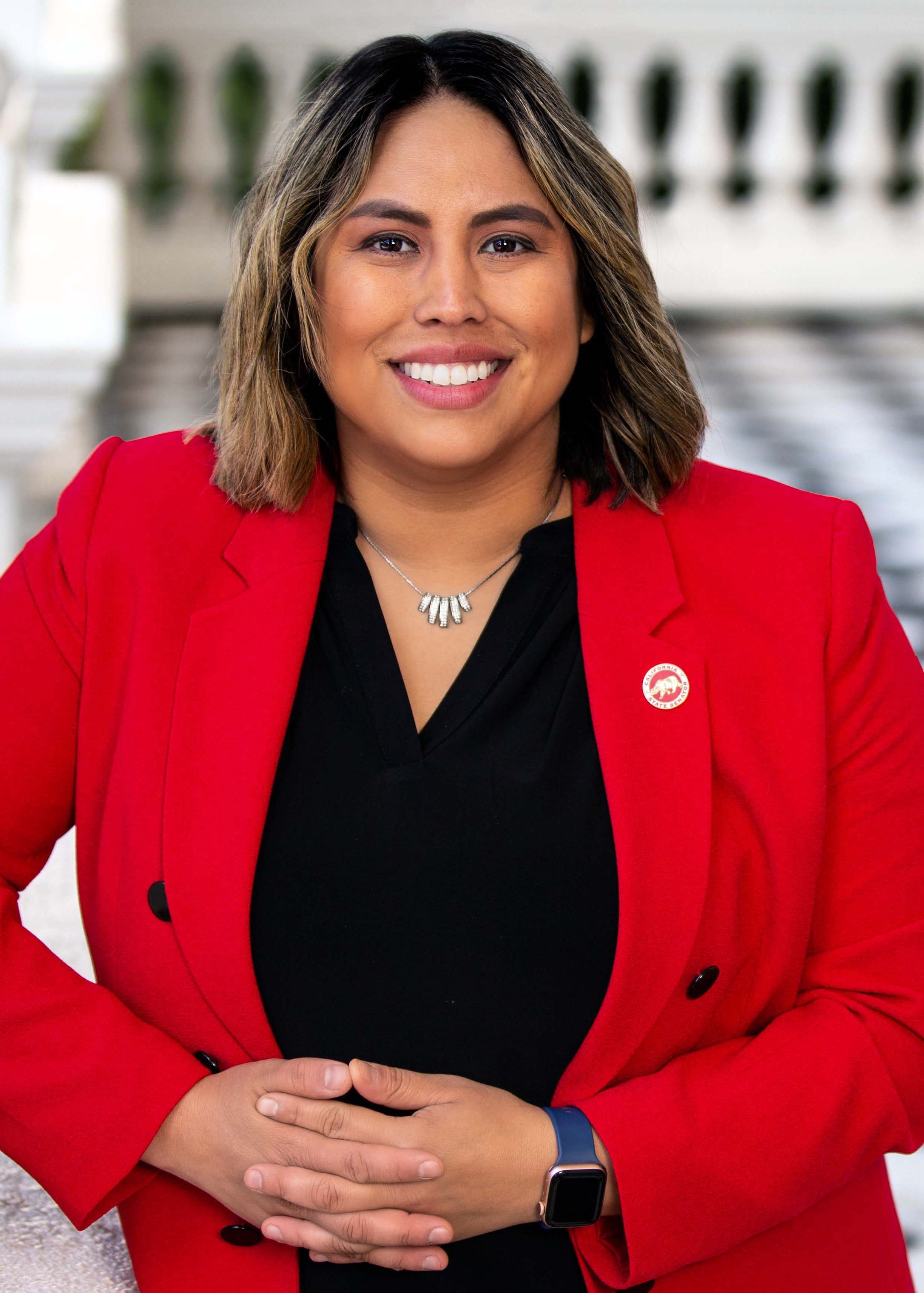
Sen. Caroline Menjivar
Sponsored bills
Existing law establishes a specialized license plate program and requires the Department of Motor Vehicles to issue specialized license plates, also referred to as environmental license plates, on behalf of a sponsoring state agency if the agency receives 7,500 applications for that plate within a 12-month period, among other requirements. Existing law authorizes a person who is the registered owner or lessee of a vehicle to apply to the department for specialized license plates. Existing law imposes a fee, in addition to the regular registration fee, for the issuance, renewal, retention, transfer, and duplication of specialized license plates. Existing law requires that all revenue derived from these fees be deposited in the California Environmental License Plate Fund. This bill would require the Arts Council to apply to the department to sponsor "The Lowrider" specialized license plate program, as specified. The bill would require the design of the plate to reflect lowrider culture and heritage. The bill would require the council to consult with a nonprofit entity for plate design consultation, stakeholder engagement, publicity, and community outreach. The bill would authorize the council to accept and use donated or licensed artwork from a nonprofit entity for these purposes, and to use funds from nonprofit or private sources to augment implementation. The bill would require the department, after deducting its administrative costs, to deposit additional revenue derived from the issuance, renewal, transfer, and substitution of the plate into the Specialized License Plate Fund in the State Treasury. The bill would require the council to use those funds, upon appropriation by the Legislature, to fund projects that include, among others, supporting lowrider arts and cultural preservation efforts. The bill would authorize the council to use 4 to 6% of those funds to consult with or enter into an agreement with a nonprofit entity to support implementation of the program.
Existing law, the Knox-Keene Health Care Service Plan Act of 1975, provides for the licensure and regulation of health care service plans by the Department of Managed Health Care and makes a willful violation of the act a crime. Existing law provides for the regulation of disability insurers by the Department of Insurance. Existing law requires a health care service plan or disability insurer to allow an individual to enroll in or change their health benefit plan as a result of a specified triggering event. This bill would make pregnancy a triggering event for purposes of enrollment or changing a health benefit plan. Because a willful violation of this provision by a health care service plan would be a crime, the bill would impose a state-mandated local program. The California Constitution requires the state to reimburse local agencies and school districts for certain costs mandated by the state. Statutory provisions establish procedures for making that reimbursement. This bill would provide that no reimbursement is required by this act for a specified reason.
Existing law requires the State Water Resources Control Board to develop a plan for the funding and implementation of the Low-Income Water Rate Assistance Program. Existing law requires the plan to include, among other things, a description of the method for collecting moneys to support and implement the program and a description of the method for determining the amount of moneys that may need to be collected from water ratepayers to fund the program. This bill would establish the Water Rate Assistance Program. As part of the program, the bill would establish the Water Rate Assistance Fund in the State Treasury, available upon appropriation by the Legislature, to provide water affordability assistance for residential water services to low-income residential ratepayers, as specified. The bill would establish separate implementation procedures depending on whether the state board determines that the Legislature appropriated enough moneys from the fund for a partial implementation of the program or a statewide implementation of the program. The bill would require the state board to take various actions in administering the fund, including, among other things, tracking and managing revenue in the fund separately from all other revenue. The bill would require the state board, in consultation with relevant agencies and after a public hearing, to adopt guidelines for implementation of the program and to adopt and submit a report to the Legislature or post the report on its internet website, as specified. The bill would require the guidelines to include minimum requirements for eligible systems, including the ability to confirm eligibility for enrollment through a request for self-certification of eligibility under penalty of perjury. By expanding the crime of perjury, the bill would impose a state-mandated local program. The bill would require the state board to take various actions in administering the program, including, but not limited to, providing guidance, oversight, and funding for low-income rate assistance for residential ratepayers of eligible systems. The bill would authorize the Attorney General, at the request of the state board, to bring an action in state court to restrain the use of any method, act, or practice in violation of these provisions, except as provided. The bill would make the implementation of all of these provisions contingent upon an appropriation by the Legislature. The California Constitution requires the state to reimburse local agencies and school districts for certain costs mandated by the state. Statutory provisions establish procedures for making that reimbursement. This bill would provide that no reimbursement is required by this act for a specified reason.
(1) Existing law, the California Healthy Youth Act, requires school districts, defined to include county boards of education, county superintendents of schools, the California School for the Deaf, the California School for the Blind, and charter schools, to ensure that all pupils in grades 7 to 12, inclusive, receive comprehensive sexual health education and human immunodeficiency virus (HIV) prevention education, as specified. This bill would authorize the State Department of Education to monitor compliance with the requirements of the California Healthy Youth Act as part of its annual compliance monitoring of state and federal programs. (2) Existing law establishes the Office of School-Based Health Programs for the purpose of assisting local educational agencies regarding the current health-related programs under the purview of the State Department of Education including, among other duties, coordinating school health program activities with public health, social services, environmental, and local educational agencies, and other public and private entities. This bill would prohibit a local educational agency, as defined, from prohibiting school-based health centers, as defined, that serve schools of the local educational agency from making internal and external condoms available and easily accessible to pupils in any of grades 7 to 12, inclusive, at the school-based health center site and would require a school of a local educational agency to allow condoms to be made available to pupils in any of grades 7 to 12, inclusive, during the course of, or in connection with, educational or public health programs and initiatives, as provided. To the extent the bill imposes additional duties on local educational agencies, the bill would impose a state-mandated local program. (3) Under existing law, the Sherman Food, Drug, and Cosmetic Law, the State Department of Public Health generally regulates the packaging, labeling, advertising, and sale of food, drugs, devices, and cosmetics, in accordance with the Federal Food, Drug, and Cosmetic Act. A violation of those provisions is generally a crime. Existing law sets forth various other provisions relating to the furnishing and health care coverage of certain types of contraception. This bill would, with certain exceptions, prohibit a retail establishment, as defined, from refusing to furnish nonprescription contraception to a person solely on the basis of age by means of any conduct, including, but not limited to, requiring the customer to present identification for purposes of demonstrating their age. Under the bill, a violation of that prohibition would be exempt from the above-described criminal penalty. (4) The California Constitution requires the state to reimburse local agencies and school districts for certain costs mandated by the state. Statutory provisions establish procedures for making that reimbursement. This bill would provide that, if the Commission on State Mandates determines that the bill contains costs mandated by the state, reimbursement for those costs shall be made pursuant to the statutory provisions noted above.
Existing law authorizes an unmarried person who is under 18 years of age to marry upon obtaining a court order granting permission and the written consent of at least one of the parents or the guardian of each underage party to the marriage, as specified. Existing law requires the court, if it considers it necessary, as part of the court order granting permission to marry, to require the parties to the prospective marriage of a minor to participate in premarital counseling, as specified. Existing law provides that 2 unmarried, unrelated adults who have chosen to share one another's lives in an intimate and committed relationship of mutual caring may establish a domestic partnership by filing a declaration with the Secretary of State, if certain requirements are met. Existing law provides that a person under 18 years of age who, together with the person with whom the person proposes to establish a domestic partnership, meets the requirements for a domestic partnership other than the requirement of being at least 18 years of age, is capable of consenting to and establishing a domestic partnership upon obtaining a court order granting permission to the underage person or persons to establish a domestic partnership. Under existing law, registered domestic partners have the same rights, protections, and benefits as spouses. This bill would repeal the authorization for a person under 18 years of age to be issued a marriage license or to establish a domestic partnership, thereby prohibiting a person under 18 years of age from being issued a marriage license or from establishing a domestic partnership. The bill would make conforming changes. Existing law requires the State Registrar to create a document, no later than March 1, 2020, concerning marriage certificates in which one or both of the parties were minors at the time of solemnization of the marriage. Existing law requires the State Registrar to update that document annually, as specified. Existing law requires the local registrar to submit specified information for the purposes of that report. This bill would repeal those provisions.
Existing law, the Reproductive Privacy Act, declares as contrary to the public policy of this state a law of another state that authorizes a person to bring a civil action against a person or entity that engages in certain activities relating to obtaining or performing an abortion. Existing law prohibits the state from applying an out-of-state law to a case or controversy in state court or enforcing or satisfying a civil judgment under the out-of-state law. This bill would specify that the protections applicable to persons who engage in legally protected health care activity, as defined, apply to a person who previously has undertaken one or more acts or omissions while in another United States jurisdiction to aid or encourage, or attempt to aid or encourage, any person in the exercise and enjoyment, or attempted exercise and enjoyment, of rights to reproductive health care services or gender affirming health care services if the acts or omissions were permissible under the laws of the jurisdiction in which the person was located at the time of the acts or omissions. Existing law prohibits a state or local law enforcement agency or officer from knowingly arresting or knowingly participating in the arrest of any person for performing, supporting, or aiding in the performance of legally protected health care activity, if the health care activity is lawful in this state. Existing law prohibits a state or local public agency from cooperating with or providing information to an individual or agency from another state or a federal law enforcement agency, as specified, regarding a legally protected health care activity that is lawful in this state. Under existing law, the Governor may surrender, on demand of executive authority of any other state, any person in this state charged in the other state, as specified, with committing an act in this state, or in a 3rd state, intentionally resulting in a crime in the state whose executive authority is making the demand. This bill would prohibit the Governor from recognizing a request for extradition of a person subject to criminal liability based on the alleged provision or receipt of, assistance in the provision or receipt of, material support for, or in any theory of vicarious, joint, several, or conspiracy liability for any legally protected health care activity, except as specified.
This measure would memorialize the Legislature's strong disagreement with the decision of the United States Supreme Court in Citizens United v. Federal Election Commission and encourage states to adopt policies to limit the powers of corporations to contribute to political campaigns, consistent with the United States Constitution.
Maddy summaryThis bill designates August 7, 2026, as Purple Heart Day within the state of California. It directly affects state agencies and the general public by establishing an official date to honor military personnel who have received the Purple Heart medal. The measure requires no new funding or changes to existing laws, serving instead as a formal recognition of service and sacrifice.
Existing law subjects a minor between 12 and 17 years of age, who violates any federal, state, or local law or ordinance, and a minor under 12 years of age who is alleged to have committed specified serious offenses, to the jurisdiction of the juvenile court, which may adjudge the minor to be a ward of the court. Existing law also establishes the transition jurisdiction or the juvenile court and subjects certain minors who are older than 17 years and 5 months of age and younger than 18 years of age, and certain nonminors who are older than 18 years of age and less than 21 years of age, who were wards of the juvenile court and in foster care placement to that jurisdiction. Existing law assigns various responsibilities relating to these individuals to the probation officer, including, among others, the responsibility to supervise minors placed on probation. Existing law requires every county to appoint a chief probation officer and requires the chief probation officer to perform the duties and discharge the obligations imposed on the office by law or by order of the superior court, including, among other things, community supervision of the minors described above and the operation of juvenile halls, camps, and ranches, pursuant to specified provisions. This bill would authorize the board of supervisors in a county with a population of at least 6,000,000 people to, except as specified, delegate to a county official who has jurisdiction over youth development, diversion, and reentry all or part of the duties and authorities concerning these individuals, as specified. The bill would require the county board of supervisors to delegate all or part of these duties and authorities to a county official that is part of a collective bargaining unit. Existing law generally limits access to juvenile case files, as defined. Existing law authorizes only certain individuals to inspect a juvenile case file, including, among others, the county counsel, city attorney, or any other attorney representing the petitioning agency in a dependency action. This bill would additionally authorize county officials who have been delegated duties, authorities, or both, as described above, to inspect a juvenile case file.