

Existing law contains numerous provisions governing the qualifications, standards, and training of peace officers. Existing law requires specified peace officers to successfully complete a training course prescribed by the Commission on Peace Officer Standards and Training (POST) before exercising the powers of a peace officer. Existing law requires the commission, for those instances where individuals have acquired prior comparable peace officer training, to adopt regulations providing for alternative means for satisfying the training required by a specified provision of law. Existing regulations provide a Basic Course Waiver to individuals with qualifying out-of-state or federal law enforcement experience whose law enforcement training, experience, and education are deemed by POST to demonstrate sufficient law enforcement knowledge, skill, and proficiency. This bill would provide that service as a sworn federal law enforcement officer whose primary duties consisted of any one or any combination of immigration inspection, border enforcement, or apprehension, detention, or removal of noncitizens under the federal immigration laws, and the training for that service, does not, standing alone, constitute qualifying training, experience, and education demonstrating sufficient law enforcement knowledge, skill, and proficiency for purposes of determining eligibility for a Regular Basic Course Waiver. By increasing duties on local law enforcement agencies, this bill would impose a state-mandated local program. The California Constitution requires the state to reimburse local agencies and school districts for certain costs mandated by the state. Statutory provisions establish procedures for making that reimbursement. This bill would provide that, if the Commission on State Mandates determines that the bill contains costs mandated by the state, reimbursement for those costs shall be made pursuant to the statutory provisions noted above.
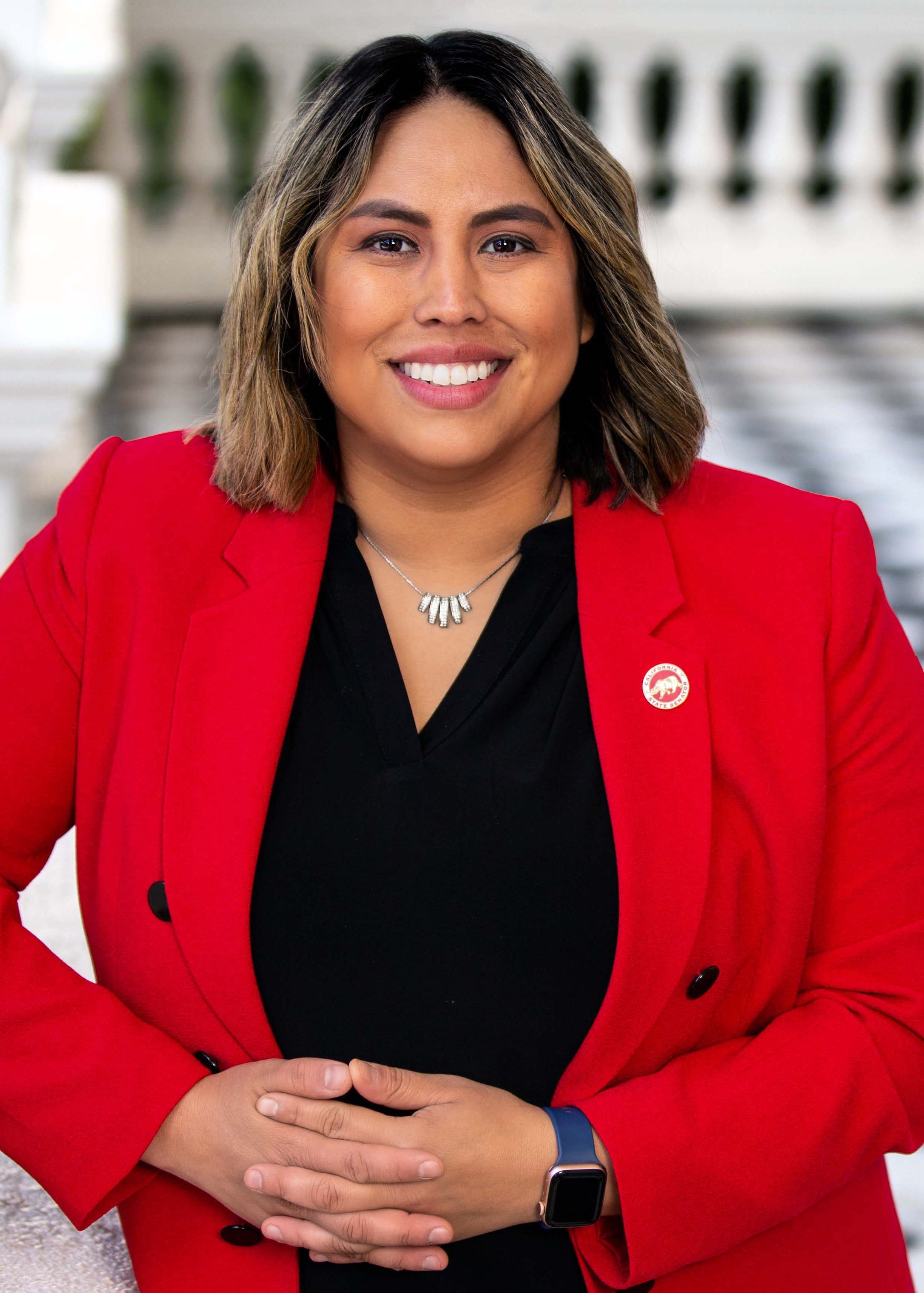
Sen. Caroline Menjivar
Sponsored bills
Existing law, the Knox-Keene Health Care Service Plan Act of 1975, provides for the licensure and regulation of health care service plans by the Department of Managed Health Care and makes a willful violation of the act a crime. Existing law also provides for the regulation of health insurers by the Department of Insurance. Existing law requires an individual or small group health care service plan contract or health insurance policy to include, at a minimum, coverage for essential health benefits, as specified. Commencing January 1, 2027, if the United States Department of Health and Human Services approves a new essential health benefits benchmark plan for the state, existing law requires essential health benefits to include an annual hearing exam and one hearing aid per ear every three years. This bill, the Let California Kids Hear Act, would require a large group health care service plan contract or health insurance policy issued, amended, or renewed on or after January 1, 2028, to include coverage for hearing aids, as defined, and related services for enrollees and insureds under 21 years of age, if medically necessary. The bill would authorize a large group health care service plan contract or health insurance policy to limit the dollar coverage for each individual hearing aid device to $3,000, as specified. Because a willful violation of these requirements by a health care service plan would be a crime, the bill would impose a state-mandated local program. The California Constitution requires the state to reimburse local agencies and school districts for certain costs mandated by the state. Statutory provisions establish procedures for making that reimbursement. This bill would provide that no reimbursement is required by this act for a specified reason.
For purposes of state apportionments based on average daily attendance, as provided, if the average daily attendance of a school district, county office of education, or charter school has been materially decreased during a fiscal year because of a specified emergency, including, among others, the imminence of a major safety hazard as determined by a local law enforcement agency, existing law requires the Superintendent of Public Instruction to estimate the average daily attendance in a manner that credits to the school district, county office of education, or charter school approximately the total average daily attendance that would have been credited to the school district, county office of education, or charter school had the emergency not occurred. This bill, for the above-described purposes, would additionally allow a local fire agency to make a determination of the imminence of a major safety hazard. This bill would declare that it is to take effect immediately as an urgency statute.
Existing law, the Healthy Workplaces, Healthy Families Act of 2014, entitles an employee who works in California for the same employer for 30 or more days within a year from the commencement of employment to paid sick days. Under existing law, an employee accrues paid sick days at a rate of not less than one hour per every 30 hours worked, subject to certain use, accrual, and yearly carryover limitations. This bill would require specified fire departments to provide a paid leave of absence of up to 26 weeks to an active firefighting member who requests leave because the firefighter is disabled by pregnancy, childbirth, or a related medical condition, as provided. The bill would apply to an active firefighting member who has at least 1,250 hours of service with the fire department in the 12-month period before the date on which the paid leave begins and would require the leave to be with full pay, except as specified, at the firefighter's regular rate of pay set forth in a collective bargaining agreement and in accordance with their normal pay schedule. The bill would require all benefits to continue to accrue during the paid leave, as specified, and would require a firefighter returning from the paid leave to be restored to their prior position, as provided. The bill would request a fire department of the University of California to comply with these provisions.
Existing law makes it a crime for a law enforcement officer to wear a facial covering in the performance of their duties, except as specified. Existing law defines law enforcement officer for these purposes as anyone designated by California law as a peace officer who is employed by a city, county, or other local agency, and any officer or agent of a federal law enforcement agency, agency or law enforcement agency of another state, or any person acting on behalf of a federal law enforcement agency. This bill would add peace officers employed by a state agency to the definition of law enforcement officers, thereby making those law enforcement officers subject to those criminal penalties. The bill would specify that facial coverings does not include certain items, including, among other things, sunglasses. The bill would, for all of the items excluded from the definition of facial coverings, limit that exclusion if the items are combined or otherwise used in a manner intended to conceal or obscure an officer's identity. By expanding the scope of a crime, this bill would impose a state-mandated local program. Existing law prohibits any person who is found to have committed an assault, battery, false imprisonment, false arrest, abuse of process, or malicious prosecution, while wearing a facial covering in a knowing and willful violation of these provisions, from asserting any privilege or immunity for their tortious conduct against a claim of civil liability, and makes that person liable for the greater of actual damages or statutory damages of not less than $10,000, whichever is greater. This bill would instead make a person who is found liable for false imprisonment or false arrest liable for those damages if the trier of fact finds that the person knowingly and willfully concealed their identity through the use of a facial covering at the time of the conduct giving rise to liability. Existing law requires a law enforcement agency operating in California to, by July 1, 2026, maintain and publicly post a written policy limiting the use of facial coverings, as specified. Existing law defines a law enforcement agency for these purposes as any entity of a city, county, or other local agency, that employs anyone designated by California law as a peace officer, any federal law enforcement agency, or any law enforcement agency of another state. This bill would add to the definition of law enforcement agency, a state entity that employs a peace officer and would change the date any law enforcement agency has to comply with that requirement to January 1, 2027. The bill would also require those policies to exempt certain surveillance operations related to enforcement of the Fish and Game Code, or similar federal law. The California Constitution requires the state to reimburse local agencies and school districts for certain costs mandated by the state. Statutory provisions establish procedures for making that reimbursement. This bill would provide that no reimbursement is required by this act for a specified reason.
Existing law authorizes the legislative body of a local agency, as defined, to, by ordinance, make any violation of an ordinance subject to an administrative fine or penalty. Existing law requires a local agency to set forth, by ordinance, the administrative procedures that govern the imposition, enforcement, collection, and administrative review of those administrative fines or penalties. Existing law requires the administrative procedures to provide for a reasonable period of time, as specified in the ordinance, for a person responsible for a continuing violation to correct or otherwise remedy the violation prior to the imposition of administrative fines or penalties, when the violation pertains to building, plumbing, electrical, or other similar structural or zoning issues, that do not create an immediate danger to health or safety. This bill would require, for any violation pertaining to building, plumbing, electrical, or other similar structural or zoning issues, that do not create an immediate danger to health or safety, of any ordinance enacted by the local agency, the reasonable period of time to correct or otherwise remedy the violation to be no less than 6 months if certain conditions are met, including that the property involved is an owner-occupied residential property containing 4 units or less and the current owner of the property submits a sworn affidavit that the current owner was not responsible for any action that caused the violation and that the current owner had no knowledge of the violation at the time the owner took title to the property. These provisions would not apply to an administrative fine or penalty imposed for a violation of various laws, regulations, and ordinances, as specified. By requiring a sworn affidavit, the bill would expand the crime of perjury, thereby imposing a state-mandated local program. The bill would require a local agency to extend the reasonable period of time described above by an additional 6 months upon a showing by the current owner of a good faith effort to correct or otherwise remedy the violation, and would authorize the agency to extend the reasonable period of time beyond that extension in its discretion, as specified. The bill would include findings that changes proposed by this bill address a matter of statewide concern rather than a municipal affair and, therefore, apply to all cities, including charter cities. The California Constitution requires the state to reimburse local agencies and school districts for certain costs mandated by the state. Statutory provisions establish procedures for making that reimbursement. This bill would provide that no reimbursement is required by this act for a specified reason.
Existing law establishes the Emergency Child Care Bridge Program for Foster Children, to be implemented at the discretion of each county, for the purpose of stabilizing foster children with families at the time of placement by providing a time-limited payment or voucher for childcare following the child's placement, or for a child whose parent is in foster care, and by providing the family with a childcare navigator to assist the family in accessing long-term subsidized childcare. Existing law, the Child Care and Development Services Act, administered by the State Department of Social Services, establishes a system of childcare and development services for children up to 13 years of age. Existing law establishes childcare resource and referral programs to serve a defined geographic area and provide prescribed services, including, making referrals to licensed child daycare facilities and the provision of childcare navigators to support children in foster care, children previously in foster care upon return to their home of origin, and children of parents involved in the child welfare system, including any child who meets the eligibility criteria for the Emergency Child Care Bridge Program for Foster Children. This bill would authorize childcare navigators to refer foster children to the county welfare department for eligibility and approval under the Emergency Child Care Bridge Program for Foster Children, and would require participating county welfare departments to determine eligibility of that referred child for the program. This bill would incorporate additional changes to Section 11461.6 of the Welfare and Institutions Code proposed by Assembly Bill 2478 to be operative only if this bill and AB 2478 are enacted and this bill is enacted last.
Existing law establishes the California Community Colleges, the California State University, and the University of California as the 3 segments of public institutions of higher education in the state. Existing law requires the California State University and each community college district, and requests the University of California, to grant priority registration for enrollment to a member or former member of the Armed Forces of the United States who is a resident of California and who has received an honorable discharge, a general discharge, or an other than honorable discharge, and to any member or former member of the State Guard, as specified, for any academic term attended at one of these institutions for 4 academic years after leaving state or federal active duty for use within 15 years of leaving state or federal active duty. This bill would, commencing July 1, 2027, remove the above-described provision limiting priority registration to 4 academic years after leaving state or federal active duty for use within 15 years of leaving state or federal active duty. To the extent the bill would add additional duties on community college districts, the bill would impose a state-mandated local program. The California Constitution requires the state to reimburse local agencies and school districts for certain costs mandated by the state. Statutory provisions establish procedures for making that reimbursement. This bill would provide that, if the Commission on State Mandates determines that the bill contains costs mandated by the state, reimbursement for those costs shall be made pursuant to the statutory provisions noted above.
Existing law defines "sexual orientation change efforts" as practices by mental health providers that seek to change an individual's sexual orientation, as specified. Existing law prohibits a mental health provider, as defined, from engaging in sexual orientation change efforts with a patient under 18 years of age, and provides that such efforts attempted by a mental health provider are considered unprofessional conduct and must subject the mental health provider to discipline by that provider's licensing entity. This bill would define "sexual orientation or gender identity change efforts" as any practices of a licensed mental health provider that seek, during the provision of mental health services, to direct a patient toward a predetermined sexual orientation or gender identity, as specified, and would apply the prohibitions described above to such efforts. The bill would exclude specified practices, including age-appropriate interventions to address unlawful conduct or unsafe practices that do not seek to direct the patient toward a particular sexual orientation or gender identity, from this definition.
(1) Existing law, the Cigarette and Tobacco Products Licensing Act of 2003, requires a retailer, as defined, to hold a license from the California Department of Tax and Fee Administration to engage in the sale of cigarettes or tobacco products. A violation of these provisions is a misdemeanor. This bill would expand those provisions to prohibit a retailer from selling nitrous oxide in any retail location, subject to certain exceptions. The bill would authorize a city or county or city and county to adopt an ordinance imposing greater restrictions on the retail sale of nitrous oxide provided the ordinance does not restrict legitimate uses, as specified. (2) By expanding the definition of an existing crime, this bill would impose a state-mandated local program. The California Constitution requires the state to reimburse local agencies and school districts for certain costs mandated by the state. Statutory provisions establish procedures for making that reimbursement. This bill would provide that no reimbursement is required by this act for a specified reason.