

(1) Existing law, the California Healthy Youth Act, requires school districts, defined to include county boards of education, county superintendents of schools, the California School for the Deaf, the California School for the Blind, and charter schools, to ensure that all pupils in grades 7 to 12, inclusive, receive comprehensive sexual health education and human immunodeficiency virus (HIV) prevention education, as specified. This bill would, in order to prevent and reduce unintended pregnancies and sexually transmitted infections, on or before the start of the 2024–25 school year, require each public school, including schools operated by a school district or county office of education, charter schools, and state special schools, to make internal and external condoms available to all pupils in grades 9 to 12, inclusive, free of charge, as provided. The bill would require these public schools to, at the beginning of each school year, inform pupils through existing school communication channels that free condoms are available and where the condoms can be obtained on school grounds. The bill would require a public school to post at least one notice regarding these requirements, as specified. The bill would require this notice to include certain information, including, among other information, information about how to use condoms properly. The bill would require each public school serving any of grades 7 to 12, inclusive, to allow condoms to be made available during the course of, or in connection with, educational or public health programs and initiatives, as provided. The bill would authorize a state agency, the State Department of Education, or a public school to accept gifts, grants, and donations from any source for the support of a public school carrying out these provisions, including, but not limited to, the acceptance of condoms from a manufacturer or wholesaler. The bill would, in order to comply with these provisions, encourage public schools to explore partnerships, including, but not limited to, partnerships with local health jurisdictions, as defined, community health centers, nonprofit organizations, and the State Department of Public Health. By imposing additional duties on public schools, the bill would impose a state-mandated local program. The bill would additionally prohibit a public school, as defined, maintaining any combination of classrooms from grades 7 to 12, inclusive, a school district, the State Department of Education, or a county office of education from prohibiting certain school-based health centers, as defined, from making internal and external condoms available and easily accessible to pupils at the school-based health center site. (2) Under existing law, the Sherman Food, Drug, and Cosmetic Law, the State Department of Public Health generally regulates the packaging, labeling, advertising, and sale of food, drugs, devices, and cosmetics, in accordance with the Federal Food, Drug, and Cosmetic Act. A violation of those provisions is generally a crime. Existing law sets forth various other provisions relating to the furnishing and health care coverage of certain types of contraception. This bill would, with certain exceptions, prohibit a retail establishment, as defined, from refusing to furnish nonprescription contraception to a person solely on the basis of age by means of any conduct, including, but not limited to, requiring the customer to present identification for purposes of demonstrating their age. Under the bill, a violation of that prohibition would be exempt from the above-described criminal penalty. (3) The California Constitution requires the state to reimburse local agencies and school districts for certain costs mandated by the state. Statutory provisions establish procedures for making that reimbursement. This bill would provide that, if the Commission on State Mandates determines that the bill contains costs mandated by the state, reimbursement for those costs shall be made pursuant to the statutory provisions noted above.
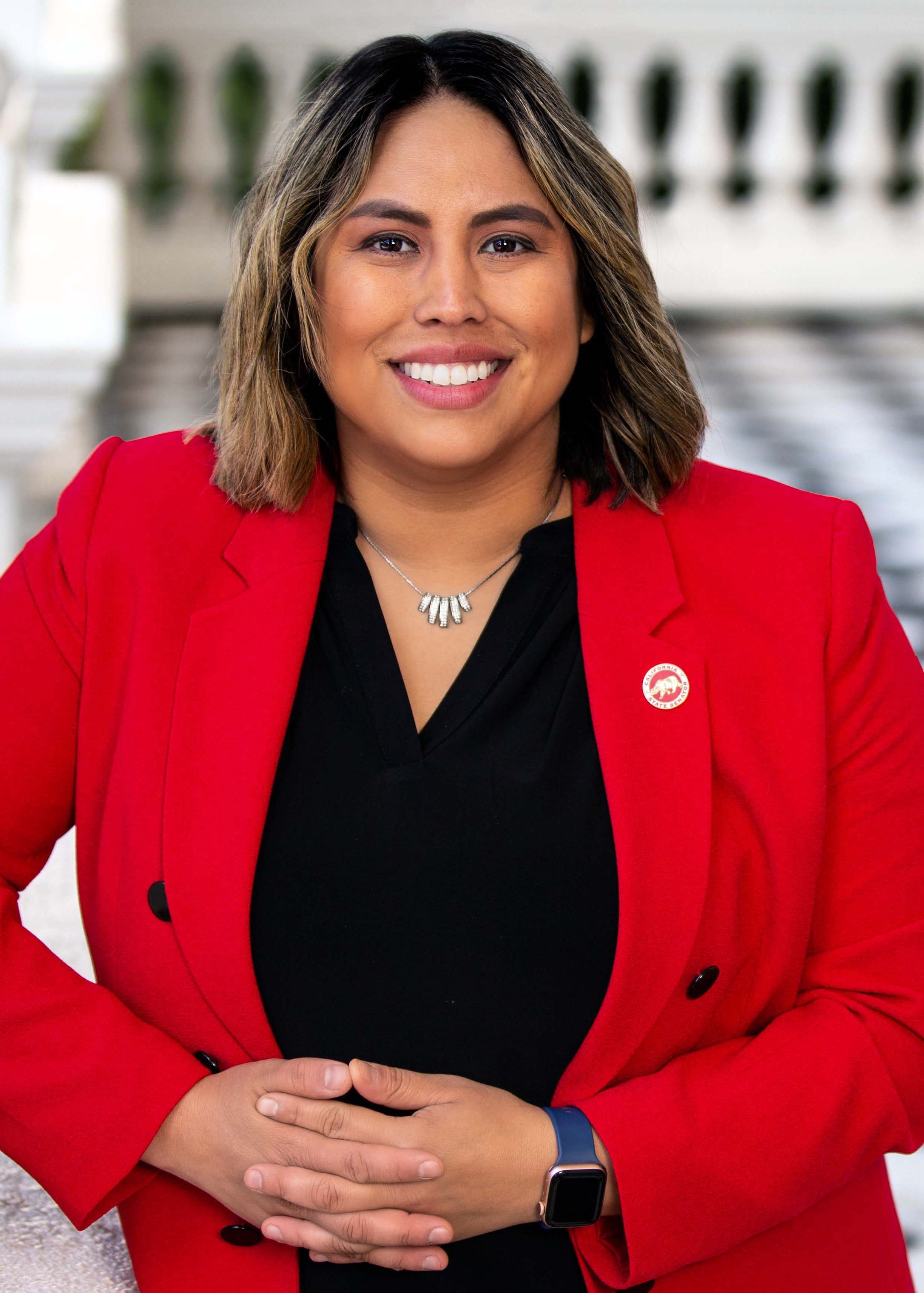
Sen. Caroline Menjivar
Sponsored bills
Existing law requires the city council for a charter city that elects its city council using district-based elections to adopt new city council district boundaries following each federal decennial census. Existing law requires the city council to adopt the new boundaries using specified criteria, and by a specified deadline, unless the charter city has adopted different redistricting criteria or a different deadline by ordinance or in its city charter. This bill would require a charter city with a population of at least 2,500,000 people to establish an independent redistricting commission to adjust the district boundaries for the city council if the city's charter does not establish an independent redistricting commission that meets specified criteria. The bill would require the commission to adjust the boundaries of the city council districts in accordance with specified criteria and deadlines. By increasing the duties on local officials, the bill would impose a state-mandated local program. This bill would make legislative findings and declarations as to the necessity of a special statute for charter cities with a population of at least 2,500,000 people. The California Constitution requires the state to reimburse local agencies and school districts for certain costs mandated by the state. Statutory provisions establish procedures for making that reimbursement. This bill would provide that, if the Commission on State Mandates determines that the bill contains costs mandated by the state, reimbursement for those costs shall be made pursuant to the statutory provisions noted above.
Existing law provides for the payment of unemployment compensation benefits and extended benefits to eligible individuals who meet specified requirements. Under existing law, unemployment benefits are paid from the Unemployment Fund, which is continuously appropriated for these purposes. Existing law makes an employee ineligible for benefits if the employee left work because of a trade dispute and specifies that the employee remains ineligible for the duration of the trade dispute. Existing case law holds that employees who left work due to a lockout by the employer, even if it was in anticipation of a trade dispute, are eligible for benefits. This bill would restore eligibility after the first 2 weeks for an employee who left work because of a trade dispute. The bill would codify specified case law that holds that employees who left work due to a lockout by the employer, even if it was in anticipation of a trade dispute, are eligible for benefits. The bill would specify that the bill's provisions do not diminish eligibility for benefits of individuals deprived of work due to an employer lockout or similar action, as specified. Because this bill would expand the categories of people eligible to receive benefits from a continuously appropriated fund, it would make an appropriation.
Existing law, the Knox-Keene Health Care Service Plan Act of 1975, provides for the licensure and regulation of health care service plans by the Department of Managed Health Care and makes a willful violation of the act a crime. Existing law also provides for the regulation of health insurers by the Department of Insurance. Existing law sets forth specified coverage requirements for health care service plan contracts and health insurance policies. This bill, the Let California Kids Hear Act, would require a health care service plan contract or health insurance policy issued, amended, or renewed on or after January 1, 2025, to include coverage for hearing aids for enrollees and insureds under 21 years of age, if medically necessary. The bill would limit the maximum required coverage amount to $3,000 per individual hearing aid, as specified. Because a willful violation of the bill's requirements relative to a health care service plan would be a crime, the bill would impose a state-mandated local program. The California Constitution requires the state to reimburse local agencies and school districts for certain costs mandated by the state. Statutory provisions establish procedures for making that reimbursement. This bill would provide that no reimbursement is required by this act for a specified reason.
Existing law provides that 8 hours of labor constitute a day's work unless it is otherwise expressly stipulated in a collective bargaining agreement, and requires that any work in excess of specified hours in one workday or one workweek be compensated at a rate higher than the regular rate of pay for the employee, as specified. Existing law authorizes, upon the proposal of an employer, employees of an employer to adopt a regularly scheduled alternative workweek that authorizes work by the affected employees for no longer than 10 hours per day within a 40-hour workweek without the payment to the affected employees of an overtime rate of compensation, as specified. Existing law prohibits an employer from employing an employee for a work period of more than 5 hours per day without providing the employee with a meal period, as specified, but, notwithstanding these provisions, existing law authorizes the Industrial Welfare Commission to adopt a working condition order permitting a meal period to commence after 6 hours of work if specified conditions are met. Under existing law, the Industrial Welfare Commission issues wage orders that regulates wages, hours, and working conditions in various occupations, including Wage Order No. 10-2001, which regulates the amusement and recreation industry. This bill would provide that these provisions do not apply to a person who is covered by a contract to play baseball at the minor league level with a labor organization that has at least 10 years of experience representing baseball players and who is compensated pursuant to the terms of a valid collective bargaining agreement that expressly provides for the wages, hours of work, working conditions of employees, payment for time worked during the off-season and spring training, and final and binding arbitration of disputes. The bill would require the Department of Industrial Relations to amend and republish Wage Order No. 10-2001 to provide that specified provisions of the wage order do not apply to a person subject to these provisions, as specified. Existing law requires an employer, semimonthly or at the time of payment of wages, to furnish an employee an accurate, itemized, written statement containing specified information regarding the amounts earned, hours worked, and the employee's identity, among other things, subject to certain variations. Existing law provides that an itemized wage statement furnished by an employer pursuant to these provisions is not required to show total hours worked by the employee if, among other things, the employee is exempt from the payment of minimum wage and overtime under specified law. This bill would provide that an itemized wage statement furnished by an employer pursuant to these provisions is not required to show total hours worked by an employee if the employee is exempt from the payment of minimum wage and overtime under the bill's provisions described above. Existing law, the Administrative Procedure Act, governs, among other things, the procedures for the adoption, amendment, or repeal of regulations by state agencies. Existing law also describes procedures for the promulgation of regulations by the Industrial Welfare Commission. This bill would exempt these provisions from the rulemaking procedures described above. Existing constitutional provisions require that a statute that limits the right of access to the meetings of public bodies or the writings of public officials and agencies be adopted with findings demonstrating the interest protected by the limitation and the need for protecting that interest. This bill would make legislative findings to that effect. This bill would declare that it is to take effect immediately as an urgency statute.
The Planning and Zoning Law requires each county and city to adopt a comprehensive, long-term general plan for its physical development, and the development of certain lands outside its boundaries, that includes, among other mandatory elements, a housing element. That law allows a development proponent to submit an application for a development that is subject to a specified streamlined, ministerial approval process not subject to a conditional use permit, if the development satisfies certain objective planning standards. Existing law, the Zenovich-Moscone-Chacon Housing and Home Finance Act, establishes the California Tax Credit Allocation Committee within the Department of Housing and Community Development. Existing law requires the committee to allocate state low-income housing tax credits in conformity with state and federal law that establishes a maximum rent that may be charged to a tenant for a project unit constructed using low-income housing tax credits. This bill would require that a housing development project be a use by right upon the request of an applicant who submits an application for streamlined approval, on any land owned by an independent institution of higher education or religious institution on or before January 1, 2024, if the development satisfies specified criteria, including that the development is not adjoined to any site where more than one-third of the square footage on the site is dedicated to industrial use. The bill would define various terms for these purposes. Among other things, the bill would require that 100% of the units, exclusive of manager units, in a housing development project eligible for approval as a use by right under these provisions be affordable to lower income households, except that 20% of the units may be for moderate-income households, and 5% of the units may be for staff of the independent institution of higher education or the religious institution that owns the land, provided that the units affordable to lower income households are offered at affordable rent, as set in an amount consistent with the rent limits established by the California Tax Credit Allocation Committee, or affordable housing cost, as specified. The bill would authorize the development to include ancillary uses on the ground floor of the development, as specified. This bill would specify that a housing development project that is eligible for approval as a use by right under the bill is also eligible for a density bonus, incentives, or concessions, or waivers or reductions of development and parking standards, except as specified. The bill would require a development subject to these provisions to provide off-street parking of up to one space per unit, unless a state law or local ordinance provides for a lower standard of parking, in which case the law or ordinance applies. The bill would prohibit a local government from imposing any parking requirement on a development subject to these provisions if the development is located within one-half mile walking distance of public transit, either a high-quality transit corridor or a major transit stop, as those terms are defined, or it is within one block of a car share vehicle. This bill would require a local government that determines a proposed development is in conflict with any objective planning standards, as specified, to provide the developer with written documentation explaining those conflicts under a specified timeframe. The bill would provide that the development shall be deemed to satisfy the required objective planning standards if the local government fails to provide the requisite documentation explaining any conflicts. The bill would authorize a local government to conduct a design review, as described, only if the design review focuses on compliance with the requisite criteria of a streamlined, ministerial review process. The bill would prohibit a local government from using a design review, as specified, from inhibiting, chilling, or precluding a streamlined, ministerial approval. The bill would require a local government to issue a subsequent permit for developments approved under the provisions of this act. The bill would include findings that changes proposed by this bill address a matter of statewide concern rather than a municipal affair and, therefore, apply to all cities, including charter cities. The California Environmental Quality Act (CEQA) requires a lead agency, as defined, to prepare, or cause to be prepared, and certify the completion of, an environmental impact report on a project that it proposes to carry out or approve that may have a significant effect on the environment or to adopt a negative declaration if it finds that the project will not have that effect. CEQA does not apply to the ministerial approval of projects. This bill, by requiring approval of certain development projects as a use by right, would expand the exemption for ministerial approval of projects under CEQA. The bill would repeal its provisions as of January 1, 2036. By adding to the duties of local planning officials with respect to approving certain development projects, this bill would impose a state-mandated local program. The California Constitution requires the state to reimburse local agencies and school districts for certain costs mandated by the state. Statutory provisions establish procedures for making that reimbursement. This bill would provide that no reimbursement is required by this act for a specified reason.
Existing law establishes the California Statewide Housing Plan, developed in cooperation with the private housing industry, regional and local housing and planning agencies, and other agencies of the state, to serve as a state housing plan. Existing law requires the plan to incorporate specified segments, including, among others, a housing strategy that coordinates the housing assistance and activities of state and local agencies, including the provision of housing assistance for various population groups, including, but not limited to, elderly persons, persons with disabilities, and other specific population groups as deemed appropriate by the department. Existing law, to the extent possible, requires the department to consult with various state departments, including the California Department of Aging and the State Department of Social Services, in developing that housing strategy. This bill would add veterans to the list of population groups included in the housing strategy described above. The bill would require the department to also consult with the Department of Veterans Affairs in developing the housing strategy, to the extent possible. This bill would incorporate additional changes to Section 50423 of the Health and Safety Code proposed by AB 1764 to be operative only if this bill and AB 1764 are enacted and this bill is enacted last.
Existing law requires a county elections official, upon receiving a vote by mail ballot, to compare the signature on the identification envelope with the voter's signature appearing on specified voter registration records. If the elections official determines that the signatures do not match, or if the identification envelope does not contain a signature, existing law requires the elections official to mail a notice to the voter, no later than 8 days before the certification of the election, of the opportunity to verify the voter's signature or provide a signature, as applicable. This bill would require the elections official to additionally notify the voter by telephone, a text message, or email, if the elections official has a telephone number or email address for the voter on file. By increasing the duties of county elections officials, this bill would create a state-mandated local program. This bill would incorporate additional changes to Section 3019 of the Elections Code proposed by AB 1037 to be operative only if this bill and AB 1037 are enacted and this bill is enacted last. The California Constitution requires the state to reimburse local agencies and school districts for certain costs mandated by the state. Statutory provisions establish procedures for making that reimbursement. This bill would provide that, if the Commission on State Mandates determines that the bill contains costs mandated by the state, reimbursement for those costs shall be made pursuant to the statutory provisions noted above.
Existing law, the Lanterman-Petris-Short Act, provides for the involuntary commitment and treatment of a person who is a danger to themselves or others or who is gravely disabled. Existing law, for purposes of involuntary commitment, defines "gravely disabled" as either a condition in which a person, as a result of a mental health disorder, is unable to provide for their basic personal needs for food, clothing, or shelter or has been found mentally incompetent, as specified. This bill expands the definition of "gravely disabled" to also include a condition in which a person, as a result of a severe substance use disorder, or a co-occurring mental health disorder and a severe substance use disorder, is, in addition to the basic personal needs described above, unable to provide for their personal safety or necessary medical care, as defined. The bill would also expand the definition of "gravely disabled," as it applies to specified sections, to include, in addition to the basic needs described above, the inability for a person to provide for their personal safety or necessary medical care as a result of chronic alcoholism. The bill would authorize counties to defer implementation of these provisions to January 1, 2026, as specified. The bill would make conforming changes. To the extent that this change increases the level of service required of county mental health departments, the bill would impose a state-mandated local program. Existing law also authorizes the appointment of a conservator, in the County of Los Angeles, the County of San Diego, or the City and County of San Francisco, for a person who is incapable of caring for the person's own health and well-being due to a serious mental illness and substance use disorder. Existing law establishes the hearsay rule, under which evidence of a statement is generally inadmissible if it was made other than by a witness while testifying at a hearing and is offered to prove the truth of the matter stated. Existing law sets forth exceptions to the hearsay rule to permit the admission of specified kinds of evidence. Under this bill, for purposes of an opinion offered by an expert witness in any proceeding relating to the appointment or reappointment of a conservator pursuant to the above-described provisions, the statements of specified health practitioners or a licensed clinical social worker included in the medical record would not be made inadmissible by the hearsay rule under specified conditions. The bill would authorize the court to grant a reasonable continuance if an expert witness in a proceeding relied on the medical record and the medical record has not been provided to the parties or their counsel. Existing law requires the State Department of Health Care Services to collect data quarterly and publish, on or before May 1 of each year, a specified report that includes, among other things, the number of persons for whom temporary conservatorship are established in each county and an analysis and evaluation of the efficacy of mental health assessments, detentions, treatments, and supportive services provided, as specified. This bill would, beginning with the report due May 1, 2024, require the report to also include the number of persons admitted or detained, as specified, for conditions that include, among others, grave disability due to a mental health disorder, severe substance use disorder, or both a mental health disorder and a severe substance use disorder. The California Constitution requires the state to reimburse local agencies and school districts for certain costs mandated by the state. Statutory provisions establish procedures for making that reimbursement. This bill would provide that, if the Commission on State Mandates determines that the bill contains costs mandated by the state, reimbursement for those costs shall be made pursuant to the statutory provisions noted above.
Existing law establishes the state flag and the state's emblems, including, among other things, the California redwood as the official state tree and the California gray whale as the official state marine mammal. This bill would establish the pallid bat (Antrozous pallidus) as the official state bat.