

Passed Feb 16, 2024
1 co-sponsor
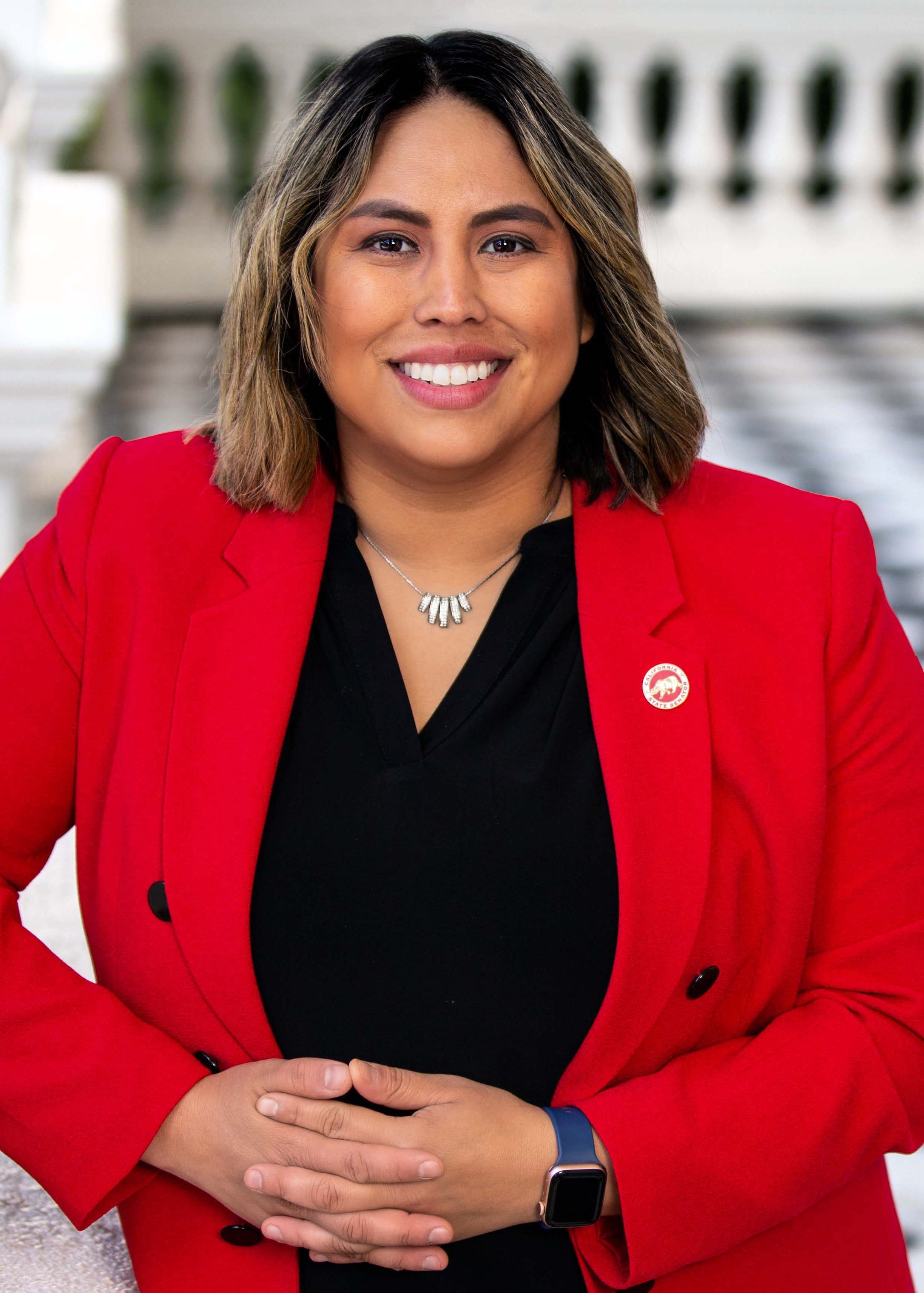
Sen. Caroline Menjivar
Total votes
9,571
all sessions
Attendance
97%
238 missed
Lower than 88% of chamber peers
With party
99%
of cast votes
Near the chamber average
Bipartisan score
0%
crosses aisle rarely
Near the chamber average
Sponsored
292
bills & resolutions
Near the chamber average
Committees
10
assignments
292 bills and resolutions
Sponsored bills
Total
292
Primary
80
Co-sponsor
212
This page
292
matching current filters
Relative to National Human Trafficking Awareness Month.
This measure would recognize the month of January 2024 as National Human Trafficking Awareness Month.
Signed into law Feb 15, 2024
1 co-sponsor
Juvenile hall.
Existing law provides for the placement of juveniles under the jurisdiction of the juvenile court into a county juvenile hall. Existing law makes it a misdemeanor for any person who is under the custody of a probation officer or any peace officer in a county juvenile hall, or committed to a county juvenile ranch, camp, forestry camp, or regional facility to escape or attempt to escape from that place or during transportation to or from that place. This bill would make technical, nonsubstantive changes to these provisions.
In committee Feb 14, 2024
0 co-sponsors
Victim compensation: use of force by a law enforcement officer.
Existing law provides for the compensation of victims and derivative victims of specified types of crimes by the California Victim Compensation Board from the Restitution Fund, a continuously appropriated fund, for specified losses suffered as a result of those crimes. Existing law defines various terms for purposes of these provisions, including "crime," which includes any public offense wherever it may take place that would constitute a misdemeanor or felony. This bill would revise the definition of "crime" to include, solely for the purposes of eligibility for compensation under this chapter, an incident occurring on or after January 1, 2024, in which an individual sustains serious bodily injury, as defined, or death as a result of a law enforcement officer's use of force, regardless of whether the law enforcement officer is arrested for, charged with, or convicted of committing a crime. The bill would define "law enforcement officer" for these purposes. By expanding the types of incidents for which compensation can be paid from a continuously appropriated fund, the bill would make an appropriation. Existing law requires that a person be ineligible for compensation under specified conditions, including, among other things, if the board determines that denial of the claim for compensation is appropriate because of the nature of the victim's involvement in the events leading to the crime or the involvement of the person whose injury or death gives rise to the application. Existing law requires the board to deny an application if it finds that the victim failed to cooperate reasonably with a law enforcement agency in the apprehension and conviction of the person committing the crime. This bill, in the case of a claim based on a victim's serious bodily injury or death that resulted from a law enforcement officer's use of force, as described above, would prohibit the board from denying an application based on certain circumstances, including the victim's or other applicant's involvement in the crime, except as specified, the victim's failure to cooperate, or the contents of a police report, or the lack thereof. The bill, in the case of a claim based on a victim's serious bodily injury or death as a result of a crime, would require the board to adopt guidelines that allow the board to rely on evidence other than a police report, as specified. Existing law requires that the board be subrogated to the rights of the recipient to the extent of any compensation granted by the board. This bill would specify that the above-described subrogation of the board applies to compensation by the board for any claim, including a claim based on serious bodily injury or death that resulted from a law enforcement officer's use of force.
In committee Feb 1, 2024
0 co-sponsors
Identification cards.
Existing law authorizes the Department of Motor Vehicles (DMV) to issue an identification card to an eligible applicant, and requires a fee of $26 to be paid upon the application to the DMV for the issuance of the identification card, except as specified. Existing law prohibits the department from charging a fee for an original or replacement identification card issued to any person who can verify their status as a homeless person or homeless child or youth. This bill would additionally prohibit the department from charging a fee for an original or replacement identification card to an applicant who is a veteran of the United States Armed Forces and can provide the department with a specified veteran verification form.
In committee Feb 1, 2024
0 co-sponsors
Local redistricting: independent redistricting commissions.
Existing law generally requires county boards of supervisors, city councils, and the governing boards of school districts, community college districts, and other special districts, if those bodies are elected using district-based elections, to adopt new boundaries for the districts following each federal decennial census. Notwithstanding that requirement, existing law authorizes a local jurisdiction other than a charter city to establish an independent redistricting commission to adopt new boundaries for the local jurisdiction's districts. This bill would require a county, general law city, charter city, or charter city and county that contains over 300,000 residents, and a school district or community college district that contains over 500,000 residents, to establish an independent redistricting commission to adopt district boundaries after each federal decennial census. The bill would require a county, general law city, charter city, or charter city or county with over 300,000 residents, and a school district or community college district with over 500,000 residents, that does not enact an ordinance, resolution, or charter amendment establishing an independent redistricting commission by January 1, 2030, and January 1 of every subsequent year ending in 0, to establish a 14-member independent redistricting commission according to specified procedures, including procedures for the random selection of the members of the commission from among applicants meeting certain qualifications. By requiring certain local jurisdictions to establish independent redistricting commissions to adopt district boundaries, the bill would impose a state-mandated local program. The bill would prohibit a member of an independent redistricting commission from communicating with any individual or organization regarding redistricting matters, except as provided. The bill would require the State Auditor to provide the contact information of any applicant to serve on the Citizens Redistricting Commission, which is responsible for adjusting the boundary lines of the congressional, legislative, and State Board of Equalization districts, to any city or county that has established an independent or hybrid redistricting commission, provided that the applicant has consented to share this information and the city or county has requested to receive this information, and to inform those applicants of opportunities to serve on an independent or hybrid redistricting commission. The bill would require the State Auditor to establish a database and create and advertise a process for this exchange of information. Under existing law, independent redistricting commissions have been established for the Counties of Los Angeles, San Diego, Riverside, Fresno, and Kern. The bill would exempt the Counties of Los Angeles, San Diego, Riverside, Fresno, and Kern from the bill's provisions requiring a county with over 300,000 residents to establish an independent redistricting commission, unless the existing law provisions establishing independent redistricting commissions for those counties are repealed or invalidated. The bill also would exempt a charter city with a population of at least 2,500,000 people from the bill's provisions if specified conditions are met, including if both this bill and Senate Bill 52 are enacted and if the city complies with certain provisions in Senate Bill 52 that require such cities to establish independent redistricting commissions. This bill would incorporate additional changes to Section 23003 of the Elections Code proposed by Assembly Bill 764 to be operative only if this bill and Assembly Bill 764 are enacted and this bill is enacted last. The bill would include findings that changes proposed by this bill address a matter of statewide concern rather than a municipal affair and, therefore, apply to all cities, including charter cities. The California Constitution requires the state to reimburse local agencies and school districts for certain costs mandated by the state. Statutory provisions establish procedures for making that reimbursement. This bill would provide that, if the Commission on State Mandates determines that the bill contains costs mandated by the state, reimbursement for those costs shall be made pursuant to the statutory provisions noted above.
Vetoed Feb 1, 2024
1 co-sponsor
Voter registration: California New Motor Voter Program.
Existing law requires, in conformance with federal law, that the Secretary of State and the Department of Motor Vehicles establish and implement the California New Motor Voter Program for the purpose of increasing opportunities for voter registration for qualified voters. Existing law requires the department to transmit to the Secretary of State specified information related to a person's eligibility to vote, which the person provides when applying for a driver's license or identification card or when the person notifies the department of an address change. Existing law requires that if this information transmitted to the Secretary of State constitutes a completed affidavit of registration, the Secretary of State must register or preregister the person to vote, as applicable, unless the person affirmatively declines to register or is ineligible to vote, as specified. This bill would additionally require the Department of Motor Vehicles to transmit specified information to the Secretary of State for a person submitting a driver's license application who provides documentation demonstrating United States citizenship and that the person is of an eligible age to register or preregister to vote. The bill would deem this information to constitute a completed affidavit of registration for such persons, and require the Secretary of State to register or preregister the person to vote, unless the Secretary of State determines they are ineligible. The bill would require, if a person is registered or preregistered to vote in this manner, that the county elections official send a notice to the person advising that they may decline to register or preregister to vote, designate a party preference, or select a language preference. The bill would also require the county elections official to send a notice to a person who is already registered to vote, but for whom the Secretary of State changes their registration information after receiving updated name or address information from the department. This bill would prohibit the department from providing a person the opportunity to attest to meeting voter eligibility requirements when they submit a driver's license application, if the person provides a document to the department during the transaction demonstrating that the person is not a United States Citizen. This bill would expand the definition of "voter registration agency" to include entities designated by the Secretary of State. The bill would require the Secretary of State to establish a schedule whereby specified voter registration agencies must provide the Secretary of State electronic information regarding individuals who are eligible to vote or who provide updated registration information. This bill would make these provisions operative on the earlier of January 1, 2026, or 5 days after the Secretary of State certifies that the information technology infrastructure to substantially implement the bill is functional. The bill would allow the Secretary of State, commencing January 1, 2024, to perform administrative actions necessary to implement these provisions. By imposing new duties on county elections officials with respect to voter registration, the bill would impose a state-mandated local program. The California Constitution requires the state to reimburse local agencies and school districts for certain costs mandated by the state. Statutory provisions establish procedures for making that reimbursement. This bill would provide that, if the Commission on State Mandates determines that the bill contains costs mandated by the state, reimbursement for those costs shall be made pursuant to the statutory provisions noted above.
In committee Feb 1, 2024
1 co-sponsor
The Social Housing Act.
Existing law establishes the Department of General Services to provide centralized services, including, but not limited to, planning, acquisition, construction and maintenance of state buildings and property. Existing law authorizes the Director of General Services, with the consent of the state agency concerned, to lease state-owned real property when the Director of General Services deems that leasing serves a beneficial public purpose limited to the development of housing. This bill would enact the Social Housing Act and would create, in the Department of General Services, the Social Housing Program, the mission of which would be to ensure that qualified social housing developments are produced on leased state property to help address the housing crisis, as specified. The bill would authorize the program to identify and develop up to 3 qualified social housing projects, as specified, with the intent to use the results to inform public policy related to developing an independent public entity to develop statewide qualified social housing. The bill would require the program to solicit bids to develop qualified social housing units, and prioritize bids that demonstrate long-term revenue neutrality or a cost rent model, as those terms are defined. The bill would require the program to employ 2 different leasing models, the rental model and the ownership model, as specified, in creating social housing. The bill would prohibit a city or county from denying a social housing development authorized under the program. The bill would authorize a city or county to propose objective design review standards, as specified, and authorize a city or county to propose modifications to mitigate any specific, adverse impacts on public health or safety, as specified.
Vetoed Jan 30, 2024
1 co-sponsor
Public documents: driver's licenses and vital records.
Existing law requires the collection of specified fees for certified copies of a birth certificate, marriage record, or marriage dissolution record. Existing law imposes fees upon the application for an original class C or M driver's license or a renewal of a driver's license or for a license to operate a different class of vehicle, as described. This bill would instead exempt persons who are recipients of specified assistance programs from payment of a fee for certified copies of a birth certificate, marriage record, or marriage dissolution record. The bill would, beginning July 1, 2027, also exempt a person who can verify their status as a homeless person or homeless child or youth from payment of a fee upon the application for an original or renewal of a driver's license. The bill would require the verification of homeless status to be subject to regulations adopted by the Department of Motor Vehicles and may be made by a homeless services provider, as defined. By establishing an exemption as to fees paid for receipt of certified copies of vital records, this bill would create a state-mandated local program. The bill would make all these provisions operative only to the extent that funding is provided by express reference for these purposes. The California Constitution requires the state to reimburse local agencies and school districts for certain costs mandated by the state. Statutory provisions establish procedures for making that reimbursement. This bill would provide that, if the Commission on State Mandates determines that the bill contains costs mandated by the state, reimbursement for those costs shall be made pursuant to the statutory provisions noted above.
Vetoed Jan 29, 2024
1 co-sponsor
Board of Behavioral Sciences, Board of Psychology, and Veterinary Medical Board: licensees' and registrants' addresses.
Existing law creates the Department of Consumer Affairs, which is composed of various boards that license and regulate specified professions deemed to engage in activities that have potential impact upon the public health, safety, and welfare. Existing law requires the Board of Behavioral Sciences, Board of Psychology, and Veterinary Medical Board, among other boards, to post information regarding the status of every license issued by those boards on the board's internet website. Existing law exempts personal information of licensees from this disclosure requirement, including home telephone number, date of birth, and social security number. This bill would, with certain exceptions, prohibit the Board of Behavioral Sciences, the Board of Psychology, and the Veterinary Medical Board from disclosing on the internet the full address of record of certain licensees and registrants, and would require those boards to disclose the city, state, county, and ZIP Code of the address of record of those licensees and registrants. The bill would require those boards to establish a process, as specified, for providing a licensee's or registrant's full address of record upon receipt of a request that is related to a court proceeding against or request for records from the licensee or registrant. Existing constitutional provisions require that a statute that limits the right of access to the meetings of public bodies or the writings of public officials and agencies be adopted with findings demonstrating the interest protected by the limitation and the need for protecting that interest. This bill would make legislative findings to that effect. This bill would incorporate additional changes to Section 27 of the Business and Professions Code proposed by AB 1263 to be operative only if this bill and AB 1263 are enacted and this bill is enacted last.
Vetoed Jan 25, 2024
0 co-sponsors
Ask Maddy
·
AI policy assistant
Ask Maddy about Caroline Menjivar
Scope: california
Hi! I can help you understand Caroline Menjivar's legislative record. What would you like to know?
Try one of these
i
Maddy answers using official bill text and legislative records. Always verify before sharing.
Sources cited inline