

Existing law establishes various boards and commissions in state government with specified duties and responsibilities. Existing law generally provides for legislative oversight of state board formation, which includes, among other things, any administrative or regulatory board, commission, and committee, whose members are appointed by the Governor, the Legislature, or both. Existing law requires the Governor to appoint every officer whose mode of appointment is not prescribed by law. This bill would require the office of the Governor, commencing January 1, 2027, to maintain on its internet website a list of each state board and commission and the membership list, stated purpose, duties, meeting frequency, internet website, and vacancies in the membership for each board or commission. The bill would require the office of the Governor, on or before January 31, 2028, and annually on January 31 thereafter, to create and publish on its internet website a report containing aggregate demographic information, as defined, of appointments made by the office during the prior calendar year, as specified. The bill would require the Secretary of the Senate and the Chief Clerk of the Assembly, commencing January 1, 2027, to maintain on their respective internet websites, or to include a link on their respective internet websites to any available resources that contain, a list of each state board or commission that each house has appointment authority over and the membership list, stated purpose, duties, meeting frequency, internet website, and any vacancies in the membership for that board or commission. The bill would also require the Secretary of the Senate and the Chief Clerk of the Assembly, on or before January 31, 2028, and annually on January 31 thereafter, to publish on their respective internet websites, to the extent available, aggregate demographic information, as defined, on their respective legislative appointments, made during the prior calendar year, as specified. The bill would require the aggregate demographic information to only include legislative appointments created by statute, and prohibit the information from including ex officio appointments of members of the Senate and the Assembly. The bill would require the above-described published aggregate demographic information on gubernatorial or legislative appointments to, among other things, be published on the respective entity's internet websites in a prescribed manner for purposes of ensuring the anonymity of the appointed individuals.
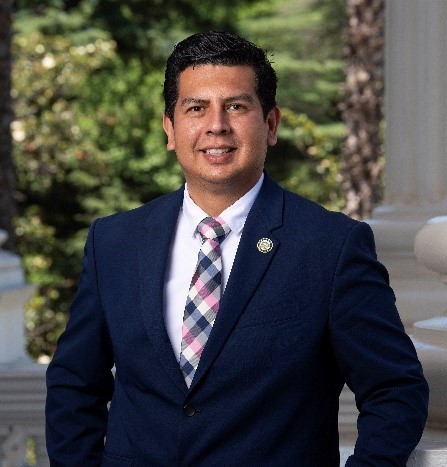
Asm. David Alvarez
Sponsored bills
Existing law establishes procedures relating to an action for unlawful detainer, and sets timelines regarding the filing of a complaint and the defendant's response, including a demurrer or motion to strike, as specified. The hearing on such a motion is required to occur within 5 to 7 court days after its filing, unless good cause is shown, in which case the hearing may occur on a later date on notice prescribed by the court. This bill would instead limit the court's authority to set a later hearing for a noticed motion. The bill would permit the court to order the hearing held on a later date upon the written stipulation of the parties or upon good cause shown in the case of a residential or commercial tenancy, not to exceed 10 court days after the first date set for a hearing on the motion in the case of a commercial tenancy.
The California Coastal Act of 1976, which is administered by the California Coastal Commission, requires a person wishing to perform or undertake any development in the coastal zone to obtain a coastal development permit. The act provides for the submission and approval of long-range land use development plans as an alternative to project-by-project review to promote greater efficiency for the planning of public works or state university or college or private university development projects and provides for amendments to those plans. The act places limits on the conditions the commission may impose on projects contained in a plan that has been certified by the commission. The act authorizes the commission to, after a public hearing, by regulation, adopt procedures for the issuance by the executive director of the commission of waivers from coastal development permit requirements for any development that is de minimis, as specified. This bill would require the commission to defer to the state university or college or private university in determining the number of vehicle parking spaces necessary for residents of student, faculty, or staff housing facilities, as provided. The bill would authorize the executive director to determine that a proposed amendment to a public works plan or long-range development plan is de minimis and would provide the procedures for the determination and approval of amendments that are de minimis. The bill would require the commission to track and publish on a public portion of its internet website any public works plans or long-range development plans, amendments to public works plans or long-range development plans, and notices of impending development submitted by a state university or college or private university to the commission for approval, as specified.
Existing law requires the State Air Resources Board to adopt and implement motor vehicle fuel specifications for the control of air contaminants and sources of air pollution. Existing law prohibits the state board from adopting any regulation that establishes a specification for motor vehicle fuel unless that regulation, and a multimedia evaluation conducted by affected agencies and coordinated by the state board, are reviewed by the California Environmental Policy Council. This bill would, notwithstanding that prohibition, authorize blends of gasoline containing 10.5% to 15% ethanol by volume to be sold in the state for use as a transportation fuel until (1) the California Environmental Policy Council completes its review of those blends and (2) the state board either adopts a regulation establishing a specification for those blends or posts an assessment on its internet website demonstrating that it is not possible for a regulation establishing a specification for those blends to meet specified requirements. This bill would declare that it is to take effect immediately as an urgency statute.
Existing law provides for the San Diego County Air Pollution Control District to have a governing board of 11 members, including 2 members representing the board of supervisors of the County of San Diego, the mayor or a city council member of the City of San Diego, a city council member from each of the 5 supervisorial districts of the county, and 3 public members who are appointed by the other members representing those local governments. Existing law requires the 5 city council members to be selected by city selection committees representing the cities of that supervisorial district. Existing law provides for the members of the governing board to receive compensation while attending meetings of the district governing board or while on official business of the district and to receive the actual and necessary expenses incurred in performing the member's official duties, as specified. This bill would provide that the members selected by the city selection committee members may be either a mayor or city council member from the applicable supervisorial district. The bill would authorize each appointing authority to designate an alternate member to serve in place of the regular member when the regular member is absent or disqualified from participating and would require the alternate member to meet the same qualifications applicable to the regular member. When serving in place of the appointed member, the bill would authorize the alternate member to vote and to receive compensation and expenses, as specified. Existing law requires each member of the district to serve a 4-year term, as specified. The bill would. require, on the first board meeting in the 2029 calendar year, the governing board clerk to conduct a random drawing to select 2 members appointed by city selection committee members and 2 public members to serve a 2-year term and until that member's successor is appointed. Existing law requires governing board of the district to designate one member representing the board of supervisors to serve as the liaison to the United States Navy, the United States Marine Corps, and the United States Coast Guard. This bill would eliminate the restriction that the member serving as the liaison be a member representing the board of supervisors and would require that member to be appointed as the liaison after consultation with the United States Armed Forces.
This measure would designate November 1, 2025, as Fernando Valenzuela Day, to highlight the positive impact his legacy created in the Latino and Hispanic community.
This measure would recognize the importance of California Native American Day, celebrated this year on September 26, 2025, and the annual California Indian Cultural Awareness Conference, to the enhancement of awareness of California Indian culture.
This measure would declare the Legislature's opposition to the unlawful Executive Order No. 14160, entitled "Protecting the Meaning and Value of American Citizenship," ending birthright citizenship as enshrined in the United States Constitution and would affirm the Legislature's commitment to birthright citizenship, as specified.
This measure would state, among other things, the Legislature and the State of California's commitment to protecting, to the fullest extent of the law, all the data and information provided by students and their families to California's postsecondary education.
Maddy summaryACR 100 is a symbolic resolution recognizing August 15, 2025, as India's Independence Day in California. It urges all Californians to participate in celebrating India's independence on that date. This resolution does not create new laws or affect specific groups, but formally acknowledges the historical significance of India's independence day. It serves as a ceremonial gesture by the California legislature to honor this event.