

Existing law provides that the Department of Transportation has full possession and control of all state highways. Existing law describes the authorized routes in the state highway system. Existing law authorizes the California Transportation Commission to select, adopt, and determine the location for state highways on routes authorized by law, as specified. Existing law authorizes the commission to adopt an existing road as a state highway on an authorized route if the road is constructed to adequate standards. Existing law provides that State Highway Route 59 is from Route 152 northerly to Route 99 near the City of Merced and from Route 99 near the City of Merced to Snelling. This bill would, on or before December 31, 2030, require the commission to reach an agreement with the Counties of Merced, Stanislaus, and Tuolumne for the acquisition and adoption of county road J59 as a state highway, as specified. The bill would, on and after January 1, 2031, instead provide that State Highway Route 59 is from Route 152 northerly to Route 99 near the City of Merced and from Route 99 near the City of Merced to the junction of Routes 108 and 120.
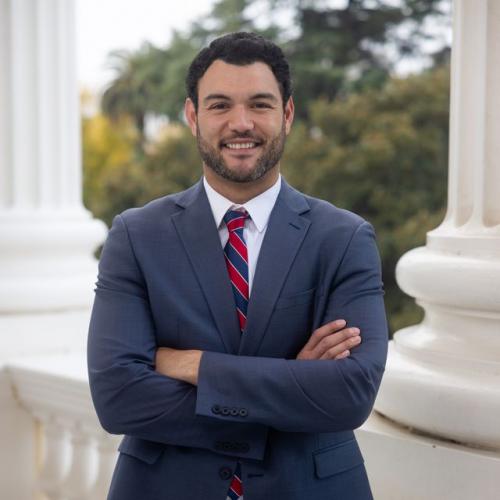
Rep. David Tangipa
Sponsored bills
Existing law requires the State Department of Public Health to develop a coordinated state strategy for addressing the health-related needs of women, as specified. This bill, the Rural Farmworker Women's Health Act of 2026, would require the department to, beginning January 1, 2028, and upon appropriation by the Legislature for this purpose, establish a program to work with local nonprofit organizations who have a history of serving farmworker communities to provide free menstrual products in rural or agricultural communities. The bill would require the department to prioritize those communities with the highest rates of poverty.
Maddy summaryThis bill designates the week of May 17 to May 24, 2026, as National Public Works Week throughout California to honor the contributions of public works professionals. It directly affects engineers, managers, and employees in government and the private sector who maintain essential infrastructure like transportation systems, water supplies, and public buildings. The resolution requests that the Governor issue a proclamation encouraging the public to observe the week with educational programs and activities that highlight the importance of these workers.
The Personal Income Tax Law, in conformity or modified conformity with federal income tax laws, allows various deductions in computing the income that is subject to the taxes imposed by that law, including a deduction for the medical and dental expenses paid during the taxable year, not compensated for by insurance or otherwise, for the medical or dental care of the taxpayer, spouse, or a dependent, to the extent that such expenses exceed 7.5% of federal adjusted gross income. This bill would, for taxable years beginning on or after January 1, 2026, and before January 1, 2031, allow a deduction from adjusted gross income for the costs of medical care, as defined, of a qualified taxpayer to the extent the costs exceed 4% of the qualified taxpayer's federal adjusted gross income. The bill would limit the deduction to $5,000. The bill would define "qualified taxpayer" for this purpose to mean an individual with adjusted gross income that does not exceed 300% of the federal poverty level and who does not take an itemized deduction for costs of medical care pursuant to the above-referenced provisions on their California income tax return. Existing law requires any bill authorizing a new tax expenditure to contain, among other things, specific goals that the tax expenditure will achieve, detailed performance indicators, and data collection requirements. This bill also would include additional information required for any bill authorizing a new tax expenditure. This bill would take effect immediately as a tax levy.
(1) Existing law prohibits a permanent school employee from being dismissed, except for one or more of certain enumerated causes, including egregious misconduct, and prescribes specific procedures for dismissals and suspensions based solely on acts of egregious misconduct. Existing law authorizes a first- or 2nd-year probationary employee of a school district to be dismissed during the school year for unsatisfactory performance or for cause, pursuant to specified procedures. Existing law specifies that those provisions do not apply to a probationary employee in a school district having an average daily attendance of less than 250 pupils and instead authorizes their suspension or dismissal for cause, including for egregious misconduct, pursuant to separate procedures that are applicable to permanent employees of a school district. Existing law also prescribes various reporting requirements relating to egregious misconduct for both certificated and noncertificated employees. Existing law, for these purposes, defines "egregious misconduct" as specified sex offenses, controlled substance offenses, and acts subject to the Child Abuse and Neglect Reporting Act. This bill would expand the definition of egregious misconduct for those purposes to include additional offenses, including, among other offenses, those relating to human trafficking, child abandonment and neglect, and impermissible contact or communication with a minor, as specified. (2) Existing law requires the Commission on Teacher Credentialing, on or before July 1, 2027, and contingent upon an appropriation for these purposes in the annual Budget Act or another statute, to develop a statewide data system that includes information relating to investigations of allegations of egregious misconduct of individuals serving in a noncertificated position for a local educational agency, as defined, or in any position for a private school. Existing law requires local educational agency employers and private school employers, following both the start of, and completion of, an investigation of egregious misconduct, to submit notice to the statewide data system, as provided. This bill would require the commission to include a section in the above-described statewide data system that identifies whether the commission received any reports of a certificated employee's possible misconduct submitted to the commission by a school district, county office of education, charter school, state special school or diagnostic center operated by the department, or private school. The bill would require the section of the data system to include the full name, date of birth, and last four digits of the social security number of the credentialholder or applicant, and the name of each school district, county office of education, charter school, state special school or diagnostic center operated by the department, or private school that has submitted a complaint, information, or indictment against the credentialholder or applicant, including specified reports. The bill would require the commission, within 5 business days of receiving a request for access to the statewide data system from a school district, county office of education, charter school, state special school or diagnostic center operated by the department, or private school, to provide the requesting entity access to the data system for the purposes of these provisions. (3) Existing law requires a person applying for a certificated position at a school district, county office of education, charter school, state special school or diagnostic center operated by the State Department of Education, or private school to provide that prospective employer with a complete list of every school district, county office of education, charter school, state special school or diagnostic center operated by the department, and private school that previously employed the applicant. Existing law requires those entities, when considering an applicant for a certificated position, to inquire with each disclosed entity as to whether the applicant, while previously employed by the disclosed entity, was the subject of any credible complaints of, substantiated investigations into, or discipline for, egregious misconduct. Existing law requires the responding entities that have made a report of an employee's egregious misconduct to the commission to disclose this fact to the inquiring entity, and to provide the inquiring entity with a copy of all relevant information within its possession that was reported to the commission. This bill, commencing July 1, 2027, would require a school district, county office of education, charter school, state special school or diagnostic center operated by the department, or private school considering an applicant for a certificated position to instead (A) check the section of the statewide data system maintained by the commission as to whether the commission received a copy of a complaint, information, or indictment, or specified report, relating to the applicant being the subject of a credible complaint of, substantiated investigation into, or discipline for, egregious misconduct, (B) identify any reporting entities, and (C) request from each reporting entity a copy of all relevant information within its possession that was reported to the commission. The bill would require a school district, county office of education, charter school, state special school or diagnostic center operated by the department, or private school identified in the data system as having submitted a report for a certificated employee to provide a copy of all relevant information within its possession to the inquiring entity. The bill would authorize, instead of require, a school district, county office of education, charter school, state special school or diagnostic center operated by the department, or private school that is considering an applicant for a certificated position to directly inquire with a disclosed entity, as described above. To the extent the bill would impose additional duties on local agencies or officials, the bill would impose a state-mandated local program. The California Constitution requires the state to reimburse local agencies and school districts for certain costs mandated by the state. Statutory provisions establish procedures for making that reimbursement. This bill would provide that, if the Commission on State Mandates determines that the bill contains costs mandated by the state, reimbursement for those costs shall be made pursuant to the statutory provisions noted above.
Existing law establishes the Office of Rural Health within the California Health and Human Services Agency to promote a strong working relationship between state government and local and federal agencies, universities, private and public interest groups, rural consumers, health care providers, foundations, and other offices of rural health, as well as to develop health initiatives and maximize the use of existing resources without duplicating existing effort. Existing law requires the office to serve as a key information and referral source to promote coordinated planning for the delivery of health services in rural California. This bill would require the office to develop and administer, upon appropriation by the Legislature, a competitive grant program for the delivery of, or the support, sustenance, or expansion of the delivery of, medical services, as defined, to individuals who reside in rural areas, as defined. The bill would authorize the office upon that appropriation to expend up to $3,000,000 annually and would authorize a qualified provider, as defined, to apply to the office once per year for a grant of up to $10,000 for those purposes. The bill would require the office to establish specified standards and procedures, including criteria and standards for eligibility and the measurement of outcomes achieved, and, on or before January 1, 2028, and annually thereafter, to publish this information on its internet website.
Existing federal law provides for the Supplemental Nutrition Assistance Program (SNAP) , known in California as CalFresh, under which supplemental nutrition assistance benefits allocated to the state by the federal government are distributed to eligible individuals by each county. Under existing state law, households are eligible to receive CalFresh benefits to the extent permitted by federal law. Existing federal law provides that students who are enrolled in college or other institutions of higher education at least half-time are not eligible for SNAP benefits unless they meet one of several specified exemptions, including participating in an employment and training program for low-income households that is operated by a state or local government, as specified. Existing law requires the State Department of Social Services, on or before May 31, 2022, to issue a guidance letter to counties, the office of the Chancellor of the California Community Colleges, the office of the Chancellor of the California State University, and the office of the President of the University of California that clarifies the state and federal eligibility requirements for a campus-based program to be a state-approved local educational program that increases employability that qualifies for the CalFresh student eligibility exemption and that clarifies the application and approval process for a campus-based program to be approved by the department as a state-approved local educational program that increases employability. Existing law requires the department to maintain, regularly update, and post on its internet website a list of the state-approved local educational programs, and requires the department to include in the list, to the extent permitted by federal law, adult education and career technical education programs. This bill would repeal the existing approval process for a campus-based program to be approved by the department as a state-approved local educational program that increases employability, and would instead require the department to issue a similar guidance letter, on or before May 31, 2027, to the same entities that makes a determination, to the extent permitted by federal law, that all adult education, career technical education, certificate, and associate, bachelor's, master's, and doctoral degree programs at a public institution of higher education and specified state-funded programs, including, among others, Educational Opportunity Program and Guardian Scholars Program, are required to be considered as a state-approved local educational program that increases employability, as specified. The bill would authorize a campus-based program at a campus of the California Community Colleges, the California State University, or the University of California that is not one of the previously described programs to submit a certification application to the department, and would require the department to determine whether the certification applications for campus-based programs meet the requirements to be considered as a state-approved local educational program that increases employability. The bill would require the department to implement these provisions through all-county letters or similar instruction, as specified. Existing law, the Cal Grant Program, establishes the Cal Grant A Entitlement Awards, the Cal Grant B Entitlement Awards, the California Community College Expanded Entitlement Awards, the California Community College Transfer Entitlement Awards, the Competitive Cal Grant A and B Awards, the Cal Grant C Awards, and the Cal Grant T Awards under the administration of the Student Aid Commission. Existing law requires the commission to prescribe the use of standardized student financial aid applications to be used for the Cal Grant Program, among other financial aid programs. The Cal Grant Reform Act revises and recasts the provisions establishing and governing the existing Cal Grant Program into a new Cal Grant Program. Existing law specifies that the act becomes operative only if General Fund moneys over the multiyear forecasts beginning in the 2024–25 fiscal year are available to support ongoing augmentations and actions, and if funding is provided in the annual Budget Act to implement the act. The act requires the commission to determine the timelines and procedures for the application process for awards, as provided. This bill would require the State Department of Social Services and the commission to develop a data-sharing agreement under which the commission is required to share student contact information with the department for the sole purpose of identifying, supporting, and linking students to on- and off-campus basic needs services and resources, including CalFresh direct outreach. The bill would require the commission, upon entering into the data-sharing agreement, to amend the commission's Grant Delivery System to ensure (1) students that might be eligible for the CalFresh program are identified, (2) identified students are able to provide their separate and distinct consent for their contact information to be shared, as specified, for the previously described purpose, and (3) identified students are linked to on- and off-campus basic needs services and resources. The bill would authorize the department to share student information with the appropriate county human services agency and the appropriate public postsecondary education systemwide office of the campus in which the student is enrolled, and would require each campus of the California Community Colleges and the California State University, and would request each campus of the University of California, commencing with the 2028–29 academic year, to contact those students who opted in to have their information shared with the department. To the extent the bill would increase the duties of counties, the bill would impose a state-mandated local program. The California Constitution requires the state to reimburse local agencies and school districts for certain costs mandated by the state. Statutory provisions establish procedures for making that reimbursement. This bill would provide that, if the Commission on State Mandates determines that the bill contains costs mandated by the state, reimbursement for those costs shall be made pursuant to the statutory provisions noted above.
The Personal Income Tax Law, in modified conformity with federal income tax laws, allows various deductions in calculating taxable income. Existing federal income tax law, for taxable years beginning before January 1, 2029, allows deductions in determining taxable income, as defined, for amounts equal to the qualified tips, as defined. This bill, for taxable years beginning on or after January 1, 2026, and before January 1, 2029, would conform to federal income tax law with regard to qualified tips, except as provided. Existing law requires any bill authorizing a new tax expenditure to contain, among other things, specific goals that the tax expenditure will achieve, detailed performance indicators, and data collection requirements. This bill also would include additional information required for any bill authorizing a new tax expenditure. This bill would take effect immediately as a tax levy.
Maddy summaryThis bill designates the month of April as California Rodeo Appreciation Month to recognize the state's rodeo culture. It directly affects rodeo enthusiasts, participants, and organizations by officially acknowledging their contributions through a state resolution. The measure does not change laws or allocate funding; instead, it serves as a commemorative gesture to highlight the importance of rodeos in California. Once passed, the designation appears in the state statutes as a formal recognition of the event.
This measure would proclaim the week of April 20, 2026, to April 24, 2026, inclusive, as California Home Visiting Week, and would encourage all Californians to recognize and celebrate the contributions of home visiting programs and professionals and the families they serve.