

Existing law states the policy of the State of California is to afford all persons in public schools, regardless of their disability, gender, gender identity, gender expression, nationality, race or ethnicity, religion, sexual orientation, or any other specified characteristic, equal rights and opportunities in the educational institutions of the state. AB 715 of the 2025–26 Regular Session proposes to, among other things, (1) establish the Office of Civil Rights, under the administration of the Government Operations Agency, with the purpose of working directly with local educational agencies to prevent and address discrimination and bias, as specified, and (2) state the intent of the Legislature to enact future legislation to establish coordinators to be employed within the Office of Civil Rights to prevent and address discrimination and bias. This bill would require the Office of Civil Rights to employ a Religious Discrimination Prevention Coordinator, a Race and Ethnicity Discrimination Prevention Coordinator, a Gender Discrimination Prevention Coordinator, and an LGBTQ Discrimination Prevention Coordinator. The bill would require each of the coordinators to be appointed by the Governor and confirmed by the Senate. This bill would make the operation of its provisions contingent upon the enactment of AB 715 of the 2025–26 Regular Session.
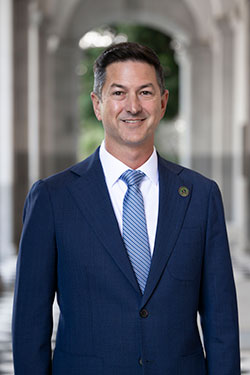
Asm. Chris Ward
Sponsored bills
Existing law requires the State Department of Public Health to license and regulate health facilities, including general acute care hospitals. Existing law makes a violation of these provisions a crime. Existing federal law, the Health Insurance Portability and Accountability Act of 1996 (HIPAA) , authorizes a covered health care provider to use specified protected health information to maintain a directory of patients in its facility, and to disclose that information to persons who ask for the patient by name. Existing federal law requires a covered health care provider to inform an individual of its privacy practices generally and the use and disclosure of information in the directory and to provide the patient with the opportunity to restrict or prohibit that use or disclosure. Existing law, the Confidentiality of Medical Information Act, prohibits a health care provider, a contractor, or a health care service plan from disclosing medical information, as defined, but does not prevent a general acute care hospital, upon an inquiry concerning a specific patient, from releasing a patient's name, address, age, and sex, and a general description of the reason for treatment, among other information, unless there is a specific written request by the patient to the contrary. This bill, beginning July 1, 2026, would require a general acute care hospital to inform a patient or the patient's representative, at the time of admission or as soon as reasonably possible in cases of patient incapacity or an emergency treatment circumstance, that the patient or the patient's representative may restrict or prohibit the use or disclosure of protected health information in the hospital's patient directory and would require the hospital to provide the patient or the patient's representative an acknowledgment of the hospital's privacy practices by using a separate document and having hospital personnel verbally inform the patient or the patient's representative, as specified. Because a violation of the bill's requirements would be a crime, this bill would impose a state-mandated local program. The California Constitution requires the state to reimburse local agencies and school districts for certain costs mandated by the state. Statutory provisions establish procedures for making that reimbursement. This bill would provide that no reimbursement is required by this act for a specified reason.
Existing law establishes various boards and commissions in state government with specified duties and responsibilities. Existing law generally provides for legislative oversight of state board formation, which includes, among other things, any administrative or regulatory board, commission, and committee, whose members are appointed by the Governor, the Legislature, or both. Existing law requires the Governor to appoint every officer whose mode of appointment is not prescribed by law. This bill would require the office of the Governor, commencing January 1, 2027, to maintain on its internet website a list of each state board and commission and the membership list, stated purpose, duties, meeting frequency, internet website, and vacancies in the membership for each board or commission. The bill would require the office of the Governor, on or before January 31, 2028, and annually on January 31 thereafter, to create and publish on its internet website a report containing aggregate demographic information, as defined, of appointments made by the office during the prior calendar year, as specified. The bill would require the Secretary of the Senate and the Chief Clerk of the Assembly, commencing January 1, 2027, to maintain on their respective internet websites, or to include a link on their respective internet websites to any available resources that contain, a list of each state board or commission that each house has appointment authority over and the membership list, stated purpose, duties, meeting frequency, internet website, and any vacancies in the membership for that board or commission. The bill would also require the Secretary of the Senate and the Chief Clerk of the Assembly, on or before January 31, 2028, and annually on January 31 thereafter, to publish on their respective internet websites, to the extent available, aggregate demographic information, as defined, on their respective legislative appointments, made during the prior calendar year, as specified. The bill would require the aggregate demographic information to only include legislative appointments created by statute, and prohibit the information from including ex officio appointments of members of the Senate and the Assembly. The bill would require the above-described published aggregate demographic information on gubernatorial or legislative appointments to, among other things, be published on the respective entity's internet websites in a prescribed manner for purposes of ensuring the anonymity of the appointed individuals.
Existing law establishes the Attorney General as the head of the Department of Justice, with charge of all legal matters in which the state is interested, except as specified. Existing law imposes various requirements on the Attorney General related to consumer protection, including, among others, the supervision of charitable trusts and the enforcement of antitrust laws. Existing law, commonly known as the Cartwright Act, identifies certain acts that are unlawful restraints of trade and unlawful trusts and prescribes provisions for its enforcement. Existing law requires a complaint or cross-complaint to contain, among other things, a statement of facts constituting the cause of action, in ordinary and concise language. This bill would instead provide that in a complaint for any violation of the Cartwright Act, it is sufficient to contain factual allegations demonstrating that the existence of a contract, combination in the form of a trust, or conspiracy to restrain trade or commerce is plausible. The bill would provide that a complaint for any violation of the Cartwright Act is not required to allege facts tending to exclude the possibility of independent action. This bill would also make it unlawful for a person to use or distribute a common pricing algorithm as part of a contract, combination in the form of a trust, or conspiracy to restrain trade or commerce. The bill would make it unlawful for a person to use or distribute a common pricing algorithm if the person coerces another person to set or adopt a recommended price or commercial term recommended by the common pricing algorithm for the same or similar products or services in the jurisdiction of the state. Because the bill would expand the scope of activities prohibited by the Cartwright Act, the violation of which is punishable as a crime, the bill would impose a state-mandated local program. The California Constitution requires the state to reimburse local agencies and school districts for certain costs mandated by the state. Statutory provisions establish procedures for making that reimbursement. This bill would provide that no reimbursement is required by this act for a specified reason.
Existing law designates specific days as holidays in this state. Existing law designates holidays on which community colleges and public schools are authorized to close pursuant to a memorandum of understanding between the governing board and represented employees, including "Native American Day" on the 4th Friday in September. Existing law entitles state employees, with specified exceptions, and authorizes certain community college and public school employees, to be given time off with pay for specified holidays, as specified. This bill would add "Diwali" to the list of state holidays. The bill would authorize community colleges and public schools to close on "Diwali," as specified. The bill would authorize state employees to elect to take, and would authorize certain community college and public school employees to be given, time off with pay in recognition of "Diwali," as specified. The bill would authorize public schools and educational institutions throughout the state to include exercises acknowledging and celebrating the meaning and importance of Diwali, as specified. Existing law adopts state holidays as judicial holidays, with certain exceptions, including Admission Day and Columbus Day. This bill would add "Diwali" to the list of holidays that are excluded from designation as a judicial holiday. This bill would make related findings and declarations.
(1) Existing law provides that ballots cast in all-mailed ballot elections, as specified, are considered timely cast if they are received by the voter's elections official by mail no later than 3 days after election day and additional, specified conditions are satisfied. This bill would extend the above deadline for mailed ballots to be timely cast to 7 days after election day. (2) Existing law establishes requirements for the conduct of recount elections, including with respect to the order in which precincts must be recounted, procedures for special recount boards, and notices issued by elections officials with respect to the commencement and results of a recount. If the votes subject to recount were cast or tabulated by a voting system, existing law requires that the voter requesting the recount, for each set of ballots cast or tabulated by a type of voting system, select whether the recount will be conducted manually or by means of the voting system used originally. Existing law allows only one method of recount to be used for all ballots cast or tabulated by the same type of voting system. This bill would allow a voter requesting a recount to specify the order in which votes are recounted by the batch in which ballots were scanned or, in the case of a recount that involves more than one county, the order in which counties will conduct the recount within the jurisdiction. The bill would prohibit unauthorized access to the voting system in use by the elections office and impose other protections on access to a voter's personal identifying information. The bill would require the requester to reimburse the county for the cost of each member of a recount board. The bill would require that a member of a special recount board be eligible to register to vote in California if they are required to tally any ballots as part of their role on the board. The bill would set qualifications for an official appointed to supervise a special recount board. The bill would impose specified requirements for notices issued by elections officials. The bill would, if the recount is to be conducted manually and the voting system has the capability to display ballot images, require the voter requesting the recount to select whether the recount will be conducted by use of paper ballots or the official ballot images. If more than one voter requests a recount for the same office or measure and at least one request is for the recount to be conducted by use of paper ballots, the bill would require the county elections official to conduct only a manual recount of the paper ballots, the result of which would be controlling. (3) This bill would incorporate additional changes to Section 15621 of the Elections Code proposed by Assembly Bill 1513 to be operative only if this bill and Assembly Bill 1513 are enacted and this bill is enacted last. (4) By increasing the duties of local elections officials, the bill would create a state-mandated local program. The California Constitution requires the state to reimburse local agencies and school districts for certain costs mandated by the state. Statutory provisions establish procedures for making that reimbursement. This bill would provide that, if the Commission on State Mandates determines that the bill contains costs mandated by the state, reimbursement for those costs shall be made pursuant to the statutory provisions noted above.
Existing law requires the State Energy Resources Conservation and Development Commission to prescribe, by regulation, lighting, insulation, climate control system, and other building design and construction standards, and energy and water conservation design standards, for new residential and new nonresidential buildings to reduce the wasteful, uneconomic, inefficient, or unnecessary consumption of energy, as specified. This bill would require the commission to evaluate the cost-effectiveness of passive house energy efficiency standards by California climate zone, using commission-adopted metrics such as long-term system cost. The bill would require the commission to evaluate the use of the 2 passive house energy models currently required for passive house certification in its analysis and the cost-effectiveness of passive house construction compared to existing construction, as specified. The bill would require the commission, on or before July 1, 2028, to submit a report to the Legislature documenting its findings and recommendations.
Existing law, the Special Occupancy Parks Act, establishes requirements for the construction, maintenance, occupancy, use, and design of special occupancy parks. Existing law defines "special occupancy park" to mean a recreational vehicle park, temporary recreational vehicle park, incidental camping area, or tent camp. This bill would specify that, for purposes of that act, a special occupancy park does not include a low-impact camping area, as specified, that is located in a county that has enacted an ordinance, as specified, authorizing low-impact camping and meeting specified requirements. The bill would impose specified requirements on owners of private property offering low-impact camping area sites and on online hosting platforms. The bill would define a "low-impact camping area" to mean any area of private property that provides for the transient occupancy rental of a temporary sleeping accommodation, as defined, for recreational purposes that is not a commercial lodging facility. The bill would specify that a low-impact camping area is not a special occupancy park if, among other things, it meets certain requirements, including compliance with applicable local requirements relating to waste disposal and quiet hours, as specified. The bill would require that a county that has authorized low-impact camping to take specified actions, including, among others, to establish a registry of low-impact camping areas, as specified, and to notify the Department of Housing and Community Development of the county's choice to authorize low-impact camping areas. The bill would also require all state and local eviction processes applicable to a special occupancy park to apply to a low-impact camping area.
Existing law declares the public policy of the state regarding labor organization, including, among other things, that it is necessary for a worker to have full freedom of association, self-organization, and designation of representatives of their own choosing, to negotiate the terms and conditions of their employment, and to be free from the interference, restraint, or coercion of employers of labor, or their agents, in the designation of such representatives or in self-organization or in other concerted activities for the purpose of collective bargaining or other mutual aid or protection. Existing law establishes the Public Employment Relations Board (PERB) in state government as a means of resolving disputes and enforcing the statutory duties and rights of specified public employers and employees under various acts regulating collective bargaining. Under existing law, PERB has the power and duty to investigate an unfair practice charge and to determine whether the charge is justified and the appropriate remedy for the unfair practice. Existing law, the federal National Labor Relations Act (NLRA) , establishes a comprehensive statutory scheme regulating unfair labor practices on the part of employers and labor organizations in industries affecting interstate commerce, and vests in the National Labor Relations Board (NLRB) the power to conduct elections to determine employee representatives and to prevent unfair labor practices affecting commerce. Existing law, the California Public Records Act, requires that public records, as defined, be available to the public for inspection and made promptly available to any person. This bill would expand PERB's jurisdiction by authorizing a worker, to petition PERB to protect and enforce prescribed rights under specified circumstances, including if the worker is employed in a position subject to the NLRA but the NLRB has expressly or impliedly ceded jurisdiction. The bill would authorize PERB to, among other things, decide unfair labor practice cases pursuant to a specified timeline and order all appropriate relief for a violation, including civil penalties, as prescribed. In order to pursue relief from PERB, the bill would require a covered worker or their representative to file an unfair practice charge or petition that includes specified information, including, where applicable, the original charge or petition filed with the NLRB. The bill would require PERB to hold the supporting documentation and evidence confidential and maintain it as part of its investigatory file and would exempt this documentation and evidence from the California Public Records Act. If PERB determines, among other things, it has insufficient resources to process certain cases or doing so would prevent it from meeting specified statutory deadlines, the bill would require PERB to process and prioritize charges, as specified. The bill would also establish the Public Employment Relations Board Enforcement Fund (fund) in the State Treasury, would require the above-described civil penalties to be deposited into the fund, and would make moneys in the fund available upon appropriation by the Legislature to PERB for the purpose of administering the above-specified provisions. The bill would authorize PERB to rely on its own decisions and precedent under the NLRA and would authorize review of its decisions by a state appellate court, as specified. Existing law, the Alatorre-Zenovich-Dunlap-Berman Agricultural Labor Relations Act of 1975, grants agricultural employees the right to form and join labor organizations and engage in collective bargaining, as specified, and prohibits agricultural employers and labor organizations from engaging in unfair labor practices. Those provisions establish the Agricultural Labor Relations Board (ALRB) and empower the ALRB to prevent any person from engaging in those practices. Existing law establishes various definitions for these purposes. Existing law requires the ALRB to follow applicable precedents of the NLRA. This bill would specify that the ALRB has exclusive jurisdiction in all phases of the administration of the act, and to determine whether any person or entity meets one or more of those definitions. The bill would instead authorize the board to follow applicable precedents of the NLRA, but would not obligate the board to follow precedents where the ALRB deems it inappropriate to do so. This bill would make related findings and declarations and would make its provisions severable. Existing constitutional provisions require that a statute that limits the right of access to the meetings of public bodies or the writings of public officials and agencies be adopted with findings demonstrating the interest protected by the limitation and the need for protecting that interest. This bill would make legislative findings to that effect.
This measure would designate November 1, 2025, as Fernando Valenzuela Day, to highlight the positive impact his legacy created in the Latino and Hispanic community.