

Existing law establishes a system of public elementary and secondary schools in this state and authorizes local educational agencies throughout the state to operate schools and provide instruction to pupils in kindergarten and grades 1 to 12, inclusive. Existing law establishes various programs for the recruitment of teachers. Existing law establishes the Bilingual Teacher Professional Development Program, administered by the State Department of Education in consultation with the Commission on Teacher Credentialing, for teachers seeking to provide instruction in bilingual and multilingual settings. This bill, which would be operative upon appropriation by the Legislature, would establish the Pathways to Bilingual Teaching Program and would require the commission to develop and implement a program to award, on a competitive basis, grants of up to $600,000 to local educational agencies to form consortia with 4-year institutions of higher education, or 4-year institutions of higher education and community colleges, to establish or expand pathways to bilingual teaching to enable bilingual pupils to earn a multiple subject, single subject, PK-3 early childhood education specialist, or education specialist teaching credential, with a bilingual authorization, as provided. The bill would require the commission to annually report to the appropriate fiscal and policy committees of the Legislature on any grants funded until funds are fully expended, as specified.
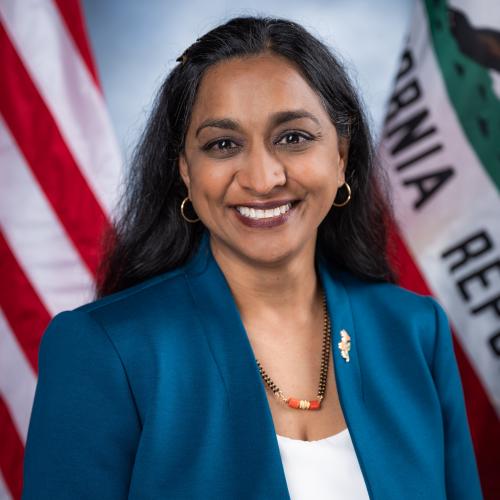
Rep. Darsh Patel
Sponsored bills
Existing law establishes the Medi-Cal program, which is administered by the State Department of Health Care Services and under which qualified low-income individuals receive health care services. The Medi-Cal program is in part governed by, and funded pursuant to, federal Medicaid program provisions. Existing federal law, enacted on July 4, 2025, sets forth various changes to Medicaid eligibility with regard to community engagement reporting, redeterminations, retroactive coverage, and cost sharing, among other factors, for certain Medicaid populations pursuant to a specified implementation timeline. This bill would require the department to establish a data dashboard that provides data on applications, enrollment, redeterminations, disenrollments, and terminations, with certain objectives in consideration, related to the impact of the above-described federal law on Medi-Cal eligibility and enrollment, as specified. The bill would require the dashboard to track and report on the specific data for work or community engagement requirements and exemptions. The bill would require the department, commencing no later than January 1, 2028, to operationalize the dashboard and to post the information on a monthly basis in a downloadable format. The bill would require the department to undertake efforts to conduct outreach about work or community engagement requirements, more frequent redeterminations, and changes to retroactive eligibility to impacted Medi-Cal beneficiaries, and to conduct listening sessions, as specified. Under the bill, beneficiary outreach and education would be coordinated across public social services programs to help minimize barriers to administrative disenrollments. The bill would require a Medi-Cal managed care plan to establish and conduct an outreach and education plan for its enrollees about the work or community engagement guidelines set forth in federal law based on guidance provided by the department. The bill would require the outreach and education plan to address certain information on Medi-Cal eligibility, the right to appeal or reinstate Medi-Cal coverage, and resources, and to meet certain cultural and linguistic appropriateness standards. Existing law requires a county to undertake outreach efforts to beneficiaries receiving Medi-Cal benefits in order to, in part, facilitate the Medi-Cal redetermination process. Existing law authorizes a county to collaborate with community-based organizations in implementing this provision. This bill would incorporate the requirements of the above-described federal law into the Medi-Cal redetermination facilitation process. The bill would require a county to make a good faith effort to collaborate with community-based organizations, as specified. The bill would require the county outreach efforts to meet cultural and linguistic appropriateness standards. By creating new duties for counties relating to Medi-Cal outreach, the bill would impose a state-mandated local program. Existing law requires the department to encourage and facilitate efforts by managed care plans to report updated beneficiary contact information to counties. When a managed care plan obtains a beneficiary's updated contact information, existing law requires the plan to ask the beneficiary for approval to provide the beneficiary's updated contact information to the appropriate county. If the managed care plan does not obtain that approval, existing law requires the county to attempt to verify that the information that it receives from the plan is accurate, as specified, before updating the beneficiary's case file. This bill would remove the requirement for the managed care plan to ask the beneficiary for approval for purposes of providing the contact information to the county. The bill would remove the requirement for the county to make the verification attempt and would remove a related provision on the method of contact. The bill would require the department to share, or require each county to share, beneficiary redetermination data with applicable managed care plans to aid in managed care plans' efforts to assist beneficiaries with retaining Medi-Cal coverage, as specified. To the extent the bill creates new duties for counties relating to the sharing of Medi-Cal redetermination data, it would impose a state-mandated local program. The California Constitution requires the state to reimburse local agencies and school districts for certain costs mandated by the state. Statutory provisions establish procedures for making that reimbursement. This bill would provide that, if the Commission on State Mandates determines that the bill contains costs mandated by the state, reimbursement for those costs shall be made pursuant to the statutory provisions noted above.
Existing law establishes the California Community Colleges, administered by the Board of Governors of the California Community Colleges, as one of the segments of public postsecondary education in the state. Existing law requires the board to appoint a chief executive officer, known as the Chancellor of the California Community Colleges. Existing law establishes community college districts throughout the state, under the administration of community college district governing boards, and authorizes these districts to provide instruction at the community college campuses they operate. Existing law establishes the Part-Time Community College Faculty Health Insurance Program, which authorizes the governing board of a community college district to provide a program of health insurance for part-time faculty, multidistrict part-time faculty, and their dependents. Existing law requires the chancellor, by June 15 of each year, to apportion to each community college that establishes a program an amount that equals up to12 of the total cost of the individual premiums required to be paid for the health insurance coverage of participating part-time faculty, multidistrict part-time faculty, and their dependents, and to apportion any remaining funds to each community college district that establishes a program and meets certain criteria, up to the total cost of the individual premiums required to be paid for the health insurance coverage of the participants, as provided. If funds appropriated for purposes of the program remain after those apportionments, existing law requires that the balance revert to the General Fund annually, as specified. This bill would instead require that the balance be deposited into the Part-Time Community College Faculty Health Insurance Program Fund, which the bill would create. The bill would continuously appropriate the moneys in the fund to the chancellor for purposes of the above-described apportionments, as specified. This bill would state the intent of the Legislature that, by January 1, 2030, each community college district commence negotiations with the exclusive representatives for part-time community college faculty to offer health insurance benefits to part-time and multidistrict part-time community college faculty and their eligible dependents.
(1) Existing law, the Ortiz-Pacheco-Poochigian-Vasconcellos Cal Grant Program, provides awards to certain California postsecondary students to help pay the costs of postsecondary education. Existing law sets the maximum Cal Grant A and B tuition award amount for new recipients in the 2023–24 award year at $9,358 for students attending independent institutions of higher education. Existing law authorizes community colleges to award an associate degree for transfer, and provides that the Cal Grant A and B tuition award amount for future years for students attending independent institutions of higher education depends on the number of commitments those institutions make to accept associate degrees for transfer. Beginning with the 2024–25 award year, existing law sets the maximum tuition award amount for new Cal Grant A and B recipients at either $9,358 or $8,056, depending upon whether the number of new unduplicated transfer students accepted by those institutions who have been given associate degree for transfer commitments in the prior award year exceeds statutory targets. This bill would set, beginning with the 2026–27 award year, and subject to an appropriation for this purpose, the maximum tuition award amount for new Cal Grant A and B recipients at either $9,708 or $8,056, with the higher amount conditioned on the achievement of the target numbers for associate degree for transfer commitments that apply for the prior award year. (2) Existing law establishes a California Community College Expanded Entitlement Award for students who were not awarded a Cal Grant A or B award at the time of the student's high school graduation but who will be enrolled at a California community college during the award year and meet other criteria. Existing law authorizes a student who receives a California Community College Expanded Entitlement Award to subsequently transfer to a University of California or California State University campus and remain eligible to receive the award. Existing law also authorizes a student who receives a California Community College Expanded Entitlement Award and who subsequently transfers to an independent institution of higher education to remain eligible to receive the award, but only if General Fund moneys over the multiyear forecasts beginning in the 2024–25 fiscal year are available to support ongoing augmentations and actions, and if funding is provided in the annual Budget Act to implement the Cal Grant Reform Act. This bill would instead authorize a student who receives a California Community College Expanded Entitlement Award and who subsequently transfers to an independent institution of higher education to remain eligible to receive the award without the above-described conditions.
Maddy summaryThis bill serves as a commemorative resolution to mark the 50th anniversary of the Surface Mining and Reclamation Act of 1975. It does not create new laws or alter existing regulations but instead formally acknowledges the milestone achievement of the original legislation. The measure is intended to honor the history of mining and land reclamation efforts established by the 1975 act.
This measure would acknowledge and celebrate 50 years of coastal protection and affirm the state's longstanding commitment to protecting its coastal waters, as specified.
Maddy summaryThis bill designates June 2026 as Men's Mental Health Month to raise awareness about mental health issues affecting men. The measure is a formal proclamation that does not change laws or allocate funding, but rather encourages public recognition of the topic. Once passed, it serves as an official declaration without imposing new requirements on individuals or organizations.
This measure would declare the month of June 2026 as Alzheimer's Disease and Brain Awareness Month, and would urge all Californians to commemorate the month of June 2026 as Alzheimer's Disease and Brain Awareness Month.
This measure would designate the week of May 24, 2026, to May 30, 2026, inclusive, as California OB-GYN Week to recognize the essential contributions of obstetricians and gynecologists (OB-GYNs) to the health care system and the critical role they play in delivering comprehensive, preventive, and primary care services, and to encourage the continued recognition and support of OB-GYNs to ensure access to high-quality, equitable health care for all Californians.
Maddy summaryThis bill designates June 23, 2026, as Social Media Harms Victim Remembrance Day in California. The measure requires the state to officially proclaim this date, creating a specific day for remembrance. It does not change laws or impose new requirements on individuals or organizations. The primary effect is to establish a formal date for commemoration within the state.