This measure would designate a specified interchange of State Highway Route 168 in the City of Clovis as the Dr. Fareed Wade Nader Memorial Interchange. The measure would request that the Department of Transportation determine the cost of appropriate signs showing this special designation and, upon receiving donations from nonstate sources covering that cost, erect those signs.
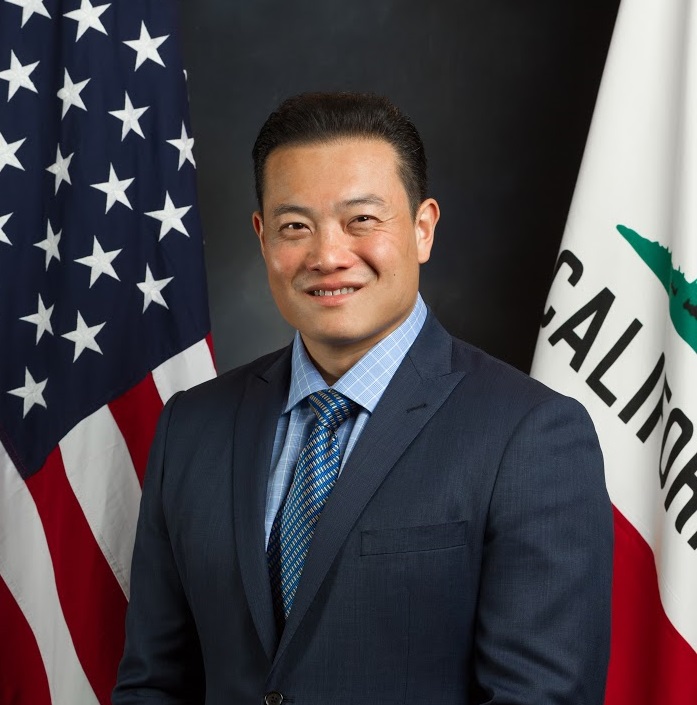
Asm. Phillip Chen
Sponsored bills
This measure would declare August 2022 as Valley Fever Awareness Month.
This measure would declare the month of September 2022 as California Emergency Preparedness Month.
Existing law requires the adopted course of study for grades 1 to 6, inclusive, to include certain areas of study, including English, mathematics, social sciences, science, visual and performing arts, health, and physical education, as specified. Existing law requires the study of English to include knowledge of and appreciation for literature and the language, as well as the skills of speaking, reading, listening, spelling, handwriting, and composition. This bill would create the Family and Community Literacy: Supporting Literacy and Biliteracy in Schools, Families, and Communities Grant Program for the purpose of supporting the goal of all of California's pupils reading at grade level by third grade and engaging families at every stage of that process. The bill would require the department to award competitive grants from the California Family Literacy Innovation Project to local educational agencies, as provided. This bill would establish the California Family Literacy Innovation Project, under the administration of the department, in order to support community literacy and educational enrichment by supporting local educational agencies to engage families to improve literacy and biliteracy outcomes. The bill would require the department to award grants of up to $1,900,000 each to at least 25 local educational agencies that conduct a needs assessment and analysis, and design an evidence-based Family Literacy and Biliteracy Innovation Plan, as provided. The bill would require grant recipients to provide annual progress reports to the department, and would require the department to contract with an external evaluator to develop a final report and evaluate program effectiveness, as provided. This bill would make the implementation of its provisions contingent upon an appropriation by the Legislature in the annual Budget Act or another statute.
Existing law, as added by the Substance Abuse and Crime Prevention Act of 2000, adopted by voters as Proposition 36 at the November 7, 2000, statewide general election, requires that persons convicted of certain nonviolent drug possession offenses be granted probation and participate in and complete an appropriate drug treatment program as a condition of that probation. After completion of drug treatment and the terms of probation, the act requires the court to conduct a hearing, set aside the conviction, and dismiss the complaint if the court finds, among other requirements, that the defendant successfully completed drug treatment. For purposes of the act, a defendant has successfully completed treatment if they have completed the prescribed course of drug treatment and, as a result, there is reasonable cause to believe that they will not abuse controlled substances in the future. The act allows its amendment by a statute passed by 2/3 of both houses of the Legislature and requires that all amendments further the act and be consistent with its purposes. This bill would amend the act by removing the requirement that there be reasonable cause to believe that the defendant will not abuse controlled substances in the future in order to be considered as having successfully completed treatment. Existing law requires the court, when granting probation after conviction of any controlled substance offense, as specified, to order as a condition of probation that the defendant secure education or treatment from a local community agency designated by the court. Existing law requires a juvenile court to order a minor, found to have been in possession of any controlled substance, to receive education or treatment from a local community agency, as specified, and to order the minor's parents or guardian to participate in the education or treatment if beneficial to the minor. Existing law provides that a defendant's willful failure to complete a court-ordered education or treatment program shall be a circumstance in aggravation for purposes of sentencing in any subsequent prosecution for specified controlled substance violations. This bill would allow the court to order the defendant, and a juvenile court to order a minor, to complete a controlled substance education or treatment program, as specified, if available. The bill would require the court or probation department to refer defendants to controlled substance education or treatment programs that adhere to specified standards. The bill would require the county drug program administrator and representatives of the court and county probation department, with input from substance use treatment providers, to design and implement an approval and renewal process for controlled substance education and treatment programs. The bill would require the court, upon conviction of a controlled substance offense resulting in imprisonment, to recommend that the defendant attend a controlled substance education or treatment program while imprisoned. By imposing additional duties on local entities, the bill would impose a state-mandated local program. Existing law requires every county drug program administrator, in consultation with representatives of the court and the county probation department, to establish minimum requirements, criteria, and fees for the successful completion of drug diversion programs, including a minimum of 20 hours of education, counseling, or any combination of both for each divertee. This bill would clarify that the 20 hours or more of education or counseling shall include education about, among other things, how the use of controlled substances affects the body and the dangers of using controlled substances, as specified. The California Constitution requires the state to reimburse local agencies and school districts for certain costs mandated by the state. Statutory provisions establish procedures for making that reimbursement. This bill would provide that, if the Commission on State Mandates determines that the bill contains costs mandated by the state, reimbursement for those costs shall be made pursuant to the statutory provisions noted above.

Existing law requires the Controller to compile, publish, and make publicly available on the Controller's internet website reports of the financial transactions and information on annual compensation of each county, city, and special district, as provided. Existing law requires the Controller to annually publish, on the Controller's internet website, reports of the financial transactions of each school district, as provided. Existing law, for purpose of permitting the compilation of the financial transactions of school districts by the Controller, requires the Superintendent of Public Instruction to make available to the Controller data and other matters, as provided. Existing law provides that no school district or county superintendent of schools is required to furnish separate reports to the Controller for these purposes. This bill would require the Controller to additionally annually publish, on the Controller's internet website, reports of the financial transactions of each county office of education and charter school. The bill would require the Superintendent to make data and other matters related to these financial transactions available to the Controller. The bill would require the Controller to annually publish, on the Controller's internet website, information on annual compensation of employees of each school district, county office of education, charter school, and entity managing a charter school, as provided. The bill would instead require each school district, county office of education, charter school, and entity managing a charter school, for purposes of permitting the compilation of the annual compensation information, to furnish reports directly to the Controller that provide information on annual compensation of the employees of these specified entities. By requiring a new duty on local educational agencies, the bill would impose a state-mandated local program. The bill would make additional related changes. The California Constitution requires the state to reimburse local agencies and school districts for certain costs mandated by the state. Statutory provisions establish procedures for making that reimbursement. This bill would provide that, if the Commission on State Mandates determines that the bill contains costs mandated by the state, reimbursement for those costs shall be made pursuant to the statutory provisions noted above.

Existing law establishes the Board of State and Community Corrections. Existing law charges the board with providing the statewide leadership, coordination, and technical assistance to promote effective state and local efforts and partnerships in California's adult and juvenile criminal justice system. Under existing law, the board administers several grant programs, including a mentally ill offender crime reduction grant program, a medication-assisted treatment grant program, and a violence intervention and prevention grant program. This bill would establish two new grant programs: the Homeless and Mental Health Court Grant Program that would, subject to an appropriation by the Legislature, be administered by the Judicial Council and provide grants to counties for the purpose of establishing or expanding homeless courts and mental health courts, as specified; and the Transitioning Home Grant Program that would, subject to an appropriation by the Legislature, be administered by the board and provide grants to county sheriffs and jail administrators to fund programs aimed at reducing homelessness among inmates released from custody, as specified. The bill would require the board and council to prepare and submit reports to the Legislature, as specified, regarding the impacts of the grant program under their jurisdiction.
Existing law establishes the Department of Consumer Affairs under the direction of the Director of Consumer Affairs. Existing law establishes various boards within the department for the licensure and regulation of various health care providers, including physicians and surgeons and nurses. Existing law generally provides for mental health services, including the Bronzan-McCorquodale Act, which contains provisions governing the organization and financing of community mental health services for persons with mental disorders in every county through locally administered and locally controlled community mental health programs, and the Mental Health Services Act, an initiative statute enacted by the voters as Proposition 63 at the November 2, 2004, statewide general election that establishes the continuously appropriated Mental Health Services Fund to fund various county mental health programs. This bill would require the director to establish a mental health resiliency program, as specified, to provide mental health services to licensed health care providers who provide or have provided consistent in-person healthcare services to COVID-19 patients. The bill would require the relevant boards to notify licensees and solicit applications for access to the program immediately upon the availability of services. The bill would require an applicant to make an attestation that states, among other things, that the applicant is an eligible licensee, as defined. The bill would make an applicant who willfully makes a false statement in their attestation guilty of a misdemeanor. By creating a new crime, this bill would impose a state-mandated local program. The bill would repeal these provisions on January 1, 2025. The bill would require the department and relevant boards, no later than June 30, 2025, to report to the relevant policy committees of the Legislature prescribed information regarding the program. The bill would exempt the records associated with the mental health resiliency program from disclosure pursuant to the California Public Records Act. Existing constitutional provisions require that a statute that limits the right of access to the meetings of public bodies or the writings of public officials and agencies be adopted with findings demonstrating the interest protected by the limitation and the need for protecting that interest. This bill would make legislative findings to that effect. The California Constitution requires the state to reimburse local agencies and school districts for certain costs mandated by the state. Statutory provisions establish procedures for making that reimbursement. This bill would provide that no reimbursement is required by this act for a specified reason. This bill would declare that it is to take effect immediately as an urgency statute.