

Existing law authorizes the removal and seizure of a vehicle under various circumstances, including whenever a peace officer determines that a person was driving without a license or while their driving privilege was suspended or revoked, or when a city or a county adopts an ordinance declaring a motor vehicle to be a public nuisance. Existing law requires that a vehicle be released to the legal owner of the vehicle or the legal owner's agent prior to the end of the impoundment period if specified conditions are met, including, among other things, that the legal owner or the legal owner's agent pays all towing and storage fees related to the seizure of the vehicle and presents specified documents showing proof of legal ownership. With regards to the payment of the fees, existing law requires a person operating or in charge of a storage facility where vehicles are stored to accept a valid bank credit card or cash for payment by a legal or registered owner or the owner's agent claiming the vehicle. Existing law prohibits any tow yard, impounding agency, or governmental agency, or any person acting on behalf of those entities, from refusing to release a vehicle or other collateral to anyone that is legally entitled to that vehicle or other collateral. A violation of any provision of the Vehicle Code is punishable as a crime, unless otherwise specified. This bill would additionally require the acceptance of debit cards, as defined, for the payment of the fees described above. The bill would provide that requiring any documents to show proof of ownership other than those specified in the provisions described above constitutes a refusal to release under the prohibition described above. The bill would also make other technical, clarifying, and conforming changes. By expanding the scope of existing crimes and creating a new crime, this bill would impose a state-mandated local program. This bill would incorporate additional changes to Section 14602.6 of the Vehicle Code proposed by AB 1830 to be operative only if this bill and AB 1830 are enacted and this bill is enacted last. The California Constitution requires the state to reimburse local agencies and school districts for certain costs mandated by the state. Statutory provisions establish procedures for making that reimbursement. This bill would provide that no reimbursement is required by this act for a specified reason.
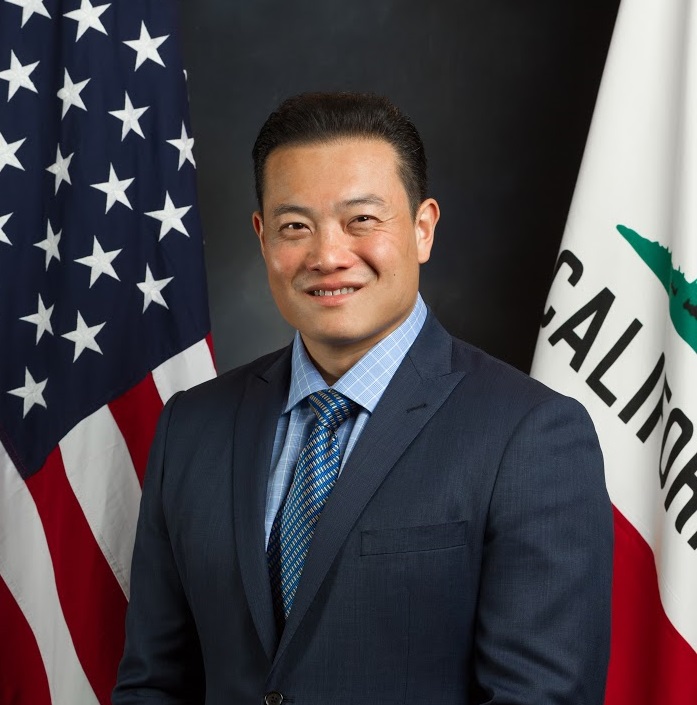
Rep. Phillip Chen
Sponsored bills
(1) Existing law requires a person engaged in the production of human whole blood or human whole blood derivatives to be licensed by the state, and requires licensed blood banks and blood transfusion services to meet specified standards. Existing law authorizes the State Department of Public Health to establish and require compliance with additional requirements, as specified. A violation of these licensing provisions is a misdemeanor. Existing law requires a license to be automatically revoked when there is a change of address, ownership, or person in charge of biologics production. Existing law authorizes a new license to be secured for the new location, owner, or person in charge prior to the actual change, as specified. This bill would prohibit the department from automatically revoking the plasma collection center's license when there is a change of the person in charge of biologics production if the owner or the owner's representative provides written notification of the change to the department within 5 days of the change, as specified, and the licensee submits, within 30 days of the change, the application for a new person in charge of biologics production. The bill would prohibit a licensee from operating without the supervision of a medical director. The bill would authorize a licensee to designate an interim person in charge of biologics production for a period not to exceed 30 calendar days if certain conditions are met. The bill would require plasma centers and their auxiliaries to be under the direction of a medical director or person in charge of biologics production who meets specified qualifications, including being a physician and surgeon and having a minimum of 3 months of experience or training in plasma center methods. Existing law requires each blood bank or plasma center to require as identification either a photographic driver's license or other photographic identification that is issued by the Department of Motor Vehicles from all donors of human whole blood or blood components who receive payment in return for the donation of the blood or blood components. The bill would instead require each blood bank or plasma center to require identification issued by the Department of Motor Vehicles, as described above, or photographic identification issued by another state, federal agency, or tribal government from all donors of human whole blood or blood components who receive payment in return for the donation of the blood or blood components. By creating new crimes, this bill would impose a state-mandated local program. (2) Existing law requires certain establishments that receive specified human whole blood and derivatives to be considered blood bank depositories and requires specified procedures on blood for transfusion to be the sole responsibility of the blood bank depository. This bill would specify that source plasma donation centers, as defined, that are licensed pursuant to the above-described provisions are not blood bank depositories. (3) Existing law authorizes a person to perform a total protein test using a digital refractometer in a licensed plasma collection center in this state, if the State Department of Public Health determines several conditions are met, including, among others, that the person meets specified training and education requirements, and performs the total protein test under supervision and using standard operating procedures, as specified. This bill would also require the department to determine that the licensed plasma collection center's supervising medical director has sufficient proficiency and knowledge with the use and supervision of digital refractometers in performing total protein tests. The bill would authorize a licensed plasma collection center's medical director to delegate to other licensed health care professionals, as approved by the department, the performance of health services duties, including donor screenings, predonation health screenings, and donor suitability assessments. (4) The California Constitution requires the state to reimburse local agencies and school districts for certain costs mandated by the state. Statutory provisions establish procedures for making that reimbursement. This bill would provide that no reimbursement is required by this act for a specified reason.
The California Deferred Deposit Transaction Law generally provides for the licensure and regulation by the Commissioner of Financial Protection and Innovation of a person who engages in the business of making deferred deposit transactions. The law requires each licensee to pay to the commissioner its pro rata share of all costs and expenses reasonably incurred in the administration of the law, as specified. This bill would require an invoice or assessment notice issued by the commissioner to a licensee pursuant to the provisions described above to include the pro rata amount calculation used to determine the amount due and payable by the licensee, as specified. This bill would incorporate additional changes to Section 23016 of the Financial Code proposed by AB 2795 to be operative only if this bill and AB 2795 are enacted and this bill is enacted last.
Existing law creates the Department of Insurance to regulate the business of insurance. Existing law generally regulates residential property insurance, including homeowners' insurance. Existing law establishes the California FAIR Plan Association, a joint reinsurance association in which all insurers licensed to write basic property insurance participate to administer a program for the equitable apportionment of basic property insurance for persons who are unable to obtain that coverage through normal channels. Existing law requires the association to establish and maintain an internet website and toll-free telephone number, requires the association to cause the toll-free telephone number to be published in all general distribution telephone directories in the state, and requires the association to include the internet website address and toll-free telephone number on all communications with an applicant or insured. This bill would require the association to, each quarter, post on its internet website specified information, including the number of policies issued by the association in each ZIP Code and the risk exposure of the association. The bill would delete the requirement that the association cause its toll-free telephone number to be published in all general distribution telephone directories in the state. This bill would incorporate additional changes to Section 10095.5 of the Insurance Code proposed by AB 69 to be operative only if this bill and AB 69 are enacted and this bill is enacted last.
Existing law requires the Governor to proclaim various days as days of remembrance or recognition. This bill would require the Governor to annually proclaim September 25 as Dolly Parton Day. This bill would declare that it is to take effect immediately as an urgency statute.
The Public Employees' Retirement Law (PERL) establishes the Public Employees' Retirement System (PERS) to provide a defined benefit to members of the system based on final compensation, credited service, and age at retirement, subject to certain variations. Existing law creates the Public Employees' Retirement Fund, which is continuously appropriated for purposes of PERS, including depositing employer and employee contributions. Under the California Constitution, assets of a public pension or retirement system are trust funds. The California Public Employees' Pension Reform Act of 2013 (PEPRA) establishes a variety of requirements and restrictions on public employers offering defined benefit pension plans. In this regard, PEPRA restricts the amount of compensation that may be applied for purposes of calculating a defined pension benefit for a new member, as defined, by restricting it to specified percentages of the contribution and benefit base under a specified federal law with respect to old age, survivors, and disability insurance benefits. Existing law, the Teachers' Retirement Law, establishes the State Teachers' Retirement System (STRS) and creates the Defined Benefit Program of the State Teachers' Retirement Plan, which provides a defined benefit to members of the program, based on final compensation, creditable service, and age at retirement, subject to certain variations. This bill, for service performed on and after January 1, 2027, would prohibit the pensionable compensation for calendar year 2027 used to calculate the defined benefit paid to a new member of a retirement system subject to PEPRA who retires from the system from exceeding specified percentages of the contribution and benefit base under the specified federal law with respect to old age, survivors, and disability insurance benefits. The bill would make related, conforming changes to these provisions on pensionable compensation. The bill also would require a new member of STRS to be subject to specified limits of the Teachers' Retirement Law. PEPRA requires each retirement system that offers a defined benefit plan for safety members of the system to use one of 3 formulas for safety members, 2% at age 57, 2.5% at age 57, or 2.7% at age 57. This bill would establish new retirement formulas, for employees first hired on or after January 1, 2027, as 2.5% at age 55, 2.7% at age 55, or 3% at age 55, subject to certain exceptions. For new members hired on or after January 1, 2013, who are safety members, the bill would require employers to adjust the formulas for service performed on or after January 1, 2027, to offer the formula that has the same fraction at age 55 as the fraction at age 57 in the formula the employer offered pursuant to existing law. The bill would authorize a public employer and a recognized employee organization to negotiate a prospective increase to the retirement benefit formulas for safety members and new safety members, consistent with the formulas permitted under PEPRA, including the new formulas described above. This bill would authorize an employer and its employees to agree in a memorandum of understanding to be subject to a higher safety plan or a lower safety plan, subject to certain requirements, including that the memorandum of understanding is collectively bargained in accordance with applicable laws. By increasing the contribution to continuously appropriated funds, and by increasing expenditures from those funds, this bill would make an appropriation.
Existing law provides for the licensure and regulation of structural pest control by the Structural Pest Control Board in the Department of Consumer Affairs. A violation of these provisions is a misdemeanor. Existing law designates each county agricultural commissioner as the lead agency for inspections and routine investigations of structural pest control operators and registered companies. Existing law prescribes 3 classifications of structural pest control licenses, which are designated as Branch 1, Branch 2, and Branch 3, based on the types of pest control work permitted. Branch 1 relates to the control of household and wood-destroying pests or organisms by fumigation with poisonous or lethal gases. Branch 2 relates to the control of household pests, excluding fumigation with poisonous or lethal gases. Branch 3 relates to the control of wood-destroying pests or organisms by the use of insecticides, or structural repairs and corrections, excluding fumigation with poisonous or lethal gases. Existing law prohibits an unlicensed individual in the employ of a registered company from applying pesticides included in Branch 2 or Branch 3, but authorizes an individual, for 90 days from the date of employment, to apply pesticides for the purposes of training under the direct supervision of a licensed field representative or operator employed by the company. This bill, on and after January 1, 2028, would also authorize an unlicensed individual employed by a registered company who has applied for a structural pest control applicator examination in Branch 2 and Branch 3 to apply pesticides included in Branch 2 and Branch 3 outdoors under the supervision of a licensed operator or field representative for up to 60 days if specified conditions are met, including that the unlicensed individual has completed a minimum of 80 hours of documented in-person training in pesticide application under the direct supervision of a licensed operator or field representative, as specified. The bill would require the registered company and supervising licensee to maintain certain documentation, including documentation demonstrating completion of required training, for at least 3 years. By expanding the scope of a crime and to the extent the bill would impose additional requirements on county agricultural commissioners, the bill would impose a state-mandated local program. The California Constitution requires the state to reimburse local agencies and school districts for certain costs mandated by the state. Statutory provisions establish procedures for making that reimbursement. This bill would provide that with regard to certain mandates no reimbursement is required by this act for a specified reason. With regard to any other mandates, this bill would provide that, if the Commission on State Mandates determines that the bill contains costs so mandated by the state, reimbursement for those costs shall be made pursuant to the statutory provisions noted above.
Maddy summaryThis bill designates September 2026 as Childhood Cancer Awareness Month. It directly affects state agencies and organizations by encouraging them to recognize this specific month for awareness activities. The measure does not change laws or allocate funding but serves as a formal commemorative resolution.
This measure would recognize and affirm the important role of artists, arts organizations, creative arts therapists, and arts for health initiatives in supporting behavioral health, promoting recovery, strengthening community resilience, and contributing to public safety. The measure would encourage and recognize exploration, support, and integration of arts and behavioral health within California's health care, behavioral health, and community-based systems.
Existing law provides for the licensure and regulation of various financial institutions by the Commissioner of Financial Protection and Innovation. Some of those laws require the commissioner to charge and collect specified fees and assessments. This bill would require the commissioner to, on or before March 1, 2027, and annually thereafter, report to the Joint Legislative Budget Committee, the Senate Banking and Financial Institutions Committee, and the Assembly Banking and Finance Committee the projected and actual revenues and expenditures, including the difference between revenues and expenditures, for the immediately preceding fiscal year for various laws enforced by the commissioner, as specified. This bill would require, for each of those laws that authorizes the Department of Financial Protection and Innovation to issue and collect assessments and charges on a pro rata basis to recover the actual costs of administering that law, the department to include in any report pursuant to the bill the method of determining those assessments and charges.