

The California Global Warming Solutions Act of 2006 establishes the State Air Resources Board as the state agency responsible for monitoring and regulating sources emitting greenhouse gases. The act requires the state board to approve a statewide greenhouse gas emissions limit equivalent to the statewide greenhouse gas emissions level in 1990 and to ensure the statewide greenhouse gas emissions are reduced to at least 40% below the statewide greenhouse gas emissions limit by 2030. The act authorizes the state board to include the use of market-based compliance mechanisms in its regulation of greenhouse gas emissions. This bill would specify that transportation fuels are not subject to regulations implementing a market-based compliance mechanism for greenhouse gas emissions. Existing law authorizes the state board to adopt and implement motor vehicle fuel specifications for the control of air contaminants and sources of air pollution. Existing law authorizes the state board to grant variances from the gasoline specifications, as provided. This bill would require the state board to grant variances from gasoline specifications, including for gasoline imported from outside the state, whenever a refinery outage or other supply interruption would result in substantial short-term price increases, as specified. Existing law requires the state board to establish, by regulation, maximum standards for volatility of gasoline, as provided. Pursuant to these authorities, the state board has adopted the California Reformulated Gasoline regulations, which include regulations establishing the maximum Reid vapor pressure of gasoline for various regions of the state at specified time periods. This bill would require the state board to waive the Reid vapor pressure requirement on summer-blend gasoline under the California Reformulated Gasoline regulations and to allow for the early transition to winter-blend gasoline if the state board determines that the gasoline market is experiencing a sudden and unusual increase in gasoline prices.
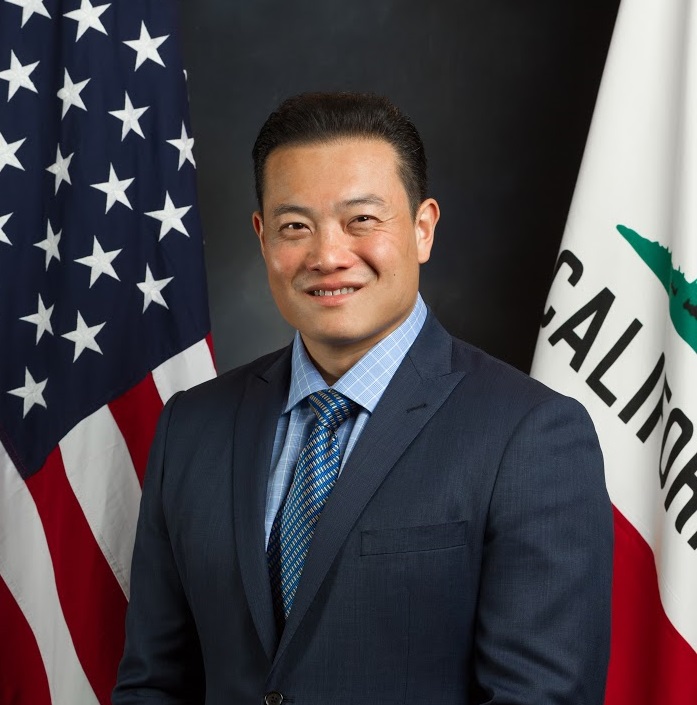
Asm. Phillip Chen
Sponsored bills
Existing law requires the adopted course of study for grades 1 to 6, inclusive, and for grades 7 to 12, inclusive, to offer courses in specified areas of study, including social sciences. Existing law establishes the Instructional Quality Commission and requires the commission to, among other things, recommend curriculum frameworks to the State Board of Education. Existing law requires the state board, concurrently with, but not before, the next revision of textbooks or curriculum frameworks in the social sciences, health, and mathematics curricula, to ensure that these academic areas integrate components of, among other things, financial literacy. Notwithstanding that requirement on the state board, existing law requires the commission, when the history-social science curriculum framework is revised after January 1, 2017, to consider including age-appropriate information for kindergarten and grades 1 to 12, inclusive, regarding certain topics on financial literacy. This bill instead would require the commission, when the history-social science curriculum framework is revised after January 1, 2024, to include age-appropriate information and content for kindergarten and grades 1 to 12, inclusive, regarding those financial literacy topics.
Existing law makes it a crime to possess for sale or purchase for purpose of sale, transport, import, sell, furnish, administer, give away, manufacture, compound, convert, produce, derive, process, or prepare various controlled substances, including, among others, fentanyl, peyote, and various other opiates and narcotics. This bill, Alexandra's Law, would require the court to advise a person who is convicted of, or who pleads guilty or no contest to, the above crimes, as specified, of the danger of selling or administering illicit drugs and counterfeit pills and that, if a person dies as a result of that action, the defendant can be charged with homicide. The bill would require the court to read the advisory statement in a case in which the defendant exchanged a controlled substance containing fentanyl or its analogs for anything else of value, as specified. The bill would require the advisory statement to be included in a plea form, if used, and specified on the record. The bill would require that the fact the advisory was given be recorded in the abstract of conviction and would prohibit the advisement from being used as evidence in the prosecution of a minor in juvenile court.
Existing law, the California Uniform Controlled Substances Act, classifies controlled substances into 5 schedules and places the greatest restrictions and penalties on the use of those substances placed in Schedule I. The act classifies the drug fentanyl in Schedule II. Existing law prohibits a person from possessing for sale or purchasing for purposes of sale, specified controlled substances, including fentanyl, and provides for imprisonment in a county jail for 2, 3, or 4 years for a violation of this provision. Existing law also requires a local health officer to assume that the fentanyl manufacturing process has led to some degree of chemical contamination and take action, as prescribed, if a fentanyl laboratory activity has taken place at a property. This bill would, upon appropriation by the Legislature, establish the Fentanyl Misuse and Overdose Prevention Task Force to undertake various duties relating to fentanyl misuse including, among others, collecting and organizing data on the nature and extent of fentanyl misuse in California and evaluating approaches to increase public awareness of fentanyl misuse. The bill would require the task force to be co-chaired by the Attorney General and the State Public Health Officer or their designees, and would specify the membership of the task force. The bill would require the first meeting of the task force to take place no later than June 1, 2024, and would require the task force to meet at least once every 2 months. The bill would require the task force to submit an interim report on its findings and recommendations to the Attorney General, the Governor, and the Legislature by July 1, 2025, and submit a final report by December 1, 2025. The bill would repeal these provisions on January 1, 2026.
Existing law, the Lanterman-Petris-Short Act, provides for the involuntary commitment and treatment of a person who is a danger to themselves or others or who is gravely disabled. Existing law, for purposes of involuntary commitment, defines "gravely disabled" as either a condition in which a person, as a result of a mental health disorder, is unable to provide for their basic personal needs for food, clothing, or shelter or has been found mentally incompetent, as specified. This bill expands the definition of "gravely disabled" to also include a condition in which a person, as a result of a severe substance use disorder, or a co-occurring mental health disorder and a severe substance use disorder, is, in addition to the basic personal needs described above, unable to provide for their personal safety or necessary medical care, as defined. The bill would also expand the definition of "gravely disabled," as it applies to specified sections, to include, in addition to the basic needs described above, the inability for a person to provide for their personal safety or necessary medical care as a result of chronic alcoholism. The bill would authorize counties to defer implementation of these provisions to January 1, 2026, as specified. The bill would make conforming changes. To the extent that this change increases the level of service required of county mental health departments, the bill would impose a state-mandated local program. Existing law also authorizes the appointment of a conservator, in the County of Los Angeles, the County of San Diego, or the City and County of San Francisco, for a person who is incapable of caring for the person's own health and well-being due to a serious mental illness and substance use disorder. Existing law establishes the hearsay rule, under which evidence of a statement is generally inadmissible if it was made other than by a witness while testifying at a hearing and is offered to prove the truth of the matter stated. Existing law sets forth exceptions to the hearsay rule to permit the admission of specified kinds of evidence. Under this bill, for purposes of an opinion offered by an expert witness in any proceeding relating to the appointment or reappointment of a conservator pursuant to the above-described provisions, the statements of specified health practitioners or a licensed clinical social worker included in the medical record would not be made inadmissible by the hearsay rule under specified conditions. The bill would authorize the court to grant a reasonable continuance if an expert witness in a proceeding relied on the medical record and the medical record has not been provided to the parties or their counsel. Existing law requires the State Department of Health Care Services to collect data quarterly and publish, on or before May 1 of each year, a specified report that includes, among other things, the number of persons for whom temporary conservatorship are established in each county and an analysis and evaluation of the efficacy of mental health assessments, detentions, treatments, and supportive services provided, as specified. This bill would, beginning with the report due May 1, 2024, require the report to also include the number of persons admitted or detained, as specified, for conditions that include, among others, grave disability due to a mental health disorder, severe substance use disorder, or both a mental health disorder and a severe substance use disorder. The California Constitution requires the state to reimburse local agencies and school districts for certain costs mandated by the state. Statutory provisions establish procedures for making that reimbursement. This bill would provide that, if the Commission on State Mandates determines that the bill contains costs mandated by the state, reimbursement for those costs shall be made pursuant to the statutory provisions noted above.
Existing law authorizes victims of domestic violence, sexual assault, stalking, human trafficking, and elder or dependent adult abuse, and members of their households, to complete an application to be approved by the Secretary of State for the purpose of enabling state and local agencies to respond to requests for public records without disclosing a program participant's changed name or location, subject to specified conditions. Existing law makes it a misdemeanor for any person to make a false statement in an application. This bill, beginning on July 1, 2024, would make victims of child abduction, as defined, and members of their households eligible for the protections of this address confidentiality program. By expanding the scope of the program to include victims of child abduction and their household members, this bill would impose new duties on local public officials and expand the scope of an existing crime, thereby imposing a state-mandated local program. The California Constitution requires the state to reimburse local agencies and school districts for certain costs mandated by the state. Statutory provisions establish procedures for making that reimbursement. This bill would provide that with regard to certain mandates no reimbursement is required by this act for a specified reason. With regard to any other mandates, this bill would provide that, if the Commission on State Mandates determines that the bill contains costs so mandated by the state, reimbursement for those costs shall be made pursuant to the statutory provisions noted above.
Existing law defines an "automobile dismantler" as a person who is engaged in the business of buying, selling, or dealing in vehicles that are required to be registered under the Vehicle Code, for the purpose of dismantling the vehicles, who buys or sells the integral parts and component materials of those vehicles, or deals in used motor vehicle parts, as specified. The definition of "automobile dismantler" also includes a person who keeps or maintains on property owned by the person, or under their possession or control, 2 or more unregistered motor vehicles no longer intended for, or in condition for, legal use on the highways, as specified. Existing law makes it a crime for a person to act as an automobile dismantler without having an established place of business, meeting specified requirements, and having a current, valid license or temporary permit issued by the Department of Motor Vehicles. This bill would revise the definition of an automobile dismantler to include a person who keeps or maintains on property owned by the person, or under their possession or control, for any of the above-described purposes 9 or more used catalytic converters that have been cut from a motor vehicle using a sharp implement. The bill would make a first violation of acting as an automobile dismantler due to possessing 9 or more catalytic converters as described above punishable as an infraction, and subsequent violations punishable as a misdemeanor, as specified. By expanding the definition of an automobile dismantler, the bill would expand the scope of an existing crime, thereby imposing a state-mandated local program. The bill would exclude from the revised definition of an automobile dismantler a junk dealer, recycler, commercial enterprise, or core recycler, as specified, that has 9 or more of these used catalytic converters. Existing law excludes from the definition of an "automobile dismantler" the owner or operator of any premises on which 2 or more unregistered and inoperable vehicles are held or stored, if the vehicles are used for restoration or replacement parts or otherwise, in conjunction with specified businesses, including the operation and maintenance of any fleet of motor vehicles used for the transportation of persons or property. This bill would also exclude from the definition of an "automobile dismantler" a person who possesses 9 or more catalytic converters that are used in the same manner as the unregistered and inoperable vehicles. The California Constitution requires the state to reimburse local agencies and school districts for certain costs mandated by the state. Statutory provisions establish procedures for making that reimbursement. This bill would provide that no reimbursement is required by this act for a specified reason.
Existing law requires the governing board of any school district to give diligent care to the health and physical development of pupils and authorizes the governing board of a school district to employ properly certified persons for the work. Existing law requires school districts, county offices of education, and charter schools to provide emergency epinephrine auto-injectors to school nurses or trained personnel who have volunteered, and authorizes school nurses or trained personnel to use emergency epinephrine auto-injectors to provide emergency medical aid to persons suffering, or reasonably believed to be suffering, from an anaphylactic reaction, as provided. This bill would authorize a school district, county office of education, or charter school to provide emergency stock albuterol inhalers, including, if necessary, single-use disposable holding chambers, as specified, to school nurses or trained personnel who have volunteered, and would authorize school nurses or trained personnel to use an emergency stock albuterol inhaler to provide emergency medical aid to persons suffering, or reasonably believed to be suffering, from respiratory distress, as provided. The bill would prohibit a local educational agency that elects to utilize stock albuterol inhalers for emergency aid from being liable for civil damages for this administration, except as provided, and would require those local educational agencies to provide defense and indemnity to an employee who volunteers under these provisions for any and all civil liability, as provided. The bill would require the Superintendent of Public Instruction to establish, and post on the State Department of Education's internet website, minimum standards of training for the administration of stock albuterol inhalers, as provided, and every 5 years or sooner, as provided, review those standards. The bill would define the terms, including, among others, "stock albuterol inhaler" and "respiratory distress" for purposes of these provisions.
Existing law establishes a system of public elementary and secondary schools in this state, and provides for their governance. Existing law establishes county boards of education and school districts throughout the state to administer the public elementary and secondary schools within their respective jurisdictions. Existing law requires county boards of education and the governing board of each school district to prescribe and enforce rules not inconsistent with state law for their own government. Existing law requires a petition to establish a charter school to include, among other things, a reasonably comprehensive description of the governance structure of the charter school. Existing law requires county boards of education, school district governing boards, and, commencing July 1, 2023, the governing body of a charter school or of an entity managing multiple charter schools to appoint at least one high school pupil as a pupil member of the board or body, as applicable, in response to a petition from high school pupils requesting the appointment of one or more pupil members. Existing law authorizes the members of city or county boards of education or the governing boards of school districts to receive compensation, as provided. Existing law, on an annual basis, authorizes the county board of education or school district governing board to increase the compensation of individual board members beyond these limits in an amount not to exceed 5% based on the present monthly rate of compensation. Existing law authorizes any member who does not attend all meetings held in any month to receive, as compensation for their services, an amount not greater than the maximum amount allowed by law divided by the number of meetings held, and multiplied by the number of meetings actually attended. Existing law also authorizes an absent member to be paid for any meeting if the county board of education or school district governing board, by resolution, makes specified findings. Existing law does not entitle a pupil member of a county board of education, school district governing board, or governing body of a charter school or of an entity managing multiple charter schools to compensation pursuant to these provisions, except that the county board of education, the school district governing board, or the governing body of a charter school or of an entity managing multiple charter schools may award a pupil member elective course credit, as provided. This bill would revise and recast provisions related to the compensation of regular members and pupil members, as defined, of county boards of education, school district governing boards, and governing bodies of charter schools and of entities managing multiple charter schools. The bill would authorize the county board of education, the governing board of a school district, and the governing body of a charter school or of an entity managing multiple charter schools to award a pupil member elective course credit or monthly financial compensation, or both, as provided. For county boards of education and school district governing boards, the bill would authorize a pupil member to also receive partial monthly compensation, as described above, and would authorize an absent pupil member or an absent regular member to be paid for any meeting if the county board of education or school district governing board, by resolution, makes specified findings. This bill would incorporate additional changes to Section 1000 of the Education Code proposed by AB 417 to be operative only if this bill and AB 417 are enacted and this bill is enacted last.
Existing law provides for the regulation of legal document assistants and unlawful detainer assistants, and requires a legal document assistant or unlawful detainer assistant to be registered by the county clerk in the county in which the legal document assistant's or unlawful detainer assistant's principal place of business is located and where they maintain a branch office. Existing law makes the failure by a person who engages in acts of a legal document assistant or unlawful detainer assistant to comply with certain requirements for legal document assistants and unlawful detainer assistants a misdemeanor. Existing law repeals those provisions regulating legal document assistants and unlawful detainer assistants on January 1, 2024. This bill would extend the operation of these provisions to January 1, 2030. Because the bill would continue the duties imposed on county clerks relating to legal document assistants and unlawful detainer assistants and because the bill would extend the operation of various provisions for which a violation is a misdemeanor, the bill would impose a state-mandated local program. The California Constitution requires the state to reimburse local agencies and school districts for certain costs mandated by the state. Statutory provisions establish procedures for making that reimbursement. This bill would provide that with regard to certain mandates no reimbursement is required by this act for a specified reason. With regard to any other mandates, this bill would provide that, if the Commission on State Mandates determines that the bill contains costs so mandated by the state, reimbursement for those costs shall be made pursuant to the statutory provisions noted above.