

(1) Existing law provides for the Medi-Cal program, which is administered by the State Department of Health Care Services, under which qualified low-income individuals receive health care services. The Medi-Cal program is, in part, governed by, and funded pursuant to, federal Medicaid program provisions. Existing law provides for the federal Medicare Program, which is a public health insurance program for persons 65 years of age and older and specified persons with disabilities who are under 65 years of age. Existing law, the Coordinated Care Initiative (CCI) , requires the department to seek federal approval pursuant to a Medicare or Medicaid demonstration project or waiver, or a combination thereof, to establish a demonstration project that enables beneficiaries who are dually eligible for the Medi-Cal program and the Medicare Program to receive a continuum of services that maximizes access to, and coordination of, benefits between these programs. Existing law requires, with some exceptions, Medi-Cal beneficiaries who have dual eligibility in the Medi-Cal program and the Medicare Program to be assigned as mandatory enrollees into Medi-Cal managed care health plans for their Medi-Cal benefits in counties participating in the CCI. Existing law conditions implementation of the CCI on whether the Director of Finance estimates that the CCI will generate net General Fund savings, as specified. Existing law, with certain exceptions, specifies those provisions of law that are within the scope of the CCI, including those relating to the demonstration project described above, to become inoperative if this condition is not met. Existing law establishes the county-administered In-Home Supportive Services (IHSS) program, under which qualified aged, blind, and disabled persons are provided with services in order to permit them to remain in their own homes and avoid institutionalization. Existing law requires, as part of the CCI, Medi-Cal long-term services and supports, including IHSS, to be covered services under managed care health plan contracts and to be available only through managed care health plans to beneficiaries residing in the CCI counties, except as specified. This bill would provide that the provision conditioning implementation of the CCI on the above-described estimation by the Director of Finance shall not apply to the requirement that IHSS be a covered service available through managed care health plans in CCI counties, and would continue IHSS as a covered service available through Medi-Cal managed care health plans in those counties. The bill would make conforming changes to related provisions. (2) Existing law permits services to be provided under the IHSS program through the employment of individual providers, a contract between the county and an entity for the provision of services, the creation by the county of a public authority, or a contract between the county and a nonprofit consortium. Under existing law, any public authority created under the IHSS program is deemed to be the employer of in-home support services personnel within the meaning of the Meyers-Milias-Brown Act, which governs local employer-employee relations. Existing law also provides that any nonprofit consortium contracting with a county is deemed the employer of in-home supportive services personnel for the purposes of collective bargaining over wages, hours, and other terms and conditions of employment. Existing law, as part of the CCI, establishes the California In-Home Supportive Services Authority, referred to as the Statewide Authority, and requires the authority to be the entity authorized to meet and confer in good faith regarding wages, benefits, and other terms and conditions of employment with representatives of recognized employee organizations for any individual provider who is employed by a recipient of supportive services, as specified. Existing law establishes the In-Home Supportive Services Fund within the State Treasury. Existing law requires that moneys in the fund be made available, upon appropriation by the Legislature, to the Statewide Authority for the purposes of funding its functions. Existing law establishes, as part of the CCI, the In-Home Supportive Services Employer-Employee Relations Act, which serves to resolve disputes regarding wages, benefits, and other terms and conditions of employment between the Statewide Authority and recognized employee organizations providing in-home supportive services. Under the act, the Statewide Authority is deemed to be the employer of record, for purposes of collective bargaining, of individual providers of in-home supportive services in each county, as specified. This bill would provide that the provision conditioning implementation of the CCI on the above-described estimation by the Director of Finance shall not apply to the provisions establishing the Statewide Authority, the provisions establishing the In-Home Supportive Services Fund, and the IHSS Employer-Employee Relations Act. (3) Existing law requires the state and counties to share the annual cost of providing in-home supportive services, with the state paying to the county 65% of the nonfederal cost and each county paying 35% of the nonfederal cost. Notwithstanding that provision, existing law requires all counties to have a County IHSS Maintenance of Effort (MOE) and requires counties to pay the County IHSS MOE instead of paying the nonfederal share of IHSS costs, as specified. Existing law provides that the County IHSS MOE base year is the 2011–12 state fiscal year and requires the County IHSS MOE from the previous year to be annually adjusted by an inflation factor of 3.5%. Existing law conditions the IHSS MOE requirement on the above-described determination by the Director of Finance. This bill would provide that the provision conditioning implementation of the CCI on the above-described estimation by the Director of Finance shall not apply to the IHSS MOE requirement. The bill would make conforming changes in related provisions. This bill would appropriate $650,000,000 from the General Fund to the department for the purpose of continuing to make IHSS available to Medi-Cal beneficiaries pursuant to these provisions.
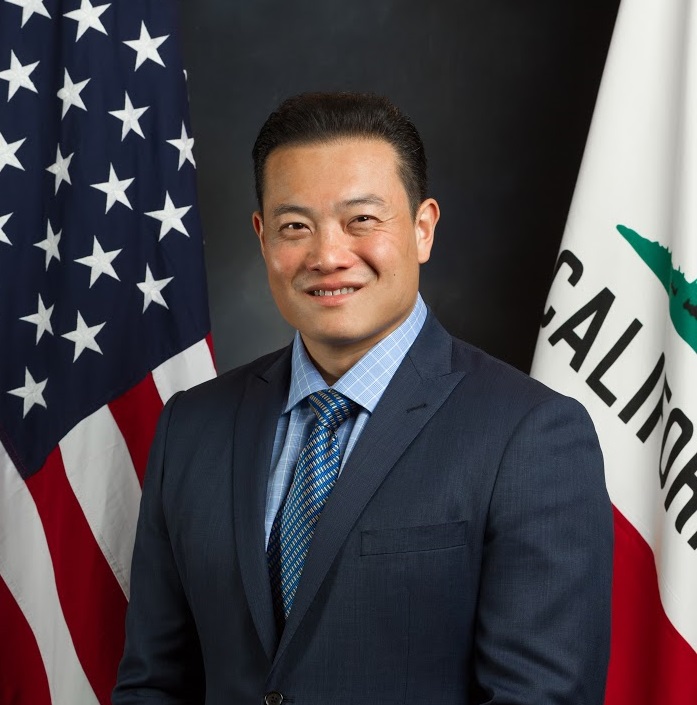
Asm. Phillip Chen
Sponsored bills
The Personal Income Tax Law, in modified conformity with federal income tax laws, allows various deductions in computing the income that is subject to the taxes imposed by that law, including miscellaneous itemized deductions that are allowed only to the extent that the aggregate amount of those deductions exceed 2% of adjusted gross income. This bill, for taxable years beginning on or after January 1, 2018, and before January 1, 2023, would allow a deduction, not to exceed $100, under that law for the qualified costs paid or incurred by a taxpayer for the adoption of a qualified pet, as defined, from a qualified animal rescue organization. The bill would make these provisions operative on the effective date of any budget measure that specifically appropriates funds to the Franchise Tax Board for its costs of administering these provisions. This bill would take effect immediately as a tax levy.
The California Environmental Quality Act (CEQA) requires a lead agency, as defined, to prepare, or cause to be prepared, and certify the completion of, an environmental impact report on a project that it proposes to carry out or approve that may have a significant effect on the environment or to adopt a negative declaration if it finds that the project will not have that effect. CEQA also requires a lead agency to prepare a mitigated negative declaration for a project that may have a significant effect on the environment if revisions in the project would avoid or mitigate that effect and there is no substantial evidence that the project, as revised, would have a significant effect on the environment. This bill would exempt from the provisions of CEQA a project, or the issuance of a permit for a project, that consists of the inspection, maintenance, repair, rehabilitation, replacement, or removal of, or the addition of an auxiliary lane or bikeway to, existing transportation infrastructure and that meets certain requirements. The bill would require the public agency carrying out the project to take certain actions.
The Consumer Credit Reporting Agencies Act requires every consumer credit reporting agency, upon request and proper identification of any consumer, to allow the consumer to visually inspect all files maintained regarding that consumer at the time of the request. The act requires every consumer reporting agency, upon contact by a consumer regarding information which may be contained in the agency files regarding that consumer, to inform the consumer of specified rights and agency obligations. This bill would make nonsubstantive changes to those provisions.
This measure would proclaim the period of October 23, 2017, to October 31, 2017, inclusive, as Red Ribbon Week and would encourage all Californians to help build drug-free communities and to participate in drug prevention activities.
Existing law authorizes an individual to contribute amounts in excess of his or her personal income tax liability for the support of specified funds. Under existing law, there are general administrative provisions applicable to these voluntary contributions, which, among other things, provide for the disbursement of contributions following repeal of the fund provisions and require undesignated funds to be transferred to the General Fund. Existing law requires any new or extended voluntary contribution to include the words "voluntary tax contribution" in the name of the fund, to require the administering agency to include specified information about the fund on its Internet Web site, to continuously appropriate from the fund the contributions made to the administering agency, and to set a minimum contribution amount for the continuation of any voluntary tax contribution on the tax return form and a generally applicable repeal date for a voluntary tax contribution. This bill would allow an individual to designate on his or her tax return that a specified amount in excess of his or her tax liability be transferred to the Rape Kit Backlog Voluntary Tax Contribution Fund, which would be created by this bill. The bill would conform with those aforementioned administrative requirements by continuously appropriating those funds to the Franchise Tax Board, the Controller, and the Department of Justice for administrative costs. The bill would require remaining funds in the Rape Kit Backlog Voluntary Tax Contribution Fund to be transferred to the Department of Justice for purposes of distributing grants to local agencies to be used for DNA testing in the processing of rape kits. The bill would also conform by repealing the provisions as of December 1 of the year that the minimum contribution amount of $250,000 is not met or by the specified repeal date and requiring the Department of Justice to post on its Internet Web site specified information. By continuously appropriating these funds, the bill would make an appropriation.
Existing law regulates the sale or offer to sell by a dealer to a consumer of a collectible in or from this state, as specified. Existing law defines the term "collectible" to mean any autographed item, as specified, sold or offered for sale in or from this state by a dealer, to a consumer for $5 or more. Existing law defines the term "autographed" to mean bearing the actual signature of a personality signed by that individual's own hand. Existing law defines a "dealer," among other things, as a person who is principally in the business of selling or offering for sale collectibles in or from this state or a person who by his or her occupation holds himself or herself out as having knowledge or skill peculiar to collectibles. Existing law includes a person engaged in a cable television business for the sale of collectibles in the definition of dealer. Existing law excludes, among other persons, the personality who signs the memorabilia from the definition of dealer. Existing law also excludes from the definition of dealer a provider or operator of an online marketplace, provided that the marketplace provider or operator is not principally in the business of selling, or offering for sale, collectibles, in or from the state, exclusively or nonexclusively, or does not hold itself out as having knowledge or skill peculiar to collectibles. This bill would instead define "autographed collectible" to mean an autographed sports or entertainment media item, as specified, sold or offered for sale by a dealer to a consumer for $50 or more, bearing the signature of a particular person that increases the sale value of the item over that of a comparable item without the actual signature. The bill would exclude, among other items, works of fine art, signed books, furniture, and decorative objects, from the definition of an autographed collectible. The bill would amend the definition of a dealer to be, among other things, a person who is in the business of selling autographed collectibles and who sells 3 or more autographed collectibles in a period of 12 months. The bill would include a person engaged in any television business for the sale of autographed collectibles and an auctioneer or auction company in the definition of dealer. The bill would delete the exclusion of a provider or operator of an online marketplace from the definition of dealer. Existing law requires a dealer to provide a certificate of authenticity, as specified, for each collectible to, among other things, indicate to a buyer whether a collectible item was purchased from a 3rd party and if so, the name and address of the 3rd party. This bill instead would require a dealer to provide an express warranty, as specified. The bill also would require a dealer, for items obtained on and after January 1, 2018, separate from the express warranty, to maintain a record stating whether the autographed collectible was purchased by the dealer from a 3rd party and the name and address of the 3rd party. The bill would permit discovery of this information in a civil dispute, as specified. The bill would require the dealer to keep the 3rd-party information on file for 7 years. Existing law requires a dealer displaying or offering for sale a collectible in this state to have at the location and in close proximity to the collectible merchandise a conspicuous sign that informs consumers of the written certificate of authenticity requirement, as specified. Existing law exempts auctioneers selling collectibles from this requirement. Existing law also requires a dealer engaged in a mail-order, telephone-order, or online business for the sale of collectibles in or from this state to, among other things, include in each television or online advertisement a similar disclosure in an onscreen message, as specified. This bill would require an auctioneer, auction company, and a vendor at a trade show to display specified signage regarding the express warranty requirements for autographed collectibles. Existing law grants certain individuals the right to cancel or to rescind certain contracts within a specified number of business days. Existing law requires a retail seller that sells goods to the public in this state that has a policy as to any of those goods of not giving full refunds, or of not allowing equal exchanges, or any combination thereof, for at least 7 days following purchase of the goods, as specified, to conspicuously display that policy, as specified. The bill would grant a consumer the right to cancel the contract for the purchase of an autographed collectible represented by a dealer as authentic until at least midnight of the 3rd day after the day on which the consumer purchased the autographed collectible, except when the autographed collectible is purchased at a public auction or trade show, or as part of a trade or barter, as specified. The bill would specify procedures and conditions of the cancellation. The bill would require the 3-day right of return, except as specified, to be included in the sign and the onscreen message a dealer is required to display. Existing law prohibits a dealer from displaying or offering for sale a collectible in this state at any trade show or similar event primarily featuring sales of collectibles or other memorabilia that offers onsite admission ticket sales, except as provided. Existing law requires a promoter who arranges or organizes a trade show featuring collectibles and autograph signings to provide a specified notification to any dealer who agrees to purchase or rent space in the trade show. This bill would repeal those provisions. Existing law provides that a consumer who is injured by a failure of the dealer to provide a certificate of authenticity is entitled to recover from that dealer, among other things, 10 times his or her actual damages. Existing law also authorizes the court to award additional damages based on the egregiousness of the dealer's conduct. This bill instead would provide for specified civil penalties in a civil action against the dealer for failure to comply with the provisions regarding express warranties. The bill would provide for separate specified civil penalties for providing a false warranty, providing a false warranty as the result of gross negligence, and knowingly providing a false warranty, as well as attorney's fees and other costs to be paid to the consumer. The bill would authorize the court to award punitive damages based on the egregiousness of the dealer's conduct. This bill would declare that it is to take effect immediately as an urgency statute.
Existing law provides for apprenticeship programs within the Division of Apprenticeship Standards, which is within the Department of Industrial Relations, sponsored by specific entities and employers, and requires the Chief of the Division of Apprenticeship Standards to perform various functions with respect to apprenticeship programs and the welfare of apprentices. This bill would require the Division of Apprenticeship Standards, in collaboration with the California Firefighter Joint Apprenticeship Committee (CAL-JAC) , to develop a statewide firefighter preapprenticeship program designed to recruit candidates from underrepresented groups. This bill would require the preapprenticeship program to meet specified objectives. This bill would also require CAL-JAC to deliver the pilot classes established by the preapprenticeship program using existing facilities and training models. This bill would require CAL-JAC to provide the program model to fire protection agencies, and would authorize a fire protection agency to then use that model and related resources to establish a local preapprenticeship program for recruiting candidates from underrepresented groups. This bill would reference an appropriation made in the Budget Act of 2017–18 to the division to establish the preapprenticeship program and would require the division to use those funds for specified purposes. This bill would declare that it is to take effect immediately as an urgency statute.
This measure would recognize the importance of civic engagement across the State of California.
Existing law authorizes, the prosecution to apply for an order that a victim's testimony at the preliminary hearing be video recorded and the video recording preserved when the defendant has been charged with certain sex crimes, including rape and sodomy, and the victim is a person 15 years of age or less or is developmentally disabled as a result of an intellectual disability. This bill would also authorize the prosecution to apply for an order that a victim's testimony at the preliminary hearing be video recorded and preserved when the defendant has been charged with aggravated sexual assault of a child under 14 years of age or charged with sexual intercourse, sodomy, sexual penetration, or oral copulation with a child under 10 years of age.