

(1) Existing law provides various sources of funding for transportation purposes, including funding for the state highway system and the local street and road system. These funding sources include, among others, fuel excise taxes, commercial vehicle weight fees, local transactions and use taxes, and federal funds. Existing law imposes certain registration fees on vehicles, with revenues from these fees deposited in the Motor Vehicle Account and used to fund the Department of Motor Vehicles and the Department of the California Highway Patrol. Existing law provides for the monthly transfer of excess balances in the Motor Vehicle Account to the State Highway Account. This bill would create the Traffic Relief and Road Improvement Program to address traffic congestion and deferred maintenance on the state highway system and the local street and road system. The bill would provide for the deposit of various existing sources of revenue in the Traffic Relief and Road Improvement Account, which the bill would create in the State Transportation Fund, including revenues attributable to the sales and use tax on motor vehicles, revenues attributable to automobile and motor vehicle insurance policies from the insurer gross premiums tax, revenues from certain diesel fuel sales and use taxes, revenues from certain vehicle registration fees, and certain miscellaneous State Highway Account revenues. This bill would continuously appropriate the revenues in the account, after deductions for administration, with 40% of the revenues to be allocated to the Department of Transportation for maintenance of the state highway system or for purposes of the State Highway Operation and Protection Program, 40% of the revenues to be apportioned by the Controller to cities and counties for road purposes pursuant to a specified formula, and 20% to fund projects in the State Transportation Improvement Program that create measurable reductions in traffic congestion. The bill would require the California Transportation Commission to adopt performance criteria and metrics for expenditure of certain of these revenues, and would impose various requirements on cities and counties in order to receive apportionments. The bill would also require the department to implement efficiency measures with the goal of generating $100,000,000 annually in savings at the department and to propose, from the identified savings, an appropriation to be included in the annual Budget Act of up to $100,000,000 from the State Highway Account for expenditure on the Active Transportation Program. (2) Article XXII of the California Constitution provides that the State of California and all other governmental entities shall be allowed the choice to contract for architectural and engineering services for all public works of improvement as an alternative to the employment of civil service employees to perform those services. This bill would require the Department of Transportation to increase its annual use of contract staff resources so that 20% of its capital outlay staff consists of contract resources by the 2020–21 fiscal year. (3) Article XIX of the California Constitution requires gasoline excise tax revenues from motor vehicles traveling upon public streets and highways to be deposited in the Highway Users Tax Account, for allocation to city, county, and state transportation purposes. Existing law generally provides for statutory allocation of gasoline excise tax revenues attributable to other modes of transportation, including aviation, boats, agricultural vehicles, and off-highway vehicles, to particular accounts and funds for expenditure on purposes associated with those other modes, except that a specified portion of these gasoline excise tax revenues is deposited in the General Fund. Expenditure of the gasoline excise tax revenues attributable to those other modes is not restricted by Article XIX of the California Constitution. This bill, commencing January 1, 2018, would instead transfer to the Highway Users Tax Account for allocation to state and local transportation purposes under a specified formula most of the gasoline excise tax revenues currently being deposited in the General Fund that are attributable to boats, agricultural vehicles, and off-highway vehicles. Because that account is continuously appropriated, the bill would make an appropriation. The bill would also delete a monthly transfer to the General Fund of $833,000 in gasoline excise taxes attributable to off-highway vehicles, thereby retaining those revenues for off-highway vehicle programs. (4) Existing law imposes weight fees on the registration of commercial motor vehicles and provides for the deposit of net weight fee revenues into the State Highway Account. Existing law provides for the transfer of certain weight fee revenues from the State Highway Account to the Transportation Debt Service Fund to reimburse the General Fund for payment of debt service on general obligation bonds issued for certain transportation purposes. Existing law also provides for the transfer of specified weight fee revenues to the Transportation Bond Direct Payment Account for direct payment of debt service on designated bonds, which are defined to be certain transportation general obligation bonds issued pursuant to Proposition 1B of 2006. Existing law also provides for loans of weight fee revenues to the General Fund to the extent the revenues are not needed for bond debt service purposes, with the loans to be repaid when the revenues are later needed for those purposes, as specified. This bill would repeal these provisions, thereby eliminating the use of the weight fee revenues for transportation general obligation bond debt service and retaining those revenues in the State Highway Account. The bill would make other conforming changes in that regard. (5) Article XIX of the California Constitution restricts the expenditure of revenues from taxes imposed by the state on fuels used in motor vehicles upon public streets and highways to street and highway and certain mass transit purposes. Existing law requires certain miscellaneous revenues deposited in the State Highway Account that are not restricted as to expenditure by Article XIX of the California Constitution to be transferred to the Transportation Debt Service Fund in the State Transportation Fund, as specified, and requires the Controller to transfer from the fund to the General Fund an amount of those revenues necessary to offset the current year debt service made from the General Fund on general obligation transportation bonds issued pursuant to Proposition 116 of 1990. This bill would delete the transfer of these miscellaneous revenues to the Transportation Debt Service Fund, and would instead require the miscellaneous revenues to be transferred to the Traffic Relief and Road Improvement Account for expenditure pursuant to (1) above. (6) Existing law provides for the deposit of all moneys received by the Department of Motor Vehicles into the Motor Vehicle Account in the State Transportation Fund, which includes some miscellaneous revenues that are not restricted by Article XIX of the California Constitution. Item 2740-011-0044 of Section 2.00 of the Budget Act of 2016, in that regard, requires the Controller to transfer those miscellaneous revenues from the Motor Vehicle Account to the General Fund and estimates the amount of those revenues in the 2015–16 fiscal year at $78,592,000. This bill would repeal the above-referenced item of the Budget Act of 2016. The bill would require the Controller to transfer, from the General Fund to the Motor Vehicle Account, an amount equal to all revenues previously transferred from that account to the General Fund pursuant to this item. The bill, commencing in the 2016–17 fiscal year, would require all revenues in the Motor Vehicle Account that are not protected by Article XIX of the California Constitution to be allocated, upon appropriation, to the Department of Motor Vehicles and the Department of the California Highway Patrol, as specified. (7) Existing law provides for loans of revenues from various transportation funds and accounts to the General Fund, with various repayment dates specified. This bill would require specified loans with a repayment date of January 1, 2018, or later to instead be repaid by December 31, 2017. The bill would require the funds repaid to the State Highway Account to be allocated between state and local government transportation purposes pursuant to a specified formula. (8) Existing law requires all moneys, except for fines and penalties, collected by the State Air Resources Board from the auction or sale of allowances as part of a market-based compliance mechanism relative to reduction of greenhouse gas emissions to be deposited in the Greenhouse Gas Reduction Fund. Existing law continuously appropriates 60% of the annual proceeds of the fund to various transportation and housing programs. Existing law, beyond the sales and use tax rate generally applicable, imposes an additional sales and use tax on diesel fuel at the rate of 1.75%, subject to certain exemptions, and provides for the net revenues collected from the additional tax to be transferred to the Public Transportation Account. Existing law continuously appropriates these revenues to the Controller for allocation by formula to transportation agencies for public transit purposes under the State Transit Assistance Program. Existing law provides for an increase of $8 in the smog abatement fee on new motor vehicles initially exempt from the smog check program, and provides for an increase of $3 in the basic vehicle registration fee, with revenues from these fee increases deposited, as specified, in the Air Quality Improvement Fund, the Alternative and Renewable Fuel and Vehicle Technology Fund, and the Enhanced Fleet Modernization Subaccount for expenditure on certain air quality programs. This bill would require equivalent amounts of revenue to be made available for the above purposes from the Greenhouse Gas Reduction Fund to the extent revenues are available after funding existing programs, and would require the specified diesel sales and use tax revenues and increases in vehicle registration fees to instead be transferred to the Traffic Relief and Road Improvement Account for expenditure pursuant to (1) above. The bill, beyond the backfill required for the Public Transportation Account, would additionally provide for an additional transfer from the Greenhouse Gas Reduction Fund to the Public Transportation Account, as specified. The bill would exempt funds transferred from the Greenhouse Gas Reduction Fund to the Public Transportation Account from statutory restrictions and limitations otherwise applicable to expenditures from the Greenhouse Gas Reduction Fund, as specified. (9) Existing law establishes in state government the Transportation Agency, which includes various departments and state entities, including the California Transportation Commission. Existing law vests the California Transportation Commission with specified powers, duties, and functions relative to transportation matters. Existing law requires the commission to retain independent authority to perform the duties and functions prescribed to it under any provision of law. This bill would exclude the California Transportation Commission from the Transportation Agency, establish it as an independent entity in state government, and require it to act in an independent oversight role. The bill would also make conforming changes. (10) Existing law creates various state agencies, including the Department of Transportation, the High-Speed Rail Authority, the Department of the California Highway Patrol, the Department of Motor Vehicles, and the State Air Resources Board, with specified powers and duties. Existing law provides for the allocation of state transportation funds to various transportation purposes. This bill would create the Office of the Transportation Inspector General in state government, as an independent office that would not be a subdivision of any other government entity, to ensure that all of the above-referenced state agencies and all other state agencies expending state transportation funds are operating efficiently, effectively, and in compliance with federal and state laws. The bill would provide for the Governor to appoint the Transportation Inspector General for a 6-year term, subject to confirmation by the Senate, and would provide that the Transportation Inspector General may not be removed from office during the term except for good cause. The bill would specify the duties and responsibilities of the Transportation Inspector General, which would include an annual audit of state transportation megaprojects, as defined, in consultation with the California State Auditor, and would require an annual report to the Legislature and Governor. (11) Existing law requires the Department of Transportation to prepare the State Highway Operation and Protection Program every other year for the expenditure of transportation capital improvement funds for projects that are necessary to preserve and protect the state highway system, excluding projects that add new traffic lanes. The program is required to be based on an asset management plan, as specified. Existing law requires the department to specify, for each project in the program the capital and support budget and projected delivery date for various components of the project. Existing law provides for the California Transportation Commission to review and adopt the program, and authorizes the commission to decline and adopt the program if it determines that the program is not sufficiently consistent with the asset management plan. The bill would require the commission, as part of its review of the program, to hold at least one hearing in northern California and one hearing in southern California regarding the proposed program. The bill would require the department to submit any change to a programmed project as an amendment to the commission for its approval. This bill, on and after February 1, 2018, would also require the commission to make an allocation of all capital and support costs for each project in the program, and would require the department to submit a supplemental project allocation request to the commission for each project that experiences cost increases above the amounts in its allocation. The bill would require the commission to establish guidelines to provide exceptions to the requirement for a supplemental project allocation requirement that the commission determines are necessary to ensure that projects are not unnecessarily delayed. (12) Existing law authorizes the Department of Transportation and regional transportation agencies, as defined, to enter into comprehensive development lease agreements with public and private entities, or consortia of those entities, for certain transportation projects that may charge certain users of those projects tolls and user fees, subject to various terms and requirements. These arrangements are commonly known as public-private partnerships. Existing law provides that a lease agreement may not be entered into under these provisions on or after January 1, 2017. This bill would authorize lease agreements under these provisions to be entered into until January 1, 2030. The bill would include the Santa Clara Valley Transportation Authority within the definition of regional transportation agency for this these purposes. The bill would make other revisions to these provisions. (13) The Highway Safety, Traffic Reduction, Air Quality, and Port Security Bond Act of 2006 (Proposition 1B) created the Trade Corridors Improvement Fund and provided for allocation by the California Transportation Commission of $2 billion in bond funds for infrastructure improvements on highway and rail corridors that have a high volume of freight movement and for specified categories of projects eligible to receive these funds. Existing law continues the Trade Corridors Improvement Fund in existence in order to receive revenues from sources other than the bond act for these purposes. This bill would require revenues apportioned to the state from the national highway freight program established by the federal Fixing America's Surface Transportation Act to be allocated for trade corridor improvement projects approved pursuant to these provisions. Existing law requires the commission, in determining projects eligible for funding, to consult various state freight and regional infrastructure and goods movement plans and the statewide port master plan. This bill would revise the list of plans to be consulted by the commission when determining eligible projects for funding. The bill would also expand eligible projects to include, among others, rail landside access improvements, landside freight access improvements to airports, and certain capital and operational improvements. (14) The California Environmental Quality Act (CEQA) requires a lead agency, as defined, to prepare, or cause to be prepared, and certify the completion of, an environmental impact report on a project that it proposes to carry out or approve that may have a significant effect on the environment or to adopt a negative declaration if it finds that the project will not have that effect. CEQA also requires a lead agency to prepare a mitigated negative declaration for a project that may have a significant effect on the environment if revisions in the project would avoid or mitigate that effect and there is no substantial evidence that the project, as revised, would have a significant effect on the environment, with certain exceptions. This bill would provide that CEQA does not apply to a project, or the issuance of a permit for a project, that consists of the inspection, maintenance, repair, rehabilitation, replacement, or removal of existing transportation infrastructure, as specified, or to the addition of an auxiliary lane or bikeway to existing transportation infrastructure under certain conditions. (15) Existing law requires the Office of Planning and Research to prepare, develop, and transmit to the Secretary of the Natural Resources Agency for certification and adoption proposed revisions to guidelines implementing the California Environmental Quality Act establishing criteria for determining the significance of transportation impacts for projects within transit priority areas that promote the reduction of greenhouse gas emissions, the development of multimodal transportation networks, and a diversity of land uses. Existing law authorizes the office to adopt guidelines to establish alternative metrics to the metrics used for traffic levels of service for transportation impacts outside transit priority areas. This bill would eliminate the authority of the office to adopt guidelines establishing alternative metrics for transportation impacts outside transit priority areas. (16) This bill would declare that it is to take effect immediately as an urgency statute.
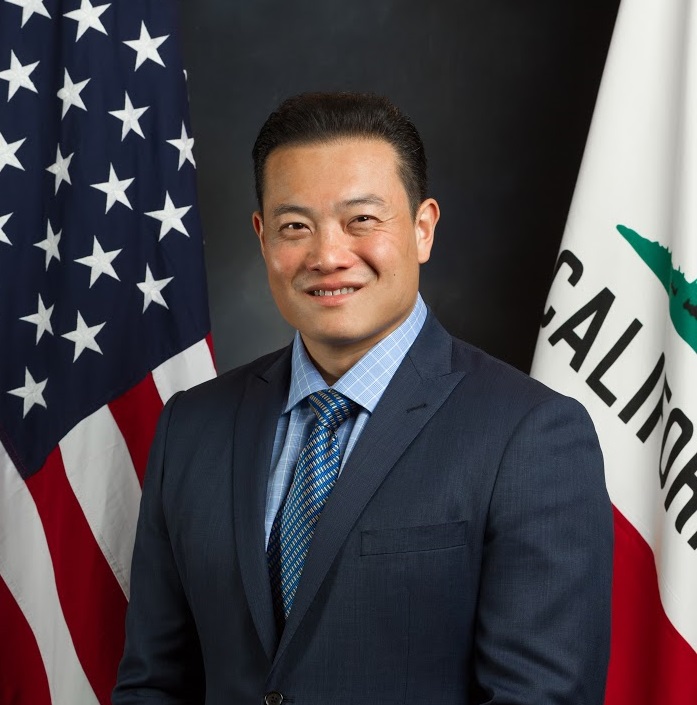
Asm. Phillip Chen
Sponsored bills
The Personal Income Tax Law and the Corporation Tax Law authorize various credits against the taxes imposed by those laws. This bill, under both laws, for taxable years beginning on or after January 1, 2018, and before January 1, 2023, would allow as a credit against those taxes an amount equal to 50% of the qualified amount paid or incurred, not to exceed $10,000, to a robotics club at a school in California during the taxable year. The bill would limit the aggregate amount of these credits to be allocated in each calendar year to up to $1,000,000. The bill would require the Franchise Tax Board to allocate and certify these tax credits to taxpayers on a first-come-first-served basis. This bill would take effect immediately as a tax levy.
(1) Existing law requires a peace officer, humane society officer, or animal control officer to take possession of a stray or abandoned animal, or any animal when the officer has reasonable grounds to believe that very prompt action is required to protect the health and safety of the animal or the health and safety of others. In the case of taking possession of a stray or abandoned animal, existing law requires the officer to provide care and treatment for the animal until the animal is deemed to be in suitable condition to be returned to the owner. This bill would require a seizing organization or entity to provide care and treatment for a seized animal until the animal is placed, returned to the owner, or euthanized. (2) Existing law requires the owner or keeper of an animal that is properly seized to be personally liable to the seizing agency for the cost of the seizure and care of the animal. This bill would, subject to exception, make the owner or keeper of the animal liable to the seizing agency, and if the animal is impounded, to the impounding agency, for the entire cost of the care, treatment, and seizure or impoundment of the animal, including costs associated with preparing and posting notices and sending statements of charges. The bill would require the seizing and impounding agency to present the owner with a statement listing all accrued charges, as provided, either at the postseizure hearing or by personal service, first-class mail, or electronic mail, as specified. By imposing new duties on local seizing and impounding agencies, this bill would impose a state-mandated local program. (3) Existing law permits the return of an animal only when the owner can demonstrate to the satisfaction of the seizing agency or hearing officer that the owner can and will provide the necessary care for the animal. This bill would, subject to exception, require that if the animal was seized pursuant to a search warrant that the court that issued or adjudicated the warrant give its express approval prior to the release of the animal to the owner. (4) Existing law makes it a misdemeanor for every owner, driver, or keeper of an animal to permit the animal to be in any building, enclosure, lane, street, square, or lot of any city, county, city and county, or judicial district without proper care and attention. Existing law, in cases involving cats and dogs, allows a seizing entity or prosecuting attorney to file a petition in a criminal action to request that the court issue an order forfeiting an animal prior to the final disposition of the case. This bill would make the above provision applicable to any animal. The California Constitution requires the state to reimburse local agencies and school districts for certain costs mandated by the state. Statutory provisions establish procedures for making that reimbursement. This bill would provide that no reimbursement is required by this act for a specified reason.
Existing law requires, in the event that the debtor has more than one debt being collected by the Franchise Tax Board and the amount collected is insufficient to satisfy the total amount owed, the amount collected to be applied to specified priorities. Existing law also establishes, for tax liabilities that are due and payable, as defined, before, on, or after July 1, 2006, a statute of limitations on collections of those liabilities to limit the collection period to 20 years beginning from the last statutory lien date for each taxable year, and would extinguish that liability for that taxable year by abating the underlying tax. This bill, beginning January 1, 2020, would make restitution payments to victims of crimes the first priority for debt collected by the Franchise Tax Board and would provide for a stay on the statute of limitations for collection of tax due for the period for which an outstanding restitution amount exists.
The California Constitution and existing property tax law authorize a person who is either severely disabled or over 55 years of age to transfer the base year value, as defined, of property that is eligible for the homeowners' property tax exemption to a replacement dwelling that is of equal or lesser value located within the same county as the property from which the base year value is transferred, and if a county ordinance so providing has been adopted, to a replacement dwelling that is located in a different county. This bill would authorize any person over 55 years of age or any severely and permanently disabled person to transfer the base year value of an original property to a replacement dwelling located in a different county without the adoption of a county ordinance so providing. The bill would limit this provision to transfers of base year value that occur on or after January 1, 2019.  By changing the manner in which local assessors assess property for property taxation purposes, this bill would impose a state-mandated local program. The California Constitution requires the state to reimburse local agencies and school districts for certain costs mandated by the state. Statutory provisions establish procedures for making that reimbursement. This bill would provide that, if the Commission on State Mandates determines that the bill contains costs mandated by the state, reimbursement for those costs shall be made pursuant to the statutory provisions noted above. Existing law requires the state to reimburse local agencies annually for certain property tax revenues lost as a result of any exemption or classification of property for purposes of ad valorem property taxation. This bill would provide that, notwithstanding those provisions, no appropriation is made and the state shall not reimburse local agencies for property tax revenues lost by them pursuant to the bill. This bill would take effect immediately as a tax levy, but would become operative only if Assembly Constitutional Amendment ____ of the 2017–18 Regular Session is approved by the voters.
(1) Existing property tax law provides, pursuant to the authority of a specified provision of the California Constitution, for a homeowners' exemption in the amount of $7,000 of the full value of a "dwelling," as defined, and authorizes the Legislature to increase this exemption. This bill, beginning with the lien date for the 2018–19 fiscal year, contingent upon a specified appropriation, would increase the homeowners' exemption from $7,000 to $25,000 of the full value of a dwelling. This bill would also require, for the 2019–20 fiscal year and for each fiscal year thereafter, the county assessor to adjust the amount of the homeowners' exemption by the percentage change in the House Price Index for California for the first 3 quarters of the prior calendar year, as specified. (2) The California Constitution requires the Legislature, whenever it increases the homeowners' property tax exemption, to provide a comparable increase in benefits to qualified renters. The Personal Income Tax Law authorizes various credits against the taxes imposed by that law, including a credit for qualified renters in the amount of $120 for spouses filing joint returns, heads of household, and surviving spouses if adjusted gross income is $50,000 or less, and in the amount of $60 for other individuals if adjusted gross income is $25,000 or less. Existing law requires the Franchise Tax Board to annually adjust for inflation these adjusted gross income amounts. This bill, for each taxable year beginning on and after January 1, 2018, contingent upon a specified appropriation, would increase this credit for a qualified renter to $428 for spouses filing joint returns, heads of household, and surviving spouses if adjusted gross income is $50,000 or less, as adjusted for inflation, and to an amount equal to $214 for other individuals if adjusted gross income is $25,000 or less, as adjusted for inflation. The bill would also require, for taxable years beginning on or after January 1, 2019, the Franchise Tax Board to annually adjust for inflation, based upon the California Consumer Price Index, the amount of these credits. The bill would also make technical, nonsubstantive changes to the renters' credit. (3) Existing law requires the state to reimburse local agencies annually for certain property tax revenues lost as a result of any exemption or classification of property for purposes of ad valorem property taxation. This bill would provide that, notwithstanding those provisions, no appropriation is made and the state shall not reimburse local agencies under those provisions for property tax revenues lost by them pursuant to the bill. (4) This bill would take effect immediately as a tax levy.
Existing law, the Lanterman-Petris-Short Act, provides for the involuntary commitment and treatment of persons with specified mental disorders for the protection of the persons so committed. Under the act, when a person, as a result of a mental health disorder, is a danger to others, or to himself or herself, or is gravely disabled, he or she may, upon probable cause, be taken into custody by a peace officer, a member of the attending staff of an evaluation facility, designated members of a mobile crisis team, or another designated professional person, and placed in a facility designated by the county and approved by the State Department of Social Services as a facility for 72-hour treatment and evaluation. Existing law, for these purposes defines "gravely disabled" to mean either a condition in which a person, as a result of a mental health disorder or chronic alcoholism, is unable to provide for his or her basic personal needs for food, clothing, or shelter, or a condition in which a person has been found mentally incompetent, as specified, and various facts exist. Existing law also provides immunity from civil and criminal liability for the detention for specified licensed general acute care hospitals, licensed acute psychiatric hospitals, licensed professional staff at those hospitals, or any physician and surgeon providing emergency medical services in any department of those hospitals if various conditions are met, including that the detained person cannot be safely released from the hospital because, in the opinion of specified treating staff, the person, as a result of a mental disorder, presents a danger to himself or herself, or others, or is gravely disabled, as defined. This bill would expand the above definition of "gravely disabled" to also include a condition in which a person, as a result of a mental health disorder or chronic alcoholism, as applicable, is unable to provide for his or her medical care. The bill would make conforming changes. Existing law prohibits a person from being tried or adjudged to punishment while that person is mentally incompetent. Existing law establishes a process by which a defendant's mental competency is evaluated and by which the defendant is committed to a facility for treatment. If the defendant is gravely disabled, as defined above, upon his or her return to the committing court, existing law requires the court to order the conservatorship investigator of the county to initiate conservatorship proceedings on the basis that the indictment or information pending against the person charges a felony involving death, great bodily harm, or a serious threat to the physical well-being of another person. By expanding the above definition of "gravely disabled," the bill would increase the duties on local agencies, and would therefore impose a state-mandated local program. The California Constitution requires the state to reimburse local agencies and school districts for certain costs mandated by the state. Statutory provisions establish procedures for making that reimbursement. This bill would provide that, if the Commission on State Mandates determines that the bill contains costs mandated by the state, reimbursement for those costs shall be made pursuant to the statutory provisions noted above.
The Personal Income Tax Law, in modified conformity with federal income tax laws, allows various deductions in computing the income that is subject to the taxes imposed by that law. This bill, for taxable years beginning on or after January 1, 2017, and before January 1, 2022, would allow a deduction in computing adjusted gross income for an amount paid or incurred by the qualified taxpayer during the taxable year, not to exceed $1,500, for qualified homeowners' association assessments, as defined. This bill would take effect immediately as a tax levy.
Existing law prohibits an employer from paying any of its employees at wage rates less than the rates paid to employees of the opposite sex for substantially similar work, when viewed as a composite of skill, effort, and responsibility, and performed under similar working conditions, unless the employer demonstrates that one or more specific factors, reasonably applied, account for the entire wage differential. Existing law also similarly prohibits an employer from paying any of its employees at wage rates less than the rates paid to employees of another race or ethnicity for substantially similar work. This bill would make a nonsubstantive change to those provisions.
Under existing law, a person, firm, or corporation that interferes with various specified rights of a disabled individual is liable for the actual damages of each offense and any amount determined by a judge or jury of up to 3 times the amount of the actual damages, but in no case less than $1,000. This bill would establish notice requirements for a plaintiff to follow before bringing an action against a small business, as defined, for an alleged violation of the Americans with Disabilities Act of 1990 (ADA) . The bill would require the plaintiff to provide notice to a business at least 6 months before filing the complaint. The bill would also preclude commencement of an action against a small business for an alleged ADA violation if the small business has made a good faith effort to correct the alleged violation.