

Existing law establishes the Medi-Cal program, which is administered by the State Department of Health Care Services and under which qualified low-income individuals receive health care services, including emergency medical transportation services. The Medi-Cal program is, in part, governed and funded by federal Medicaid program provisions. Existing law authorizes a Medi-Cal provider of ground emergency medical transportation services that is owned or operated by specified entities, including a fire protection district or a federally recognized Indian tribe, to receive supplemental Medi-Cal reimbursement in addition to the rate of payment the eligible provider would otherwise receive for those services. Existing law requires the department to develop a modified supplemental reimbursement program that would seek to increase the reimbursement to those eligible providers, and requires the nonfederal share of any supplemental reimbursement provided under the modified program to be derived from voluntary intergovernmental transfers of local funds. Existing law requires the department to implement, no sooner than July 1, 2021, the Public Provider Intergovernmental Transfer Program (program) , for the duration of any Medi-Cal managed care rating period, and authorizes the department to continue conducting any administrative duties related to the above-specified supplemental Medi-Cal reimbursement. Existing law requires an eligible provider, defined, in part, as a provider of emergency medical transport, to receive an add-on increase to the associated Medi-Cal fee-for-service payment schedule, and requires the department to develop the add-on increase pursuant to specified standards, including an eligible provider's average cost directly associated with providing a Medi-Cal emergency medical transport under the Medi-Cal program. Existing law, the Medi-Cal Emergency Medical Transportation Reimbursement Act, imposes a quality assurance fee for each emergency medical transport provided by an emergency medical transport provider subject to the fee in accordance with a prescribed methodology. Existing law exempts an eligible provider from the quality assurance fee and add-on increase for the duration of any Medi-Cal managed care rating during which the program is implemented. Existing law requires each applicable Medi-Cal managed care health plan to satisfy a specified obligation for emergency medical transports and to provide payment to noncontract emergency medical transport providers, and provides that this provision does not apply to an eligible provider who provides noncontract emergency medical transports to an enrollee of a Medi-Cal managed care plan during any Medi-Cal managed care rating period that the program is implemented. The bill would provide that during the entirety of any Medi-Cal managed care rating period for which the program is implemented an eligible provider shall not be an emergency medical transport provider, as defined, who is subject to a quality assurance fee or eligible for the add-on increase, and would provide that the program's provisions do not affect the application of the specified add-on to any payment to a nonpublic emergency medical transport provider. The bill would redefine "emergency medical transport provider" to mean any provider of emergency medical transports, except during the entirety of any Medi-Cal managed care rating period for which the program is implemented, in whole or in part, that excludes any public provider of emergency medical transports, including any provider who meets prescribed requirements. With respect to the quality assurance fee, commencing in the 2021–22 fiscal year, and for each state fiscal year thereafter, the bill would require the Director of Health Care Services to comply with specified requirements, including calculating the annual quality assurance fee applicable to a specified program period at least 150 days before the start of the state fiscal year, and would make conforming changes. The bill would delete the above-specified limitation on the provision relating to Medi-Cal managed care health plans and their obligation to provide emergency medical transports and payment to noncontract providers.
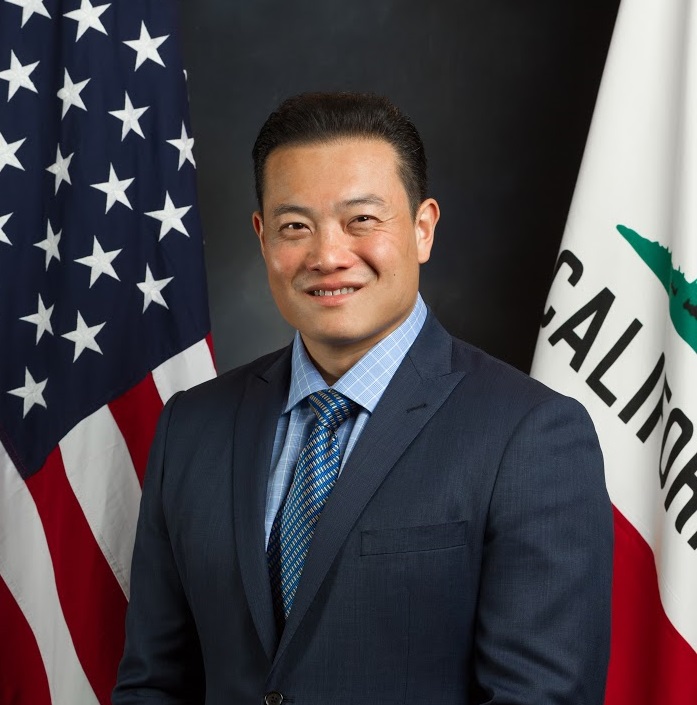
Asm. Phillip Chen
Sponsored bills
Existing law, the Contractors' State License Law, creates the Contractors' State License Board within the Department of Consumer Affairs and provides for the licensure and regulation of contractors. Existing law, with certain exceptions, prohibits an unlicensed contractor from recovering compensation for work performed while they were unlicensed and authorizes a person who utilizes an unlicensed contractor to bring an action in any court of competent jurisdiction in this state for recovery of compensation paid to the unlicensed contractor for performance of any act or contract. Existing law provides that the prohibition on recovering compensation for work performed while unlicensed does not apply to a contractor who was individually licensed but failed to comply with specified joint licensing provisions. This bill would also provide that the prohibition on recovering compensation for work performed while unlicenced does not apply to a limited partnership in which the license is held by the general partner of the limited partnership.
Existing law provides for the regulation of legal document assistants and unlawful detainer assistants and requires a legal document assistant or unlawful detainer assistant to be registered by the county clerk in the county where their principal place of business is located and where they maintain a branch office. Existing law requires the Department of Consumer Affairs to develop the required application for a person to register as a legal document assistant. Existing law makes a failure to comply with specified requirements imposed on legal document assistants and unlawful detainer assistants a crime. This bill would require a legal document assistant or unlawful detainer assistant to file with the Secretary of State a disclosure form that contains specified information, a copy of a valid and current photo identification, and a photograph of themselves, as specified. The bill would require a legal document assistant or unlawful detainer assistant to notify the Secretary of State's office in writing within 30 days of specified events. The bill would require the Secretary of State to post information on its internet website specified information received from a legal document assistant or unlawful detainer assistant and to charge and collect a filing fee to cover the cost of administering these provisions. By expanding the crime of perjury and imposing new requirements on legal document assistants and unlawful detainer assistants, the violation of which is a crime, this bill would impose a state-mandated local program. The California Constitution requires the state to reimburse local agencies and school districts for certain costs mandated by the state. Statutory provisions establish procedures for making that reimbursement. This bill would provide that no reimbursement is required by this act for a specified reason.
Existing law establishes the Permit Assistance Program within the Governor's Office of Business and Economic Development (GO-Biz) to, among other things, provide permitting and regulatory compliance assistance to businesses. Existing law requires GO-Biz to report to the Governor and the Legislature annually on the activities and outcomes of the program. This bill would instead require GO-Biz to provide this report at least annually.
Existing law defines the crime of burglary to include entering a vehicle when the doors are locked with the intent to commit grand or petit larceny or a felony. Existing law makes the burglary of a vehicle punishable as a misdemeanor or a felony. This bill would require the Board of State and Community Corrections to administer grants to law enforcement agencies that participate in regional vehicle burglary reduction joint task forces. The bill would make law enforcement agencies in specified counties eligible to participate in the regional task forces. The bill would require participating law enforcement agencies in each region to form a joint task force coordination council consisting of the sheriff or chief of police, or their representatives, of each participating law enforcement agency, and would authorize the Commissioner of the Department of the California Highway Patrol to designate a representative of the California Highway Patrol to serve as an ex officio member for each task force. The bill would require the board to distribute funding to the task forces, and require those funds to be expended with the goal of reducing vehicle burglary, identifying suspects engaged in vehicle burglary, identifying interregional movement of vehicle burglary offenders, coordinating joint vehicle burglary enforcement efforts, and promoting law enforcement training and best practices to reduce the incidence of vehicle burglary. The bill would additionally require the lead agency of each task force to report to the board specified information relating to the crime of vehicle burglary in the jurisdictions participating in the task force. The bill would require the board to compile those statistics and, on or after January 1 of the year subsequent to the receipt of those reports, and annually thereafter, to report this information to the Legislature and the Governor and post the information on the board's internet website. The bill would require these provisions to be implemented only to the extent that funding is appropriated for these purposes, as specified. This bill would make legislative findings and declarations as to the necessity of a special statute for the Counties of Alameda, Contra Costa, Los Angeles, Orange, San Bernardino, San Diego, San Mateo, Santa Clara, Riverside, and Ventura, and the City and County of San Francisco.
This measure would designate the week of February 24, 2020, to March 1, 2020, as Eating Disorders Awareness Week.
Existing law categorizes certain weapons, including nunchaku, as a generally prohibited weapon, and, except as specified, subjects a person who manufactures, imports, keeps for sale, or offers or exposes for sale, or who gives, lends, or possesses any nunchaku to imprisonment in a county jail, as specified. Existing law also declares nunchaku to be a nuisance and authorizes the Attorney General, a district attorney, or a city attorney to bring an action to enjoin any of the activities stated above. This bill would remove nunchaku from the list of generally prohibited weapons and repeal its designation as a nuisance. This bill would make possession and manufacture of nunchaku by persons confined in a penal institution a felony, but would otherwise allow the purchase, possession, and use of a nunchaku by a person for self-defense purposes, with the exception of a person convicted of a felony or a crime involving an assault or a person who is addicted to any narcotic drug. Additionally, this bill would prohibit a person from selling or furnishing a nunchaku to a minor unless the minor attends a school that teaches the art of self-defense. By establishing new crimes, this bill would impose a state-mandated local program. The California Constitution requires the state to reimburse local agencies and school districts for certain costs mandated by the state. Statutory provisions establish procedures for making that reimbursement. This bill would provide that no reimbursement is required by this act for a specified reason.
Existing law, the Information Practices Act of 1977, prescribes a set of requirements, prohibitions, and remedies applicable to public agencies, as defined, with regard to their collection, storage, and disclosure of personal information. The act specifically requires an agency to establish rules of conduct for persons involved in the design, development, operation, disclosure, or maintenance of records containing personal information and to instruct these people with respect to the rules and the requirements of the act. This bill would require that the above-described rules of conduct include security awareness and training policies and procedures.
This measure would declare March 5, 2020, as Family Justice Center Day in California and would recognize the lifesaving and hope-giving work of the California Family Justice Center Network and its member Family Justice Centers as they work with rape crisis centers, domestic violence shelters, human trafficking agencies, prosecutors' offices, law enforcement agencies, and other professionals and community-based organizations to ensure that adult and child survivors of trauma can access all of their services in one setting.