

Existing law makes it unlawful for any person to practice veterinary medicine or any branch thereof in the state unless the person holds a valid, unexpired, and unrevoked license to practice veterinary medicine, surgery, and dentistry, and the various branches of those practices, as described. Existing law makes it a misdemeanor for any person to violate, or to aid or abet in violating, any of these provisions. Existing law exempts a person from licensure and specified requirements imposed on licensees when the person engages in specified acts of veterinary care for an animal, including, among other acts, administering sodium pentobarbital for the euthanasia of sick, injured, homeless, or unwanted domestic pets or animals without the presence of a veterinarian when the person is an employee of an animal control shelter and its agencies or humane society and has received proper training in the administration of sodium pentobarbital for these purposes. This bill would expand this exception to include officers and employees of a shelter and would expand the types of veterinary care that may be provided pursuant to these provisions to include, but not be limited to, the administration of nonprescription vaccinations, pursuant to written protocols, to prevent the spread of communicable disease and administering first aid, as defined, without the presence of a veterinarian as long as the person has received the required training, as specified. The bill would require a shelter engaging in these exempted acts of veterinary care to maintain records of the care, as provided. The bill would preclude these exemptions from being construed to relieve a duly authorized officer of a shelter from the obligation to convey an injured animal to a veterinarian as specified or as otherwise necessary to provide the animal with needed veterinary care that the shelter is unable to perform in accordance with the exempted acts of veterinary care. The bill would exempt a person from licensure and specified requirements imposed on licensees when engaging in specified acts of veterinary care. By changing the scope of a crime, this bill would impose a state-mandated local program. Existing law also requires all premises, as defined, where veterinary medicine, dentistry, or surgery, or the various branches thereof, is being practiced to register with the board. This bill would require public animal shelters, shelters operated by a society for the prevention of cruelty to animals, and humane societies that offer limited veterinary services, as defined, to register with the Veterinary Medical Board as a limited veterinary premises. The bill would specify application, staffing, and operations requirements for the limited veterinary premises registration. By expanding the scope of a crime, the bill would impose as state-mandated local program. Existing law requires the initial and annual fees for registration of veterinary premises to be set by the board in an amount not to exceed $400 annually. This bill would require a limited veterinary premises to pay that fee. The California Constitution requires the state to reimburse local agencies and school districts for certain costs mandated by the state. Statutory provisions establish procedures for making that reimbursement. This bill would provide that no reimbursement is required by this act for a specified reason.
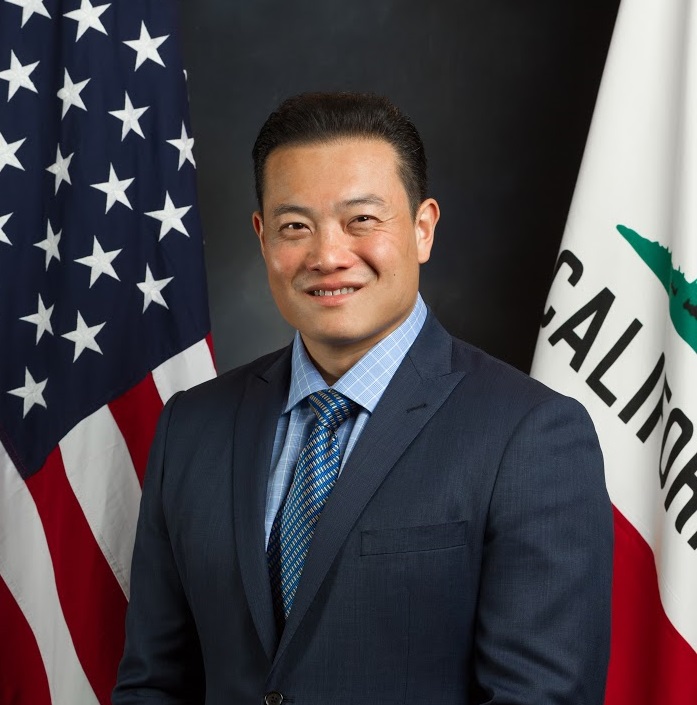
Asm. Phillip Chen
Sponsored bills
Existing sales and use tax laws impose a tax on retailers measured by the gross receipts from the sale of tangible personal property sold at retail in this state, or on the storage, use, or other consumption in this state of tangible personal property purchased from a retailer for storage, use, or other consumption in this state. Those laws provide various exemptions from those taxes, including, until July 1, 2023, an exemption for the sale of, or the storage, use, or other consumption of, menstrual hygiene products, defined as tampons, specified sanitary napkins, menstrual sponges, and menstrual cups. Existing law requires the Department of Finance, beginning on May 15, 2020, to estimate the total dollar amount of revenue that would have been credited to the Local Revenue Fund 2011 if not otherwise exempted under the sales and use tax exemption for menstrual hygiene products and requires the Controller to transfer that amount from the General Fund to the Local Revenue Fund 2011, a continuously appropriated fund, no later than June 30 of each fiscal year. This bill would establish a similar exemption for the sale of, or the storage, use, or other consumption of, menstrual hygiene products beginning July 1, 2023, and would define menstrual hygiene products to additionally include menstrual underwear. The bill would provide that the Department of Finance is required to calculate, and the Controller is required to transfer, the total dollar amount of revenue prior to January 1, 2024, that would have been credited to the Local Revenue Fund 2011 if not otherwise exempted under the sales and use tax with respect to menstrual hygiene products, as specified. The Bradley-Burns Uniform Local Sales and Use Tax Law authorizes counties and cities to impose local sales and use taxes in conformity with the Sales and Use Tax Law, and existing laws authorize districts, as specified, to impose transactions and use taxes in accordance with the Transactions and Use Tax Law, which generally conforms to the Sales and Use Tax Law. Amendments to the Sales and Use Tax Law are automatically incorporated into the local tax laws. Existing law requires the state to reimburse counties and cities for revenue losses caused by the enactment of sales and use tax exemptions. This bill would provide that, notwithstanding Section 2230 of the Revenue and Taxation Code, no appropriation is made and the state shall not reimburse any local agencies for sales and use tax revenues lost by them pursuant to this bill. This bill would take effect immediately as a tax levy.
This measure would proclaim March 2, 2020, to March 6, 2020, inclusive, as School Breakfast Week.
Existing law, the Alarm Company Act, provides for the regulation of alarm companies by the Bureau of Security and Investigative Services, which is under the supervision and control of the Director of Consumer Affairs. The act requires an alarm company operator to be licensed and provides specified other registration, certification, and permitting requirements for certain alarm company employees and business locations, including, among others, registration as an alarm agent, certification as a qualified manager, and registration for a branch office. The act also provides for the issuance of firearms permits to licensees, qualified managers, designated branch office managers, and alarm agents, as specified. Existing law authorizes the Department of Consumer Affairs to enter into a contract with a vendor for the licensing and enforcement of the BreEZe system, which is a specified integrated, enterprisewide enforcement case management and licensing system, as specified. This bill, on and after July 1, 2021, would require all applications under the act to be submitted electronically through the BreEZe system.
This measure would declare the week of February 17 to February 21, 2020, inclusive, as California Fitness Week, and would encourage Californians to enrich their lives through proper nutrition and exercise.
This measure would proclaim February 20, 2020, as Introduce a Girl to Engineering Day.
Existing law designates all parks, public campgrounds, monument sites, landmark sites, and sites of historical interest established or acquired by the state, or that are under its control, as the state park system, except as specified. Under existing law, the Department of Parks and Recreation controls the state park system, which is made up of units, one of which is the Chino Hills State Park. This bill would require the department to provide all necessary assistance for the state's acquisition and acceptance of 3 specified parcels from willing sellers that are adjacent to the Chino Hills State Park. The bill would require the department to agree to accept and manage each parcel as it is acquired with specified funds as part of the Chino Hills State Park.
This measure would proclaim March 15, 2020, to March 22, 2020, as California Down Syndrome Awareness Week and March 21, 2020, as California Down Syndrome Day, and would encourage all Californians to support and participate in related activities.
(1) The Professional Engineers Act and the Professional Land Surveyors' Act provide for the licensure and regulation of professional engineers and land surveyors by the Board for Professional Engineers, Land Surveyors, and Geologists. Under those acts, a land surveyor includes a person who engages in specified practices, and civil engineering is defined to include a person who locates, relocates, establishes, reestablishes, or retraces the alignment or elevation for any of the fixed works embraced within the practice of civil engineering, as defined, determines the configuration or contour of the earth's surface, or the position of fixed objects above, on, or below the surface of the earth by applying the principles of mathematics or photogrammetry, or engages in geodetic or cadastral surveying, as defined. This bill would include within the practices that subject a person to those acts, with regard to the practice of identifying the location, alignment, or elevation for any of the fixed works embraced within the practice of civil engineering, laying out the reference points or lines through the use of mathematical or physical measurements. The bill would expand the practice of land surveying and civil engineering to include determining the benthic surface below water bodies and the measuring for volumetric calculations of earthwork. The bill, with respect to the practice of making determinations regarding the position of objects, would expand that practice to include such a determination made by applying the principles of mathematics or the use of photogrammetric methods or remote sensing, as defined. The bill would further revise that practice so that the determination regarding the position of objects is made regarding either manmade or natural fixed objects, instead of fixed objects. The bill would modify the definition of geodetic surveying for purposes of the Professional Land Surveyors' Act to mean performing surveys by using techniques or methods of 3-dimensional geospatial data acquisitions, and make conforming changes to that effect. (2) The Professional Land Surveyors' Act provides that it does not prevent an individual or business engaged in any line of endeavor, other than the practice of land surveying, from employing or contracting with a licensed land surveyor or a licensed civil engineer to perform the respective land surveying services incidental to the conduct of business. The Professional Engineers Act provides that it does not prevent an individual or business engaged in any line of endeavor other than the practice of civil, electrical, or mechanical engineering from employing or contracting with a licensed civil, electrical, or mechanical engineer to perform the respective engineering services incidental to the conduct of business. This bill would delete those provisions and make conforming changes. (3) Existing law makes any violation of the Professional Engineers Act or the Professional Land Surveyors' Act a misdemeanor. By expanding the scope of practices subject to the Professional Engineers Act and the Professional Land Surveyors' Act, the bill would impose a state-mandated local program. The California Constitution requires the state to reimburse local agencies and school districts for certain costs mandated by the state. Statutory provisions establish procedures for making that reimbursement. This bill would provide that no reimbursement is required by this act for a specified reason.
The California Emergency Services Act includes various provisions intended to mitigate the effects of emergencies and to generally protect the health and safety and preserve the lives and property of the people of the state. Among other things, the act authorizes the Governor to expend any appropriation for support of the act to carry out its provisions. This bill would require the Governor to submit a copy of any contract executed with moneys authorized for expenditure, as described above, to the Joint Legislative Budget Committee and members of the Senate Committee on Budget and Fiscal Review and the Assembly Committee on Budget within 72 hours of the contract becoming final.