

Existing law requires the Department of Motor Vehicles to issue a driver's license to an applicant when the department determines that the applicant is lawfully entitled to a license. Existing law allows an in-person applicant for a driver's license or identification card to request the word "VETERAN" be printed on the face of the driver's license or identification card, subject to certain requirements, including, among others, verification of veteran status, as specified, and payment of a $5 fee, which the department is authorized to increase by regulation in an amount not to exceed $15, as specified. Existing law prohibits a fee from being charged for that request if made by (1) a person who has been determined to have a current income level that meets the eligibility requirements for specified assistance programs, or (2) a person who can verify their status as a homeless person, in accordance with specified provisions. This bill would direct the department to discontinue the fee for printing the word "VETERAN" on the face of a driver's licence or identification card by July 1, 2022, and would repeal that fee provision on January 1, 2023. The bill would also make technical and conforming changes.
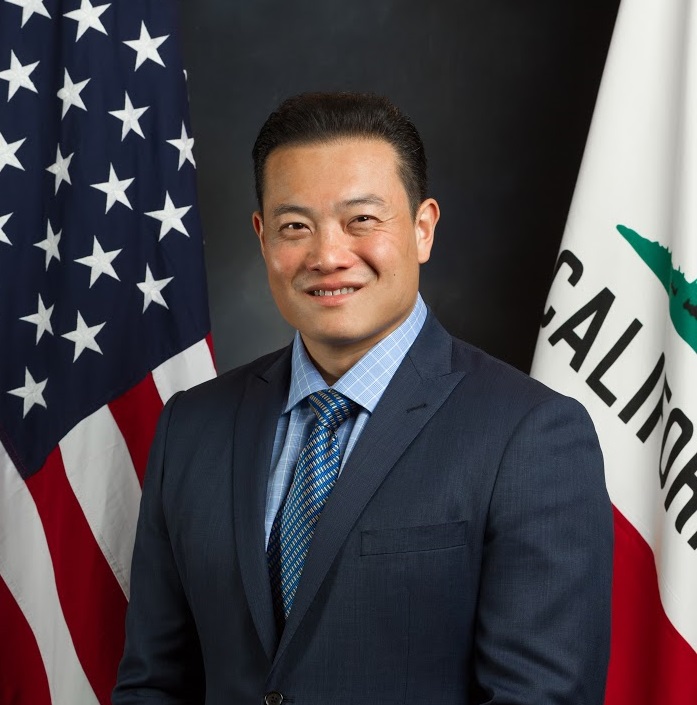
Asm. Phillip Chen
Sponsored bills
The Personal Income Tax Law and the Corporation Tax Law allow various credits against the taxes imposed by those laws. Existing law requires any bill authorizing a new tax expenditure to contain, among other things, specific goals, purposes, and objectives the tax expenditure will achieve, detailed performance indicators, and data collection requirements. This bill would allow a credit against those taxes for each taxable year beginning on or after January 1, 2022, and before January 1, 2023, to a taxpayer that is a business with a physical location in the state in an amount equal to the costs paid or incurred by the qualified taxpayer during the taxable year for the purchase of cleaning and sanitizing supplies used at business locations in the state to prevent the transmission of the novel coronavirus (COVID-19) . The bill would also include additional information required for any bill authorizing a new tax expenditure. This bill would take effect immediately as a tax levy.
(1) The Professional Engineers Act and the Professional Land Surveyors' Act provide for the licensure and regulation of professional engineers and land surveyors by the Board for Professional Engineers, Land Surveyors, and Geologists. Under those acts, a land surveyor includes a person who engages in specified practices, and civil engineering is defined to include a person who locates, relocates, establishes, reestablishes, or retraces the alignment or elevation for any of the fixed works embraced within the practice of civil engineering, as defined, determines the configuration or contour of the earth's surface, or the position of fixed objects above, on, or below the surface of the earth by applying the principles of mathematics or photogrammetry, or engages in geodetic or cadastral surveying, as defined. This bill would include within the practices that subject a person to those acts, with regard to the practice of identifying the location, alignment, or elevation for any of the fixed works embraced within the practice of civil engineering, laying out the reference points or lines through the use of mathematical or physical measurements. The bill would expand the practice of land surveying and civil engineering to include determining the benthic surface below water bodies and the measuring for volumetric calculations of earthwork. The bill, with respect to the practice of making determinations regarding the position of objects, would expand that practice to include such a determination made by applying the principles of mathematics or the use of photogrammetric methods. The bill would further revise that practice so that the determination regarding the position of objects is made regarding either manmade or natural fixed objects, instead of fixed objects. The bill would modify the definition of geodetic surveying for purposes of the Professional Land Surveyors' Act to mean performing surveys by using techniques or methods of 3-dimensional geospatial data acquisitions, and make conforming changes to that effect. The bill would also, for purposes of that act, provide that a land surveyor includes a person who does or offers to do remote sensing, as defined. (2) The Professional Land Surveyors' Act provides that it does not prevent an individual or business engaged in any line of endeavor, other than the practice of land surveying, from employing or contracting with a licensed land surveyor or a licensed civil engineer to perform the respective land surveying services incidental to the conduct of business. The Professional Engineers Act provides that it does not prevent an individual or business engaged in any line of endeavor other than the practice of civil, electrical, or mechanical engineering from employing or contracting with a licensed civil, electrical, or mechanical engineer to perform the respective engineering services incidental to the conduct of business. This bill would delete those provisions and make conforming changes. (3) Existing law makes any violation of the Professional Engineers Act or the Professional Land Surveyors' Act a misdemeanor. By expanding the scope of practices subject to the Professional Engineers Act and the Professional Land Surveyors' Act, the bill would impose a state-mandated local program. The California Constitution requires the state to reimburse local agencies and school districts for certain costs mandated by the state. Statutory provisions establish procedures for making that reimbursement. This bill would provide that no reimbursement is required by this act for a specified reason.
Existing law authorizes a court, on its own motion or on request of certain specified persons, to appoint a guardian ad litem in a probate proceeding, as specified, to represent the interests of certain persons, including a minor or an incapacitated person. Existing law prohibits the appointment of a public guardian as a guardian ad litem in a probate proceeding, unless the court finds that no other qualified person is willing to act as a guardian ad litem. Existing law, the Lanterman-Petris-Short Act, provides for the involuntary commitment and treatment of a person who is a danger to themselves or others or who is gravely disabled. Existing law also provides for a conservator of the person or estate to be appointed for a person who is gravely disabled. Existing law, for the purposes of involuntary commitment and conservatorship, defines "gravely disabled," among other things, as a condition in which a person, as a result of a mental health disorder, is unable to provide for the person's basic personal needs for food, clothing, or shelter. This bill would establish an additional procedure for the appointment of a guardian ad litem for a person who lacks the capacity to make rational informed decisions regarding medical care, mental health care, safety, hygiene, shelter, food, or clothing with a rational thought process due to a mental illness, defect, or deficiency. The bill would authorize certain persons to petition the court for the appointment of a guardian ad litem under these provisions, and would establish the procedures that would govern the filing of a petition, its notice provisions, and court procedures. Under certain circumstances, the bill would require the court to appoint the public defender or private counsel to represent a person who is the subject of a petition.
Existing law defines the crime of burglary to include entering a vehicle when the doors are locked with the intent to commit grand or petit larceny or a felony. Existing law makes the burglary of a vehicle punishable as a misdemeanor or a felony. Existing law prohibits the theft of a vehicle, as specified. Existing law makes the theft of a vehicle punishable as a misdemeanor or felony. This bill would require the Board of State and Community Corrections to administer grants to law enforcement agencies that participate in regional vehicle burglary and theft reduction joint task forces. The bill would make law enforcement agencies in specified counties eligible to participate in the regional task forces. The bill would require participating law enforcement agencies in each region to form a joint task force coordination council consisting of a representative of the Department of the California Highway Patrol and the sheriff or chief of police, or their representatives, of each participating law enforcement agency. The bill would require the board to distribute funding to the task forces, and require those funds to be expended with the goal of reducing vehicle burglary and theft, identifying suspects engaged in vehicle burglary and theft, identifying interregional movement of vehicle burglary and theft offenders, coordinating joint vehicle burglary and theft enforcement efforts, and promoting law enforcement training and best practices to reduce the incidence of vehicle burglary and theft. The bill would additionally require the lead agency of each task force to report to the board specified information relating to the crimes of vehicle burglary and theft in the jurisdictions participating in the task force. The bill would require the board to compile those statistics and, on or after January 1 of the year subsequent to the receipt of those reports, and annually thereafter, to report this information to the Legislature and the Governor and post the information on the board's internet website. The bill would require these provisions to be implemented only to the extent that funding is appropriated for these purposes, as specified. This bill would make legislative findings and declarations as to the necessity of a special statute for the Counties of Alameda, Contra Costa, Los Angeles, Orange, San Bernardino, San Diego, San Mateo, Santa Clara, Riverside, and Ventura, and the City and County of San Francisco.
Existing law defines the crime of burglary to include entering a vehicle when the doors are locked with the intent to commit grand or petit larceny or a felony. Existing law makes the burglary of a vehicle punishable as a misdemeanor or a felony. This bill would make forcibly entering a vehicle, as defined, with the intent to commit a theft therein a crime punishable by imprisonment in a county jail for a period not to exceed one year or imprisonment in a county jail for 16 months, or 2 or 3 years. By creating a new crime, this bill would impose a state-mandated local program. The California Constitution requires the state to reimburse local agencies and school districts for certain costs mandated by the state. Statutory provisions establish procedures for making that reimbursement. This bill would provide that no reimbursement is required by this act for a specified reason.
Existing law generally regulates classes of insurance, including automobile insurance. Under existing law, modification of automobile physical damage coverage by the inclusion of a deductible that does not exceed $100 is not a cancellation of the coverage or of the policy. This bill would increase that amount to $200, thus providing that modification of automobile physical damage coverage by the inclusion of a deductible that does not exceed $200 is not a cancellation of the coverage or of the policy.
Existing law authorizes the Employment Development Department (department) to administer the federal-state unemployment insurance program and provides for the payment of unemployment compensation benefits to eligible individuals who are unemployed through no fault of their own. Existing law establishes procedures for the filing, determination, and payment of benefit claims, and those benefits are payable from the Unemployment Fund. Existing law requires the department to promptly pay benefits if it finds the claimant is eligible and to promptly deny benefits if it finds the claimant is ineligible for benefits. Existing law requires the department to consider facts submitted by an employer in making this determination and also provides for the department to audit claims, as specified. This bill would, beginning July 1, 2021, require the department, as part of its process for determining eligibility for unemployment insurance benefits, cross-check all claimant information with state and county correctional facility inmate data in an effort to detect fraudulent applications. This bill would declare that it is to take effect immediately as an urgency statute.
The Gambling Control Act provides for the licensure and regulation of various legalized gambling activities and establishments by the California Gambling Control Commission and the investigation and enforcement of those activities and establishments by the Department of Justice. Existing law requires the commission to deny a license to an applicant for specified reasons, including if the applicant has been convicted of a felony, except as specified. Existing law prohibits the commission from issuing a license unless the commission is satisfied that the applicant meets various requirements, including that the applicant is a person of good character, honesty, and integrity. Existing law defines "applicant" as any person who has applied for, or is about to apply for, a state gambling license, or other licenses, permits, or approvals, as specified. This bill would add additional exceptions to the requirement that the commission deny a license to an applicant for a felony conviction for certain circumstances, including, among others, that the person has obtained a certificate of rehabilitation, been granted clemency or a pardon, or had the felony conviction dismissed, as specified. The bill would prohibit the commission from denying a license to an applicant on the basis of a conviction of a crime, or on the acts underlying that crime, if the person has obtained a certificate of rehabilitation, been granted clemency or a pardon, or had the conviction dismissed, as specified. The bill would provide a definition of "conviction" for those purposes.
Existing law, the Financial Institutions Law, regulates the activities of various financial entities, including commercial banks, industrial banks, trust companies, credit unions, and savings associations. Existing law establishes the Department of Financial Protection and Innovation, which is under the direction of the Commissioner of Financial Protection and Innovation, and is responsible for the administration and enforcement of the Financial Institutions Law. Existing law authorizes the commissioner to charge a maximum of $0.25 for each page copied when the department is required to furnish a copy of a filed paper, as prescribed. This bill would, instead, authorize the commissioner to charge no more than $0.10 for each page copied.