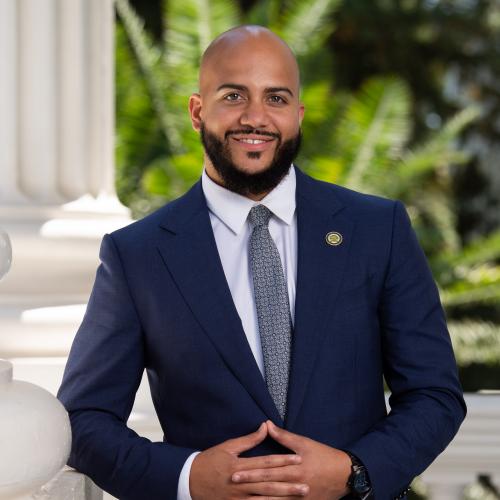
Photo of Isaac Bryan
D California House · District 55 On the 2026 ballot

Rep. Isaac Bryan

Compare
Total votes
17,249
all sessions
Attendance
89%
1,359 missed
Near the chamber average
With party
99%
of cast votes
Near the chamber average
Bipartisan score
0%
crosses aisle rarely
Near the chamber average
Sponsored
1,230
bills & resolutions
Near the chamber average
Committees
12
assignments
1,230 bills and resolutions

Sponsored bills

Total
1,230
Primary
117
Co-sponsor
1,113
This page
1,230
matching current filters
Co-sponsor HR 135
Passed · California House · Co-sponsor
Relative to Neonatal Intensive Care Unit Awareness Month.

Maddy summaryThis California House Resolution declares September 2026 as Neonatal Intensive Care Unit (NICU) Awareness Month to highlight the challenges faced by families with newborns requiring extended hospital care. The bill notes that approximately 17,500 to 22,500 infants in the state experience NICU stays longer than two weeks each year, which can strain parental bonding and financial stability. It encourages individuals, businesses, and organizations to support parents in securing adequate time for bonding and home care after discharge. The resolution also directs copies of the text to be sent to the Governor and the Director of Employment Development for distribution.

Passed Aug 19, 2026 1 co-sponsor
Co-sponsor HR 130
Passed · California House · Co-sponsor
Relative to racial discrimination.

Maddy summaryCalifornia House Resolution 130 recognizes March 21, 2026, as the United Nations International Day for the Elimination of Racial Discrimination. The resolution cites historical context and current challenges in education, employment, criminal justice, and healthcare to highlight the impact of racial bias. It formally declares racism a public health crisis and commits the Assembly to actively participating in efforts to dismantle it.

Passed Aug 19, 2026 1 co-sponsor
Co-sponsor HR 86
Passed · California House · Co-sponsor
Relative to Canine "K-9" Appreciation Week.

Maddy summaryCalifornia Assembly Resolution 86 proclaims the week of September 1 through 7, 2026, as Canine "K-9" Appreciation Week to honor police dogs and their handlers. The resolution cites the historical growth of canine units in California and highlights their contributions to law enforcement, such as apprehending suspects, detecting narcotics, and locating missing persons. It also notes that these teams often reduce the need for lethal force and engage with the public through community demonstrations.

Passed Aug 19, 2026 1 co-sponsor
Co-sponsor SCR 152
Signed into law Aug 18, 2026 1 co-sponsor
Co-sponsor HR 132
Passed · California House · Co-sponsor
Relative to Young Women's Reproductive Health Awareness Month.

Maddy summaryThis California House Resolution proclaims September 2026 as Young Women's Reproductive Health Awareness Month to highlight the importance of early diagnosis and education for adolescent girls. The resolution urges high schools, colleges, public health agencies, and medical providers to promote educational campaigns on topics such as menstrual health, HPV vaccination, and sexual health practices. It specifically aims to address disparities in care by encouraging outreach to communities that face systemic barriers or lack culturally appropriate resources.

Passed Aug 13, 2026 1 co-sponsor
Co-sponsor ACA 18
Passed · California House · Co-sponsor
A resolution to propose to the people of the State of California an amendment to the Constitution of the State, by amending Section 9 of Article IX thereof, relating to the University of California.

The California Constitution provides that the University of California constitutes a public trust, and requires the university to be administered by the Regents of the University of California, a corporation in the form of a board, with full powers of organization and government, subject to legislative control only for specified purposes. The California Constitution requires the board to consist of 7 ex officio members and 18 appointive members appointed by the Governor and approved by the Senate. The California Constitution authorizes the members of the board to appoint either a member of the faculty at a campus of the university or of another institution of higher education, or a person enrolled as a student at a campus of the university, or both, as members of the board serving for no less than one year with all rights of participation. Beginning on July 1, 2027, this measure would require, instead of authorize, the members of the board to appoint to the board for 2-year terms, 2 undergraduate students and 2 graduate students enrolled at a campus of the university for each regular academic term during their service as members of the board, as provided. The measure would require each student board member to serve as a nonvoting student regent-designate in the first year of their 2-year term, and would authorize a student member who graduates from the university on or after January 1 of the 2nd year of the student member's 2-year term to serve the remainder of their term.

Passed Aug 13, 2026 1 co-sponsor
Co-sponsor HR 112
Passed · California House · Co-sponsor
Relative to Black Music Month.

Maddy summaryThis House Resolution officially designates September as Black Music Month to honor the significant contributions of Black artists to American culture. The measure recognizes a wide range of musical genres, including jazz, blues, gospel, and hip-hop, by highlighting their historical origins and influential figures. While the text celebrates these artistic achievements, it does not impose any new legal requirements or funding mandates.

Passed Aug 13, 2026 1 co-sponsor
Co-sponsor SB 1146
Passed · California Senate · Co-sponsor
Advertisement claims: health-related consumer products and services: digital replicas and synthetic performers.

Existing unfair competition laws make various unfair competition practices unlawful, including any unlawful, unfair, or fraudulent business act or practice and unfair, deceptive, untrue, or misleading advertising. Existing law makes it unlawful for any person doing business in California and advertising to consumers in California to make any false or misleading advertising claim. Existing law makes a person who violates specified false advertising provisions liable for a civil penalty, as specified, and provides that a person who violates those false advertising provisions is guilty of a misdemeanor. Existing law makes it unlawful for healing arts licensees, as specified, to disseminate or cause to be disseminated any form of public communication containing a false, fraudulent, misleading, or deceptive statement, claim, or image in order to induce the provision of services or products in connection with their licensed professional practice or business. Existing law makes a violation of these provisions punishable as a misdemeanor and, in the case of a licensed person, provides that a violation constitutes unprofessional conduct and grounds for suspension or revocation of a license by the relevant board. This bill would require a person who creates or causes to be created an advertisement that includes a digital replica or synthetic performer depicted as a health care provider to promote the sale of a health-related consumer product or service to include a clear and conspicuous disclosure that the health care provider depicted in the advertisement was generated or substantially altered by artificial intelligence or that no human health care provider is depicted. The bill would also define terms for its purposes. This bill would provide that a violation of its provisions constitutes a violation of specified unfair competition and false advertising laws. By expanding the scope of a crime, this bill would impose a state-mandated local program. The bill would also authorize a natural person whose digital replica is used in an advertisement to bring a civil action to enforce these provisions. The bill would specify that a violation of the bill does not constitute a misdemeanor under provisions regulating healing arts licensees. The California Constitution requires the state to reimburse local agencies and school districts for certain costs mandated by the state. Statutory provisions establish procedures for making that reimbursement. This bill would provide that no reimbursement is required by this act for a specified reason.

Passed Aug 13, 2026 1 co-sponsor
Co-sponsor SB 1185
Passed · California Senate · Co-sponsor
Pharmaceutical facilities: skilled and trained workforce.

Existing law requires a skilled and trained workforce to be used in the construction, alteration, demolition, installation, repair, or maintenance work of certain public works and privately-owned facilities engaged in certain petroleum-related activities, manufacturing hydrogen, biofuels, or certain specified chemicals, or capturing, sequestering, or using carbon dioxide, as specified. Existing law defines "skilled and trained workforce" to include, among other criteria, skilled journeypersons who are paid at least a rate equivalent to the applicable prevailing hourly wage rate. This bill would require an owner, operator, or developer of a facility that will be used for the research, development, or production of pharmaceutical products to, when contracting for the performance of construction, alteration, demolition, installation, repair, or maintenance work on the facility, require that its contractors and subcontractors use a skilled and trained workforce to perform all onsite work within an apprenticeable occupation in the building and construction trades, and would require all contractors and subcontractors performing the work to use a skilled and trained workforce. The bill would require the owner, operator, or developer of the facility to provide to the Labor Commissioner a monthly report demonstrating compliance with the bill's provisions that includes, among other things, the full name and other identifying information relating to each worker relied on to satisfy the apprenticeship graduation percentage requirements. If the Labor Commissioner determines that a contractor or subcontractor failed to use a skilled and trained workforce, the bill would require the contractor or subcontractor to forfeit, as a civil penalty to the state, up to $5,000 per month of work performed for a first violation, and, for a second or subsequent violation, up to $10,000 per month of work performed. The bill would authorize the Labor Commissioner to reduce or waive the penalty under specified circumstances.

Passed Aug 13, 2026 1 co-sponsor
Primary AB 946
Passed · California House · Lead sponsor
Natural resources: equitable outdoor access: 30x30 goal: urban nature-based projects.

By Executive Order No. N-82-20, Governor Gavin Newsom directed the Natural Resources Agency to combat the biodiversity and climate crises by, among other things, establishing the California Biodiversity Collaborative and conserving at least 30% of the state's lands and coastal waters by 2030. Existing law requires the Secretary of the Natural Resources Agency to prepare and submit, on or before March 31, 2024, and annually thereafter, a report to the Legislature on the progress made in the prior calendar year toward achieving the goal to conserve 30% of California's lands and coastal waters by 2030. Existing law provides that it is the goal of the state to conserve at least 30% of California's lands and coastal waters by 2030, known as the 30x30 goal. Existing law establishes the Equitable Outdoor Access Act, which sets forth the state's commitment to ensuring all Californians can benefit from, and have meaningful access to, the state's rich cultural and natural resources. Existing law declares that it is state policy, among other things, to ensure that all Californians have equitable opportunities to safe and affordable access to nature and access to the benefits of nature, and to prevent and minimize the intentional and unwarranted limitation of sustainable public access to public lands, where appropriate, including, but not limited to, local, regional, state, and federal parks, rivers, lakes, beaches, forests, mountain ranges, deserts, and other natural landscapes. Existing law requires specified state agencies to consider and incorporate, as appropriate, the state policy when revising, adopting, or establishing policies, regulations, or grant criteria, or making expenditures, as specified. Existing law requires all state agencies implementing the above-described state policy to do so in a manner consistent with the mission of their agency and that protects the health and safety of the public and conserves natural and cultural resources. This bill would provide that, to advance and promote environmental, conservation, and public access policies and budget actions, the Governor's office, state agencies, and the Legislature, when distributing resources, shall recognize the coequal goals and benefits of the 30x30 goal and the Outdoors for All initiative, and, to the extent practical, maximize investment in historically underserved urban communities consistent with those initiatives. The bill would encourage decisionmakers, when distributing resources to achieve the goals and benefits of the 30x30 goal and the Outdoors for All initiative, to consider factors that are unique to urban settings, including, among other things, higher land value acquisition and development costs per acre, the acute health needs of a local population due to historic lack of greenspace access and development externalities, local park needs assessment plans, current or impending loss of parks or greenspace as a result of state or federal infrastructure projects, and the availability of mobility options near a proposed land conservation site. The bill would encourage regulatory agencies, including the Department of Toxic Substances Control, to work with local communities to restore degraded lands that could contribute to a more equitable strategy for meeting the state's environmental, conservation, and public access goals. The bill would require state funding agencies, including certain state conservancies and the Wildlife Conservation Board, to allow, to the extent consistent with the funding source, the funding program's authorizing statutes, and the state's goals, for urban nature-based projects on degraded lands to be eligible and competitive for state funds.


Passed Aug 13, 2026 0 co-sponsors
Showing 71 to 80 of 1,230 bills
Previous 1 7 8 9 123 Next