

Existing law establishes a specialized license plate program and requires the Department of Motor Vehicles to issue specialized license plates, also referred to as environmental license plates, on behalf of a sponsoring state agency if the agency receives 7,500 applications for that plate within a 12-month period, among other requirements. Existing law authorizes a person who is the registered owner or lessee of a vehicle to apply to the department for specialized license plates. Existing law imposes a fee, in addition to the regular registration fee, for the issuance, renewal, retention, transfer, and duplication of specialized license plates. Existing law requires that all revenue derived from these fees be deposited in the California Environmental License Plate Fund. This bill would require the Arts Council to apply to the department to sponsor "The Lowrider" specialized license plate program, as specified. The bill would require the design of the plate to reflect lowrider culture and heritage. The bill would require the council to consult with a nonprofit entity for plate design consultation, stakeholder engagement, publicity, and community outreach. The bill would authorize the council to accept and use donated or licensed artwork from a nonprofit entity for these purposes, and to use funds from nonprofit or private sources to augment implementation. The bill would require the department, after deducting its administrative costs, to deposit additional revenue derived from the issuance, renewal, transfer, and substitution of the plate into the Specialized License Plate Fund in the State Treasury. The bill would require the council to use those funds, upon appropriation by the Legislature, to fund projects that include, among others, supporting lowrider arts and cultural preservation efforts. The bill would authorize the council to use 4 to 6% of those funds to consult with or enter into an agreement with a nonprofit entity to support implementation of the program.
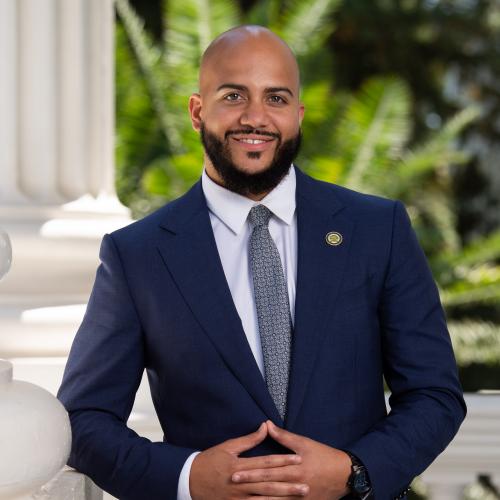
Rep. Isaac Bryan
Sponsored bills
Existing law requires every retail seller and manufacturer doing business in this state and having annual worldwide gross receipts that exceed $100,000,000 to disclose, as specified, its efforts to eradicate slavery and human trafficking from its direct supply chain for tangible goods offered for sale. Existing law also requires a person that submits a bid or proposal to, or otherwise proposes to enter into or renew a contract with, a state agency with respect to any contract in the amount of $100,000 or more to certify, under penalty of perjury, at the time the bid or proposal is submitted or the contract is renewed that they have complied with the Unruh Civil Rights Act and the California Fair Employment and Housing Act, and that any policy that they have adopted against any sovereign nation or peoples recognized by the government of the United States is not used as a pretext for discrimination in violation of the Unruh Civil Rights Act or the California Fair Employment and Housing Act. This bill, upon appropriation by the Legislature, would require any business or enterprise that is doing business in the state that was in existence or whose predecessor company was in existence on or before December 31, 1964 and has annual worldwide gross receipts that exceed $100,000,000 to complete an affidavit, under penalty of perjury, verifying that it has searched through any and all records in its and its related entities', as defined, possession, control, and knowledge for records that the covered entity or its related entities bought or sold persons subjected to slavery, used persons subjected to slavery as collateral, provided loans to purchase persons subjected to slavery, insured such transactions or the persons subjected to slavery, or provided related or other services to aid or otherwise facilitate those transactions. The bill would set forth the contents of the affidavit, the timeline and manner of submission, and reporting requirements. This bill would require the Civil Rights Department to create a public, digital platform within one year after an appropriation is made, that would make available affidavits and records made pursuant to the bill and disaggregated data, as described. The bill would additionally require the above-described business or entity, that submits a bid or proposal to, or otherwise proposes to enter into or renew a contract with, a state agency, as described above, to additionally certify, under penalty of perjury, that they have submitted the affidavit in compliance with the above-described provisions. By requiring an affidavit and to certify under penalty of perjury regarding compliance with the above-described affidavit requirements, and thus expanding the crime of perjury, the bill would impose a state-mandated local program. The California Constitution requires the state to reimburse local agencies and school districts for certain costs mandated by the state. Statutory provisions establish procedures for making that reimbursement. This bill would provide that no reimbursement is required by this act for a specified reason.
Existing law requires the governing board of a school district to have general control of, and be responsible for, all aspects of the interscholastic athletic policies, programs, and activities in its school district, as provided, and requires the governing board of a school district to ensure that all interscholastic policies, programs, and activities in the school district comply with state and federal law. Existing law authorizes the governing board of a school district to enter into associations or consortia with other governing boards for purposes of governing regional or statewide interscholastic athletics, as provided. Existing law describes the California Interscholastic Federation (CIF) as a voluntary organization that consists of school and school-related personnel with responsibility for administering interscholastic athletic activities in secondary schools and states the intent of the Legislature that the CIF, in consultation with the State Department of Education, implement specified policies relating to interscholastic athletics. Existing law, the 1998 California High School Coaching Education and Training Program, declares the intent of the Legislature to establish a California High School Coaching Education and Training Program, to be administered by school districts with an emphasis on specific components, including, among other components, sports psychology. Existing law requires every high school sports coach to complete, at their own expense, a coaching education program that meets the guidelines established by the California High School Coaching Education and Training Program. This bill would add a component on mental health training, as specified, to the list of components to be emphasized by the 1998 California High School Coaching Education and Training Program. The bill, commencing with the 2027–28 school year, would require a person who serves as a coach in an interscholastic athletic program at a high school, including a private school, that is a member of the California Interscholastic Federation to complete an initial training, and a subsequent training every 2 years, on mental health, as provided. The bill, commencing with the 2027–28 school year, would also require a school district, county office of education, or charter school that elects to offer an athletic program, other than an interscholastic athletic program, to ensure that the athletic program's coaches complete an initial training, and a subsequent training every 2 years, that covers sudden cardiac arrest, as provided, and youth athletics behavioral and mental health training, as provided. This bill would incorporate additional changes to Section 35179.1 of the Education Code proposed by AB 1626 to be operative only if this bill and AB 1626 are enacted and this bill is enacted last. This bill would make the operation of its provisions contingent upon the enactment of AB 1626 of the 2025–26 Regular Session.
Existing law requires the Geologic Energy Management Division in the Department of Conservation, on or before March 1, 2025, to identify all low-production wells, as defined, that are located in the County of Los Angeles in an oil field that is adjacent to a state recreation area or state park and is located, in whole or in part, within the boundary of the Baldwin Hills Conservancy, as provided. Existing law prohibits, commencing March 1, 2026, the owners of those wells from allowing those wells to be low-production wells for more than 12 months. Upon a violation of that prohibition, existing law requires the State Oil and Gas Supervisor to charge an administrative penalty of $10,000 per month to the low-production well owner, until the low-production well is plugged and abandoned, as provided. Existing law requires the plugging and abandoning of all wells located in the County of Los Angeles in an oil field that is adjacent to a state recreation area or state park and is located, in whole or in part, within the boundary of the Baldwin Hills Conservancy by December 31, 2030. Existing law requires the supervisor, on and after January 1, 2031, to charge the owner of a well an administrative penalty of $10,000 per month for a violation of that requirement, until the well is plugged and abandoned. Existing law establishes the Equitable Community Repair and Reinvestment Account, requires the above-described administrative penalties to be deposited into the account, and makes the funds from the account available, upon appropriation by the Legislature, to the Department of Conservation for allocation to the County of Los Angeles for projects that benefit communities living within 212 miles of the identified low-production wells, as provided. This bill would require the Department of Conservation, upon appropriation by the Legislature and subject to the terms of the appropriation, to distribute the first $5,000,000 deposited into the Equitable Community Repair and Reinvestment Account, after accounting for appropriations made for administrative purposes, to the County of Los Angeles to establish a program to disburse in direct cash assistance in equal amounts to households located within 212 miles of the identified low production wells who have at least one member with respiratory or reproductive health impacts. The bill would, among other things, require the county to establish processes for households to verify that they meet the residency and health-impact requirements, as provided. The bill would require the application process for direct cash assistance to be noninvasive, simple, and standardized. The bill would limit the disbursement of direct cash assistance to 1,000 households and would require the county to select recipient households by randomized lottery if the number of applications from verified eligible households exceeds 1,000. The bill would exclude this direct cash assistance from income or resource considerations for purposes of determining any member of the household's eligibility for benefits or assistance, or the amount or extent of benefits or assistance, under any state or local benefit or assistance program, as provided. The bill would require the department, subject to an appropriation by the Legislature, to distribute to the county for administrative purposes an amount that does not exceed 10% of the programmatic appropriation. By imposing new duties on the County of Los Angeles, the bill would impose a state-mandated local program. The California Constitution requires the state to reimburse local agencies and school districts for certain costs mandated by the state. Statutory provisions establish procedures for making that reimbursement. This bill would provide that, if the Commission on State Mandates determines that the bill contains costs mandated by the state, reimbursement for those costs shall be made pursuant to the statutory provisions noted above.
Existing law establishes the Department of Financial Protection and Innovation under the direction of the Commissioner of Financial Protection and Innovation. Existing law makes the department responsible for administering various laws relating to financial institutions, including the Banking Law, the California Credit Union Law (CCUL) , and the California Residential Mortgage Lending Act (CRMLA) , a willful violation of which is punishable as a misdemeanor. The CRMLA requires, as often as the commissioner deems necessary and appropriate, but at least once every 48 months, the commissioner to examine the affairs of each residential mortgage lender and servicer licensee for compliance with the CRMLA. The CRMLA authorizes the commissioner to examine the licensee's officers, directors, employees, or agents under oath regarding the licensee's operations. The CRMLA requires the commissioner to provide a written statement, the disclosure of which is subject to certain restrictions, of the findings of the examination, issue a copy of that statement to each licensee's principals, officers, or directors, and take appropriate steps to ensure correction of any violations of the CRMLA. This bill, the California Fair Lending Examination Act, would require, under the Banking Law and the CCUL, the commissioner to, at least once every 4 years, examine, as prescribed, the books and records of certain entities subject to the commissioner's examination authority under those laws for compliance with any nondiscrimination law applicable to mortgage lending, as specified, and would require the commissioner to provide a written statement of the findings of that examination, issue a copy of that statement to the subject's principals, officers, or directors, and take appropriate steps to ensure correction of any violations of applicable nondiscrimination laws. The bill would prohibit disclosure of that statement to anyone other than the subject entity, law enforcement officials, or other state or federal regulatory agencies for further investigation and enforcement. This bill would, as part of the above-described examination required by the CRMLA, require the commissioner to additionally examine the licensee for compliance with any nondiscrimination law applicable to mortgage lending, as prescribed. This bill would make a violation of an applicable nondiscrimination law a violation of the Banking Law, the CCUL, or the CRMLA, as applicable, and would authorize, under the Banking Law and the CCUL, the commissioner to examine the applicable entity's officers, directors, employees, or agents under oath regarding the entity's operations. By expanding the scope of the crimes of perjury and of violating the CRMLA, this bill would impose a state-mandated local program. Existing constitutional provisions require that a statute that limits the right of access to the meetings of public bodies or the writings of public officials and agencies be adopted with findings demonstrating the interest protected by the limitation and the need for protecting that interest. This bill would make legislative findings to that effect. The California Constitution requires the state to reimburse local agencies and school districts for certain costs mandated by the state. Statutory provisions establish procedures for making that reimbursement. This bill would provide that no reimbursement is required by this act for a specified reason.
Existing law establishes the Department of Corrections and Rehabilitation to administer the state prison system under the direction of the Secretary of the Department of Corrections and Rehabilitation. Existing California constitutional provisions grant the department the authority to award credits earned for good behavior and approved rehabilitative or educational achievements in order to enhance public safety, improve rehabilitation, and avoid the release of prisoners by federal court order. This bill, the Second Chance Sports Act, would, until January 1, 2036, require the department to formalize, in consultation with specified individuals and organizations, a policy on organized sports programming. The bill would authorize the department to solicit and accept proposals and negotiate and enter into agreements with specified entities for the purposes of expanding access to sports programming as described above. The bill would establish the Second Chance Sports Fund within the State Treasury. The bill would require the department to seek advisement from the Legislature on the priorities for utilizing the moneys in the fund. The bill would make funds available, upon appropriation by the Legislature in the annual Budget Act, for the above-described purposes. The bill would require the Controller, on or before January 1, 2029, and annually thereafter, to provide a report to the Legislature on the amounts deposited into the fund. The bill would make related findings and declarations.
Existing law, the Reproductive Privacy Act, declares as contrary to the public policy of this state a law of another state that authorizes a person to bring a civil action against a person or entity that engages in certain activities relating to obtaining or performing an abortion. Existing law prohibits the state from applying an out-of-state law to a case or controversy in state court or enforcing or satisfying a civil judgment under the out-of-state law. This bill would specify that the protections applicable to persons who engage in legally protected health care activity, as defined, apply to a person who previously has undertaken one or more acts or omissions while in another United States jurisdiction to aid or encourage, or attempt to aid or encourage, any person in the exercise and enjoyment, or attempted exercise and enjoyment, of rights to reproductive health care services or gender affirming health care services if the acts or omissions were permissible under the laws of the jurisdiction in which the person was located at the time of the acts or omissions. Existing law prohibits a state or local law enforcement agency or officer from knowingly arresting or knowingly participating in the arrest of any person for performing, supporting, or aiding in the performance of legally protected health care activity, if the health care activity is lawful in this state. Existing law prohibits a state or local public agency from cooperating with or providing information to an individual or agency from another state or a federal law enforcement agency, as specified, regarding a legally protected health care activity that is lawful in this state. Under existing law, the Governor may surrender, on demand of executive authority of any other state, any person in this state charged in the other state, as specified, with committing an act in this state, or in a 3rd state, intentionally resulting in a crime in the state whose executive authority is making the demand. This bill would prohibit the Governor from recognizing a request for extradition of a person subject to criminal liability based on the alleged provision or receipt of, assistance in the provision or receipt of, material support for, or in any theory of vicarious, joint, several, or conspiracy liability for any legally protected health care activity, except as specified.
Existing law establishes in the Natural Resources Agency the Department of Forestry and Fire Protection, and requires the department to be responsible for, among other things, fire protection and prevention, as provided. Existing law establishes the California Conservation Camp program for the purpose of having inmates and wards work on projects supervised by the department. Existing law requires the department to utilize inmates and wards assigned to conservation camps in performing fire prevention, fire control, and other work at the department. This bill would require, on and after July 1, 2027, the department to, in partnership with the Department of Corrections and Rehabilitation and the California Conservation Camp program, implement a standardized process to ensure that all eligible individuals who successfully complete training in a department firefighting training camp while incarcerated receive official written certification reflective of the training completed before their release, as specified. This bill would require the department, on and after January 1, 2028, if a qualified formerly incarcerated individual, as defined, applies for a Fire Fighter 1 Classification position, or any successor classifications, and has the required training and meets the minimum qualifications for the position, to award hiring preference under Category Placement 2 to the qualified formerly incarcerated individual, as specified. The bill would require the department, on and after January 1, 2028, if a qualified formerly incarcerated individual applies for a Forestry Technician Classification position, or any successor classifications, to count the duration of specified training and fieldwork as an incarcerated hand crew member towards the minimum qualifications for the classification.
Existing law, as amended by the Public Safety and Rehabilitation Act of 2016, enacted by Proposition 57 at the November 8, 2016, statewide general election, authorizes the district attorney to make a motion to transfer a minor from juvenile court to a court of criminal jurisdiction in a case in which a minor is alleged to have committed a felony when the minor was 16 years of age or older, or in a case in which a specified serious offense is alleged to have been committed by a minor when the minor was 14 or 15 years of age, but the minor was not apprehended prior to the end of juvenile court jurisdiction. Existing case law prohibits the use of a minor's statements made at a transfer hearing or to a probation officer from being used during a criminal prosecution of the minor transferred to the court of criminal jurisdiction. This bill would codify existing case law to prohibit the use of the minor's statements made during a transfer hearing or to the minor's probation officer for the purposes of preparing a report for a transfer hearing from being used against the minor during subsequent juvenile proceedings or subsequent criminal proceedings, as specified. This bill would state that the provisions of this bill are declaratory of existing law.
Existing law authorizes the Secretary of the Department of Corrections and Rehabilitation to prescribe and amend rules and regulations for the administration of prisons and requires regulations, which are adopted by the Department of Corrections and Rehabilitation, to recognize and consider the value of incarcerated person visitation as a means of increasing safety in prisons, maintaining family and community connections, and preparing incarcerated persons for successful release and rehabilitation. Existing regulations create the framework for establishing a visitation process in prisons that is conducted in as accommodating a manner as possible, subject to the need to maintain order, the safety of persons, the security of institutions and facilities, and required prison activities and operations. This bill, the Humanizing and Uniting Generations Safely Act of 2026, would additionally require those regulations pertaining to incarcerated person visits to recognize and consider the importance of physical contact in incarcerated person visitation. The bill would prohibit the department from unreasonably restricting the ability of incarcerated persons or their visitors to engage in certain types of nonsexual physical contact throughout the visit, as provided. The bill would prohibit the department from taking disciplinary action based on alleged inappropriate physical contact, without first providing a warning and a reasonable opportunity to immediately correct the conduct.